


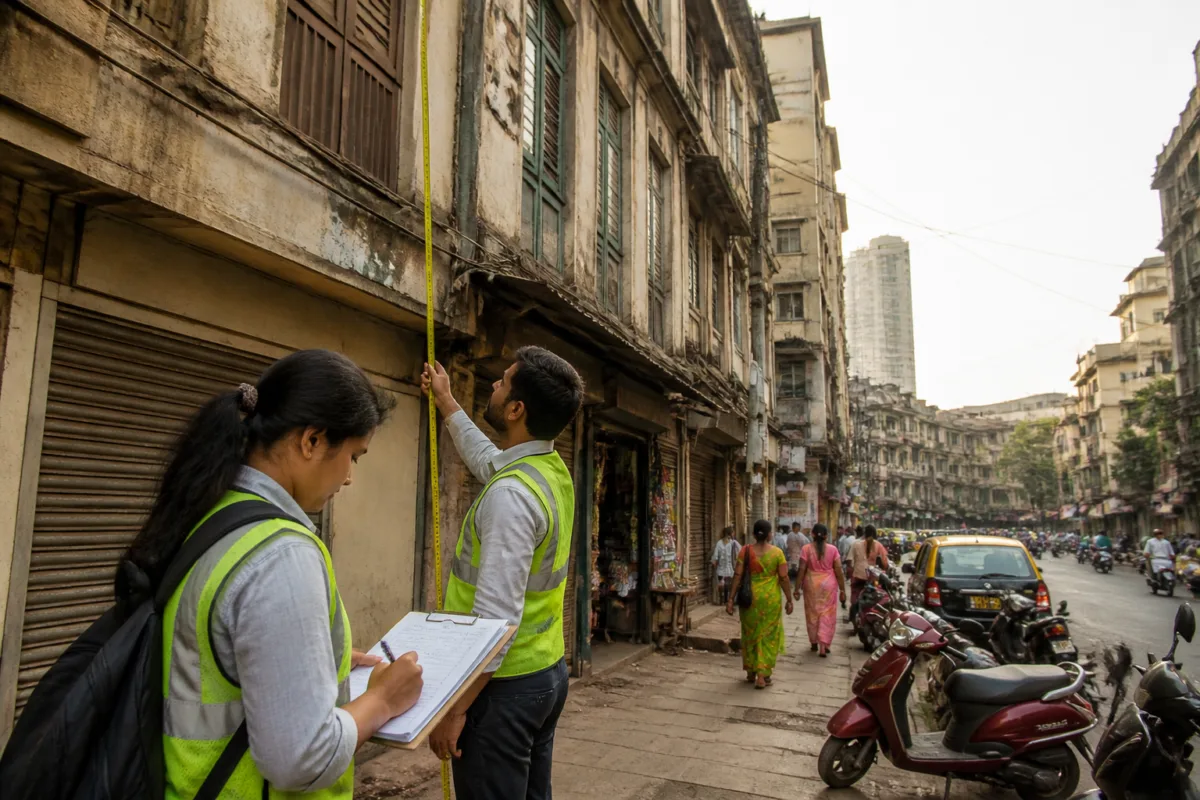
Mumbai Metro Line 11 survey work has begun across around 800 buildings and structures that could be affected by the proposed underground corridor between Wadala and the Gateway of India, according to a report by MagicBricks.
The survey is being conducted for the Mumbai Metro Rail Corporation (MMRC) to record the existing condition of potentially affected properties and assess the socio-economic profile of residents, tenants and businesses along the proposed alignment. The exercise is intended to support the assessment of social and economic impacts and rehabilitation and resettlement planning wherever required.
MagicBricks reported that MMRC has appointed Socioquest Solutions to carry out the baseline survey. Survey teams are expected to visit the identified structures to take physical measurements and collect photographs and videos, while recording information about occupants, property conditions and commercial activity.
People being approached for verification have reportedly been asked to provide original documents, including Aadhaar cards, electricity and water bills, property tax receipts, property cards, rent receipts and rent agreements, ration cards, Index-II documents, occupancy certificates and business licences. These records are intended to establish ownership, occupancy and other relevant details for properties within the proposed corridor.
The proposed corridor is described as approximately 17.5 km long, with all stations planned underground. The route reported by MagicBricks includes Wadala Depot, CGS Colony, Ganesh Nagar, BPT Hospital, Shivdi, Haji Bunder, Darukhana, Byculla, Nagpada Junction, Bhendi Bazaar, CSMT Metro, Horniman Circle and Gateway of India.
However, the report refers to 14 planned stations while listing 13 station names. It also says that the alignment and scope have been subject to subsequent revisions. This station-count discrepancy and the final route configuration require confirmation from MMRC or other official project documents.
The corridor is proposed to connect Wadala and eastern waterfront areas with established residential and commercial districts in South Mumbai. The survey could therefore affect property owners, tenants, households and businesses along the alignment, particularly where land-related processes, construction access or rehabilitation measures become necessary.
The report also refers to a possible extension towards Bandra Terminus via Dharavi, measuring approximately 6.9 km, while noting that feasibility assessments and related studies are still underway. A separate route-planning development described as taking place in March 2026 reportedly proposed an independent connection between Bandra Terminus and the Gateway of India via Dharavi, Wadala Depot, Sewri and CSMT. The final relationship between these proposals remains to be established.
MagicBricks reported an estimated project cost of approximately Rs 23,487 crore. It said the Maharashtra Government included the initial proposal in its 2026-27 Budget and that the proposed financing structure may include assistance from the Japan International Cooperation Agency (JICA).
The report attributed a proposed JICA Development Assistance Loan of 92.4 billion Japanese yen, equivalent to approximately Rs 5,500 crore, to the first phase extending up to Wadala. It also listed proposed contributions of Rs 2,411 crore from the Brihanmumbai Municipal Corporation, Rs 804 crore from the Mumbai Port Authority, Rs 3,137 crore from the Maharashtra Government, Rs 3,137 crore from the Central Government and more than Rs 12,000 crore in institutional loans.
A provisional completion date of August 2032 was cited, although progress would depend on approvals, land-related processes, rehabilitation planning, financing and construction. Until the alignment, station count, funding arrangements and implementation schedule are confirmed through primary sources, the survey should be treated as a preparatory exercise rather than confirmation of a final project design.

