


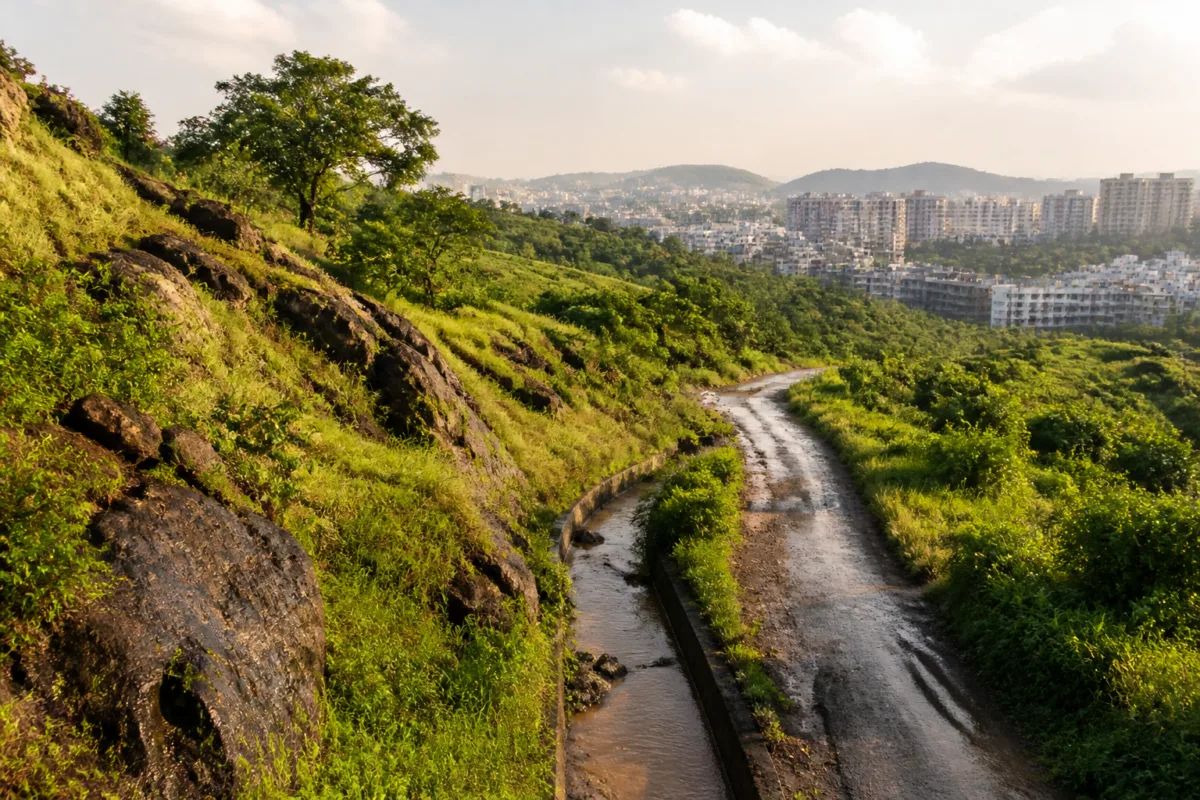
A high-level committee has recommended that landowners affected by Pune’s Biodiversity Park (BDP) reservations be allowed limited development if the state fails to acquire their land within five years, while requiring at least 70% of each relevant parcel to remain a permanent biodiversity park.
The proposal, submitted to the Maharashtra government, would permit construction on the remaining 30% only under strict environmental conditions. The recommendation follows the state government’s decision in August 2015 to reserve hilltops and slopes in villages brought within the Pune Municipal Corporation limits for BDP development.
According to the report, no land has been acquired in the 11 years since the reservation was imposed. The committee, chaired by former IAS officer Ramanath Jha, has recommended that affected landowners receive 100% compensation and that the land-acquisition process begin within five years of the reservation notification.
If acquisition does not take place within that period, the committee has proposed a phased development model based on accommodation reservation. Under this model, work on the biodiversity park would have to begin on at least 70% of the land and be completed within two years from the start of development. Construction on the remaining portion would be permitted only after the planning authority or another designated competent authority certifies that the park work has been completed.
The proposed construction controls include a ground-plus-one-floor limit. Stilt parking would not be permitted, and the permissible floor space index would be capped at 10%. The recommendations also require the original landform and natural slopes of the hills to be retained, with environmentally suitable construction materials and techniques used in the permitted development.
The committee has proposed restrictions on road construction within BDP areas. Concrete roads would not be allowed. Instead, water-bound macadam roads, designed to support water infiltration, could be permitted up to a maximum width of 12 metres. Roads would have to be aligned without cutting into the hills, with their direction and cross-section determined by the municipal commissioner.
The proposal also calls for natural open drainage systems for rainwater. Sewage-treatment plants could be permitted, provided the treated water is reused.
A separate recommendation concerns vacant plots surrounded by extensive development. Where 90% or more of the surrounding area has already been developed, such plots could be converted into local parks. If a plot already contains construction, the BDP reservation could be considered for removal after technical verification.
The committee has also suggested that land made developable through such exclusions should attract a special premium. The resulting funds would be used to develop the remaining BDP parks.
The recommendations attempt to address two competing issues: the long delay in acquiring privately owned land reserved for public environmental purposes, and the need to retain the ecological function of Pune’s hilltops and slopes. Their practical effect will depend on whether the state government accepts the proposed five-year acquisition framework, the compensation principle and the conditions governing any limited construction. Until a government decision and implementing rules are issued, the 70:30 model remains a recommendation rather than an operative development entitlement.

