


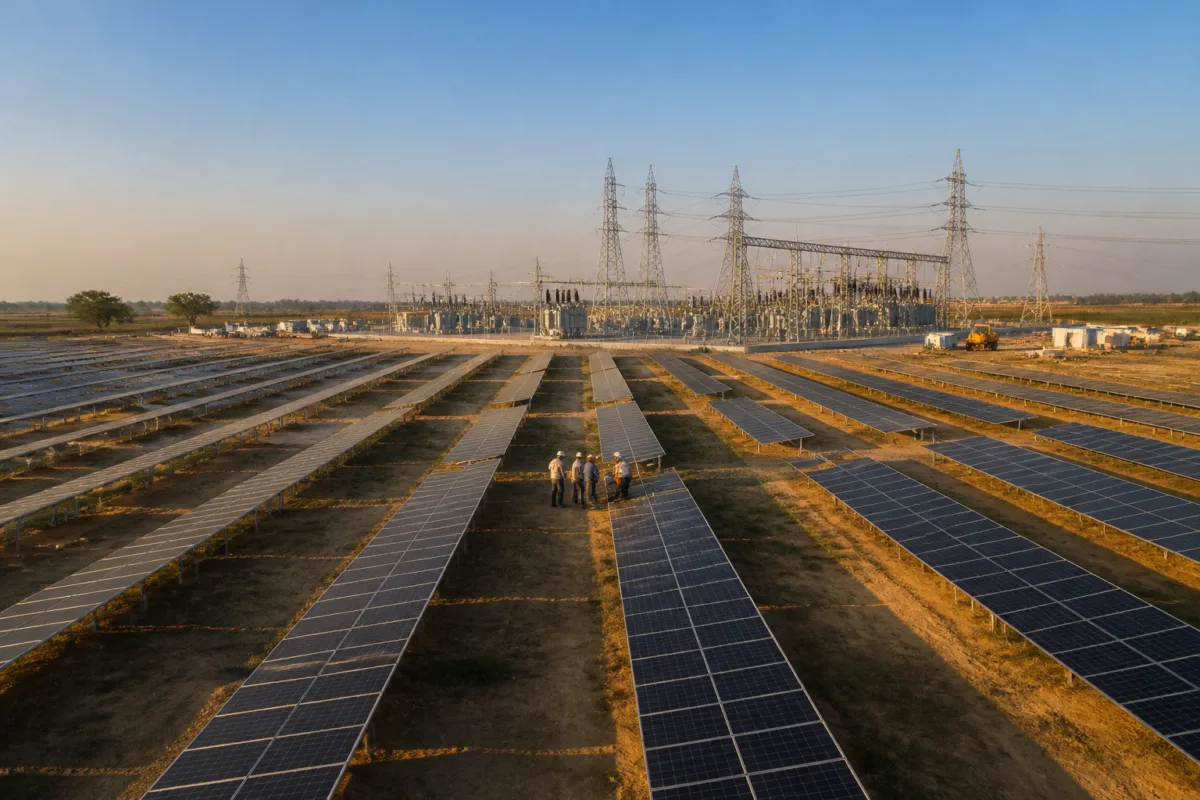
Indian Oil Corporation Ltd (IOCL) plans to expand its renewable energy capacity to 31 GW over the next five years from about 260 MW currently, according to a senior company executive cited by the Economic Times. The proposed expansion would make renewable power a substantially larger part of the state-run energy company’s business and require significant capital mobilisation, acquisitions and project execution.
The programme is expected to be implemented mainly through IOCL’s wholly owned subsidiary, Terra Clean, using a combination of new projects, mergers and acquisitions, and joint ventures. Solar currently accounts for about 92 MW of IOCL’s renewable capacity, with wind providing the balance.
The executive said IOCL expects to contribute about ₹5,000 crore to ₹10,000 crore annually through equity investment in Terra Clean. The subsidiary is also expected to raise debt, with IOCL targeting a debt-equity ratio of 75:25 for its renewable portfolio. The financing structure indicates that the proposed capacity will depend not only on corporate investment but also on access to substantial external borrowing.
Of the 31 GW target, about 6 GW is planned through organic capacity additions and around 7.5 GW through mergers and acquisitions. The remaining capacity is expected to come through joint ventures. The IOCL board has approved investments in projects totalling 5.3 GW under Terra Clean, while the subsidiary has secured connectivity approvals for 2.6 GW, the report said.
Land procurement has begun at several locations. IOCL has been allotted 423 acres in Uttar Pradesh for a solar project of about 100 MW. The company also has a joint venture with state-run power producer NTPC for 2 GW of renewable capacity. According to the executive, that capacity is expected to become operational in five to six months.
The planned generation will serve different purposes. The NTPC joint venture’s capacity is intended primarily for captive consumption, while most of Terra Clean’s planned generation is expected to be sold in the market through power purchase agreements and other arrangements. This split links the expansion both to IOCL’s own electricity requirements and to the development of a broader commercial renewable-power portfolio.
The company expects the projects to begin operations from 2028 and Terra Clean to become EBITDA-positive in the financial year 2030. These milestones place the immediate challenge on securing land and grid connectivity, completing acquisitions and joint ventures, and raising the debt required to build the portfolio. The report does not provide project-wise schedules, locations or contracted power buyers for the full 31 GW target.
IOCL’s renewable programme is being pursued alongside investment in its existing businesses. The company incurred capital expenditure of ₹12,162 crore in the first half of FY27 and has set a full-year target of ₹32,700 crore covering refinery, marketing, petrochemical and pipeline projects.
The scale of the renewable target therefore has implications beyond individual solar and wind projects. IOCL will need to allocate capital across its conventional energy operations and its proposed clean-energy portfolio while building capabilities in project development, acquisitions and power-market participation. The information reported so far establishes the ambition, initial approvals and financing approach, but the eventual pace of delivery will depend on project execution, connectivity, land availability and the completion of planned partnerships.

