


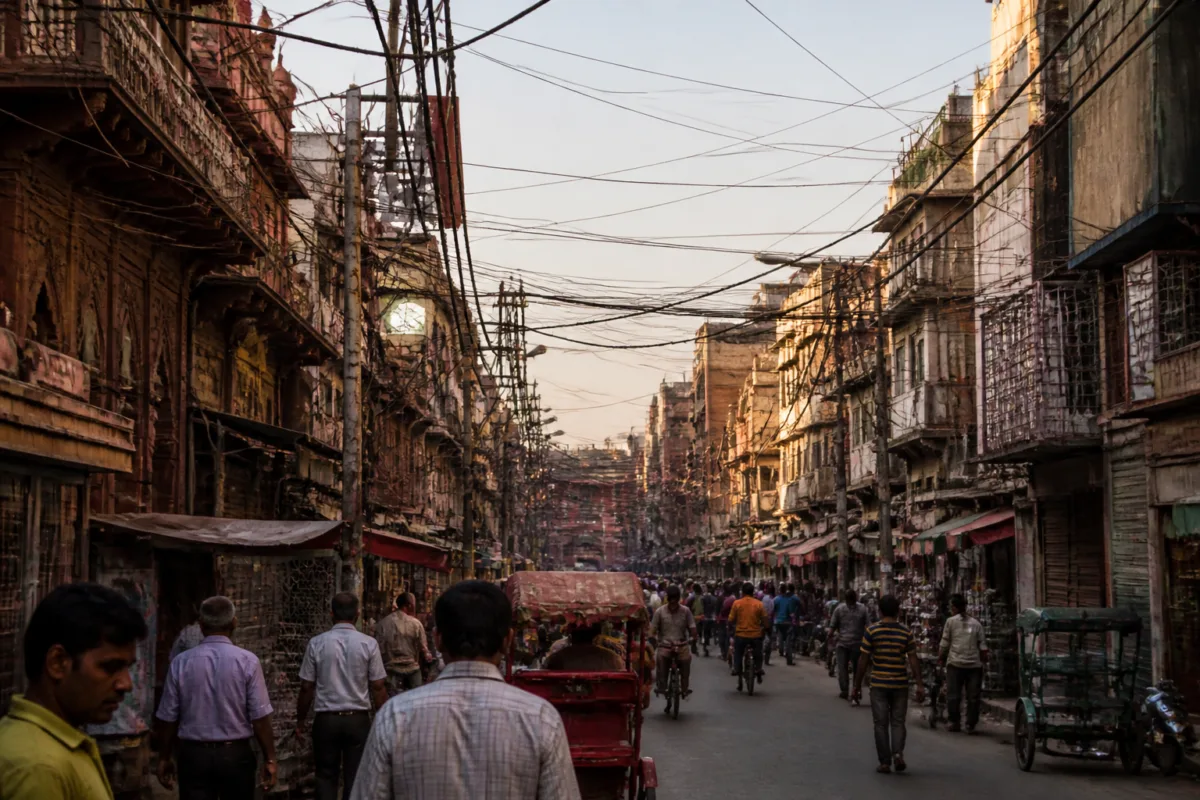
Delhi’s underground cabling programme has entered a fresh technical review, with the government examining a proposed multi-utility duct system for parts of the Chandni Chowk area while preparing to extend underground power infrastructure to Lajpat Nagar and other markets.
The government has released Rs 99.49 crore against a Rs 200-crore allocation for 2026-27, according to a report by Millennium Post. The funding is part of a wider Rs 463-crore plan covering 125 residential colonies across Delhi.
The first meeting of the Technical Convergence Committee was held on November 20. Chaired by the District Magistrate of Old Delhi and the Special Secretary, Power, the committee examined the technical feasibility, specifications and implementation framework for the Chandni Chowk project.
The review covered the Concept Note and Detailed Project Report for a multi-utility duct system along stretches of More Sarai Road and Esplanade Road. The proposed model is intended to place multiple essential services in shared underground corridors, reducing the need for repeated excavation of roads.
Such an approach could help address a persistent problem in dense commercial areas, where road-cutting for electricity, telecommunications and other utilities can disrupt pedestrian movement, traffic and business activity. The report, however, does not provide a confirmed construction schedule or details of how different utility agencies will coordinate during execution.
The revised DPR has not yet been confirmed as approved. The government has also not announced contracts or a new completion deadline. These decisions are expected to follow the technical review, officials told the publication.
Lajpat Nagar and other markets have been finalised for the next phase of underground cabling. The selection is being guided by public safety, pedestrian footfall and technical readiness, although detailed implementation schedules are still being prepared.
The broader programme covers 125 residential colonies. The Power Department and distribution companies are compiling colony-wise information on completed works, ongoing projects and schemes awaiting tenders or approvals. Densely populated residential areas have been prioritised, but the government has not released a detailed progress breakdown.
The initiative therefore remains at different stages across Delhi: technical scrutiny in Chandni Chowk, location selection in markets such as Lajpat Nagar, and data consolidation for the residential-colony programme. Public assessment will depend on whether the government publishes project-wise timelines, procurement details, utility coordination arrangements and progress updates.
Power Minister Ashish Sood said the Delhi government was working to make power supply “safer and cleaner” and described undergrounding overhead wires as a key part of that effort. The immediate administrative focus, however, remains the completion of technical reviews and confirmation of the projects’ delivery framework.

