


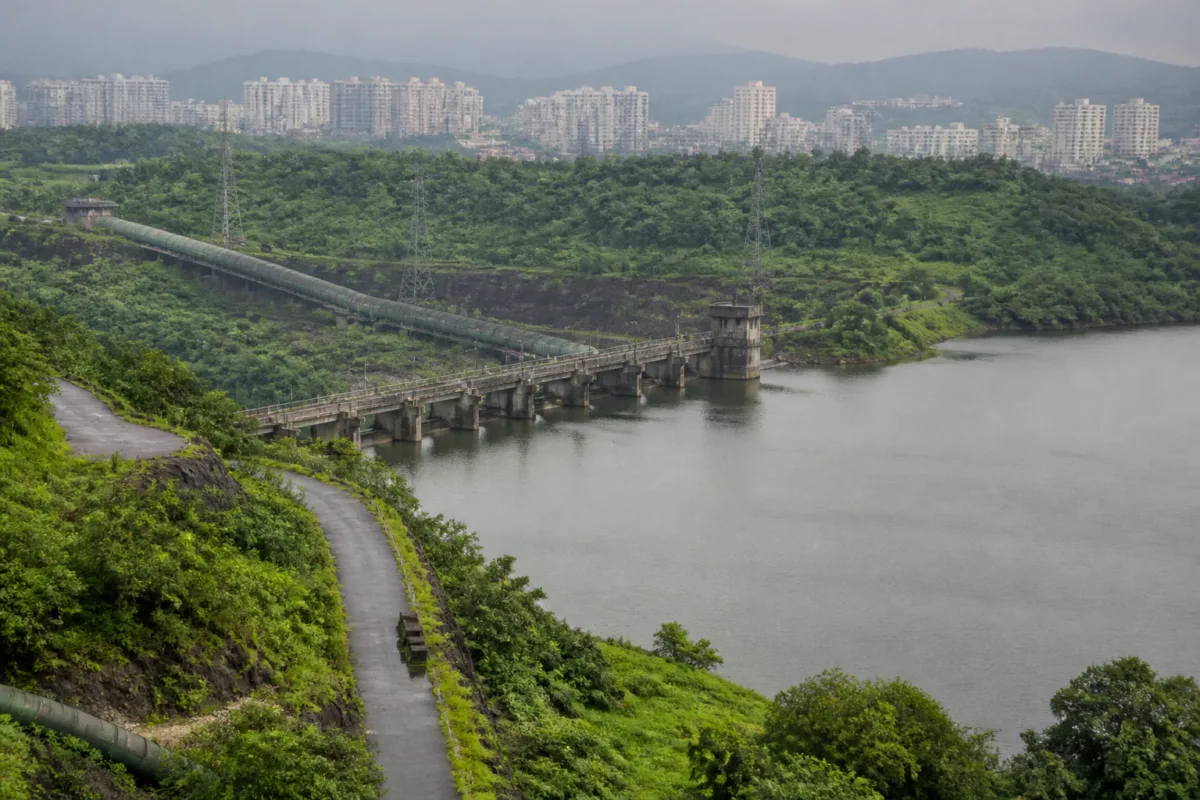
Maharashtra plans to build the Kushir and Shilar dams in Raigad district to meet rising drinking-water demand across the Thane region, with water from the projects projected to reach households by 2031. Each dam is proposed to have a capacity of 1,000 million litres per day (MLD).
The proposed Shilar dam is intended to supply Thane city. The Kushir dam is planned to serve Navi Mumbai, Panvel, Khalapur and Khopoli. Both projects are to be located in the Karjat tehsil of neighbouring Raigad district, according to a report by the Free Press Journal.
The plans were discussed at a Janta Darbar, or public grievance meeting, held at Gadkari Rangayatan in Thane. Forest Minister Ganesh Naik said new water sources were needed to address the district’s growing water shortage and to plan for future generations. The report said an immediate meeting was convened after the issue was brought before Chief Minister Devendra Fadnavis.
The proposed dams form part of a wider set of water-supply projects mentioned at the meeting. The ongoing Kalu dam project is expected to supply Thane, Ambernath, Badlapur and Ulhasnagar. Naik also said water from the Surya dam would be made available to Mira-Bhayandar and Vasai-Virar.
For the region’s expanding urban centres, the plans are significant because they link future water availability to the pace of population growth and development. Thane, Navi Mumbai, Panvel and adjoining areas are continuing to absorb housing and other urban expansion, increasing the importance of dependable bulk-water sources for municipal distribution.
However, the report does not provide details on the proposed dams’ costs, approval status, land requirements, environmental clearances, construction schedules or the distribution infrastructure needed to carry water from Raigad to the intended cities. It also does not specify how the proposed capacities would be divided among municipalities or how the projects would be coordinated with existing sources.
The stated objective is for the projects to deliver water to households by 2031. Until the plans move through the required administrative and project-development stages, that target remains a future projection. The effectiveness of the proposals will ultimately depend not only on dam capacity, but also on timely implementation, treatment and transmission systems, and municipal distribution networks.

