


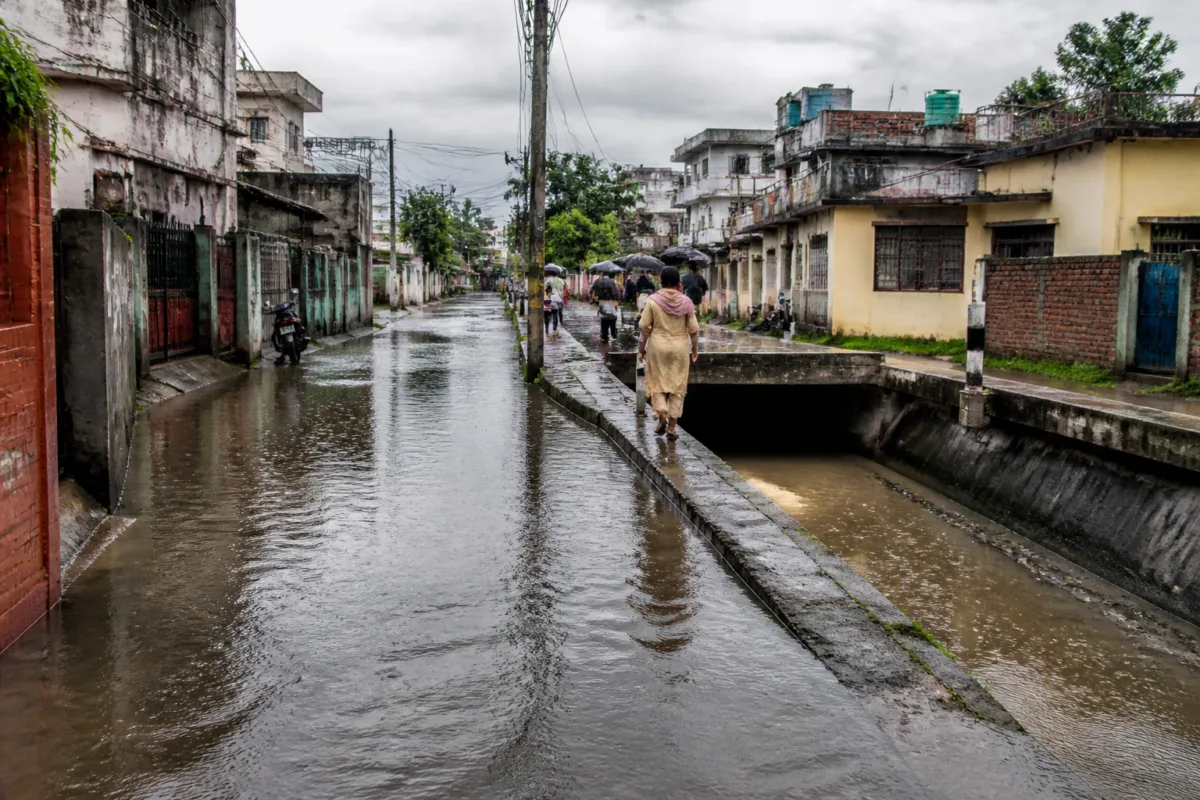
Agartala’s municipal election campaign has put the city’s unresolved drainage, drinking-water and road problems back at the centre of public debate, according to a report by Pratibadi Kalam. The report says residents in several parts of the city continue to face waterlogging, inadequate civic infrastructure and uneven access to basic services despite years of Smart City investment.
The concerns are spread across Agartala’s central, northern and southern zones, although the nature of the deficiencies varies. The central area is described as having persistent drainage problems, while localities north of the Kata Khal and east and south of the Haora River are reported to face gaps in roads and drinking-water supply.
The report says the Agartala Smart City project has involved expenditure of nearly Rs 3,000 crore and that its deadline has been extended twice. It describes the project as being in its final stage, but questions whether the investment has produced a corresponding improvement in everyday civic services. The report does not cite project accounts, completion documents or an official response from the Smart City authorities to substantiate these figures and assessments.
Waterlogging is presented as the most visible test of the city’s urban infrastructure. According to the report, drains remain incomplete in some locations and overflow onto roads during rainfall. It also says that moderate rain can leave neighbourhoods waterlogged, even after additional pumping capacity and uninterrupted electricity arrangements were introduced.
The report identifies the Kalapaniya Khal, Akhaura Khal and a third drainage channel near Bijoy Kumar Chowmuhani as important natural drainage routes. It says these channels discharge towards Bangladesh, but that downstream stretches are shallow, narrow or obstructed. Because the drainage routes cross towards an international border, any long-term intervention would require coordination beyond the municipal administration. The report questions whether sufficient administrative or bilateral action has been pursued, but provides no documentary record of such efforts.
It also carries allegations that some central-city drains became narrower or shallower during subsequent construction work. The reported justification was that a revised design would increase water velocity. However, the article argues that continuing waterlogging has raised doubts about whether the design has worked in practice. These allegations require verification through project drawings, before-and-after measurements, completion certificates and drainage performance data.
Pumping has become another part of the city’s response to flooding. The report says Agartala had about 12 water-discharge pumps around five years ago and that additional pumps have since been installed. It questions whether a pumping-dependent system can provide a durable solution when natural drainage channels remain obstructed. The distinction is important for urban planning: pumps can provide emergency relief, but they do not by themselves resolve restricted outfalls, inadequate drain capacity or blocked waterways.
Drinking-water supply is identified as a second major pressure. Two treatment plants at College Tilla and Bordowali reportedly depend on the Haora River. The report says demand has risen with population growth, while production capacity may not have expanded at the same rate. It also refers to overhead tanks and shallow tube wells across the municipal corporation area, but says there is no reliable consolidated account of the number of household tube wells in operation or the volume of groundwater being extracted.
That gap matters because groundwater use is difficult to manage without a basic inventory of extraction points, operating status and consumption. The report links rapid urbanisation and uncontrolled extraction to concerns about falling groundwater levels. It further argues that ponds, water bodies and rivers should form part of a longer-term water-conservation strategy, although it does not provide hydrological studies or a formal conservation plan.
Two proposals mentioned in the report illustrate the scale of the water challenge. One involved a dam in the Baramura Hills, while another concerned a canal of about 25 kilometres from the Maharani Barrage to transfer water from the Gomati River to the Haora River. The report says neither proposal has resulted in a clear implementation decision and raises questions about feasibility, environmental consequences and practical execution. Those questions would need to be assessed through publicly available technical and environmental studies before either proposal could be treated as a viable solution.
The report also describes an uneven distribution of visible Smart City work. It identifies the VIP Road towards the airport and the road-and-drainage corridor from Durga Chowmuhani to Panchabati as areas that have received attention. At the same time, it says several neighbourhoods outside the central areas still have narrow or basic roads, limited drainage and inadequate water infrastructure. Some roads are reportedly still brick-paved and have not been upgraded to fully paved streets.
This unevenness raises a central implementation question: whether citywide inclusion in a project boundary has translated into citywide improvement. A Smart City programme can deliver high-visibility corridors and selected projects, but residents experience urban governance through routine services such as passable roads, functioning drains, reliable water supply and protection from repeated flooding.
The report says residents are also questioning whether municipal tax increases have been matched by better services. That claim is presented as part of the election debate and is not supported in the article by tax receipts, budget comparisons or service-level data. Such evidence would be necessary to measure the relationship between revenue collection and outcomes rather than relying only on public perceptions.
Agartala’s immediate civic test, as described by the report, is therefore not the visibility of individual projects but the performance of interconnected systems. Drainage depends on channel capacity, outfalls, maintenance and pumping. Water security depends on treatment capacity, river flows, groundwater regulation and conservation. Road upgrades are linked to drainage design, land levels and access across peripheral areas.
With the municipal election approaching, these issues have become part of the accountability debate. The available report documents residents’ concerns and raises questions about implementation, but it does not independently establish the scale of each shortfall. The next stage for public scrutiny would be a transparent account of project expenditure, revised deadlines, ward-level works, drainage measurements, water-production capacity, groundwater extraction and the status of proposed interventions. Those records would help determine whether Agartala’s Smart City programme has addressed the city’s underlying service deficits or mainly improved selected corridors.

