


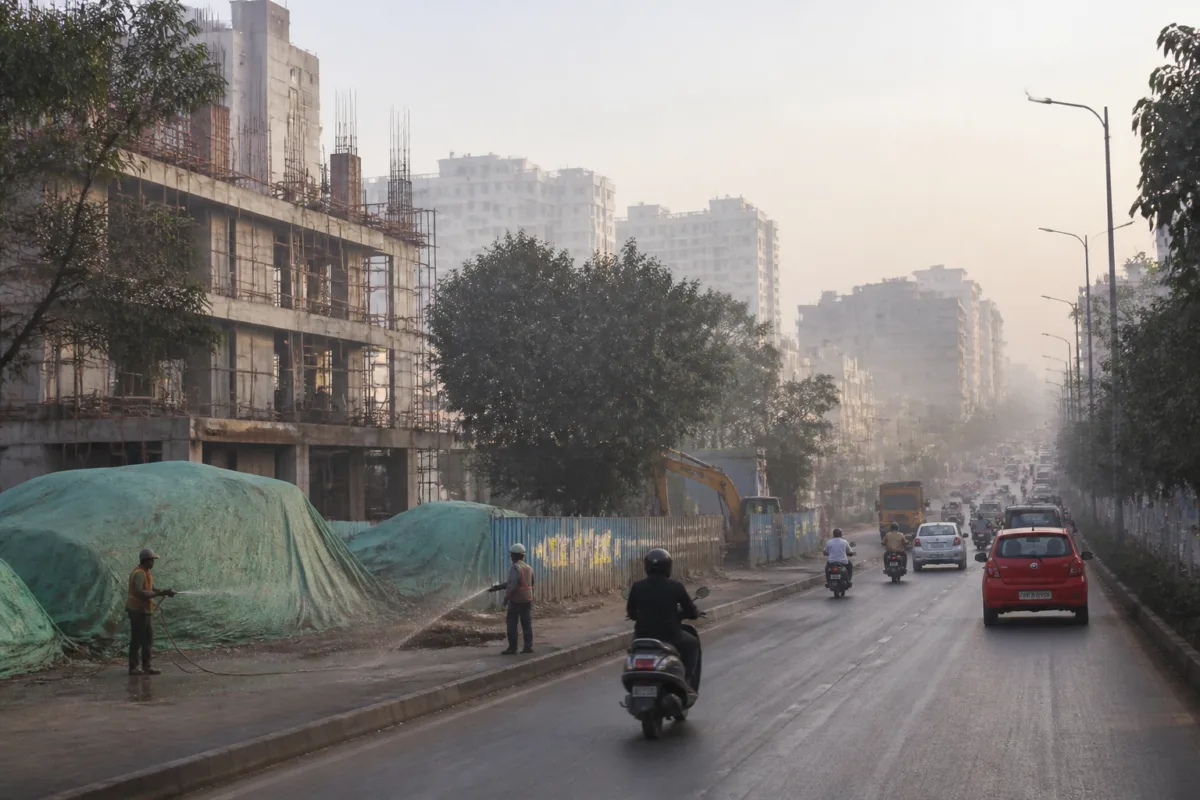
Pune air quality remains a concern 10 days after Diwali, with monitoring cited by Lokmat showing poor conditions in several parts of the city and Pimpri-Chinchwad. The report attributes the continuing pollution to weak winds, temperature fluctuations, construction dust and vehicle emissions.
Pune’s average air quality index (AQI) was reported at 152, while Pimpri-Chinchwad recorded an average of 159. Hadapsar recorded the highest AQI among the cited locations at 210, followed by Bhosari at 209. Both readings fall in the poor category.
The report said air quality was also poor in Chhatrapati Shivaji Maharaj Nagar, Wakad, Viman Nagar and the Bhumkar Chowk area. Areas including Dhankawadi, Panchavati, Pune University, Katraj, Bhumkarnagar, Gawalinagar, Savata Malinagar, Thergaon and Nigdi were reported to have moderate air quality.
The readings were attributed to the Central Pollution Control Board and SAFAR-IITM. Lokmat reported that pollution levels had improved to some extent after Diwali, but remained concerning in several parts of the metropolitan area. Low wind speeds were cited as a reason pollutants were lingering in the air, creating hazy conditions during the early morning and at night.
The report also highlighted the sharp deterioration during Diwali. On the night of Lakshmi Puja on 8 November, Pune’s AQI reportedly reached between 427.39 and 432, while some suburbs crossed 500. The report said the index rose by 129 points within 24 hours. Average PM2.5 concentration on the night was reported at about 800 micrograms per cubic metre, with some monitoring stations recording up to 1,000 micrograms per cubic metre—around 17 times the level described as safe in the report.
Construction activity is among the urban sources identified in the report. Dust generated by construction works, combined with emissions from vehicles, can add to pollution when atmospheric conditions limit dispersion. The report did not identify specific construction sites, enforcement actions or transport measures linked to the cited readings.
Lokmat said measures were being undertaken under the National Clean Air Programme, but that air quality had not improved as expected. It also reported concern for residents, particularly those with respiratory disorders. The continuing readings point to the need for sustained monitoring and implementation of dust-control and emissions-reduction measures beyond the temporary pollution spike associated with Diwali.

