


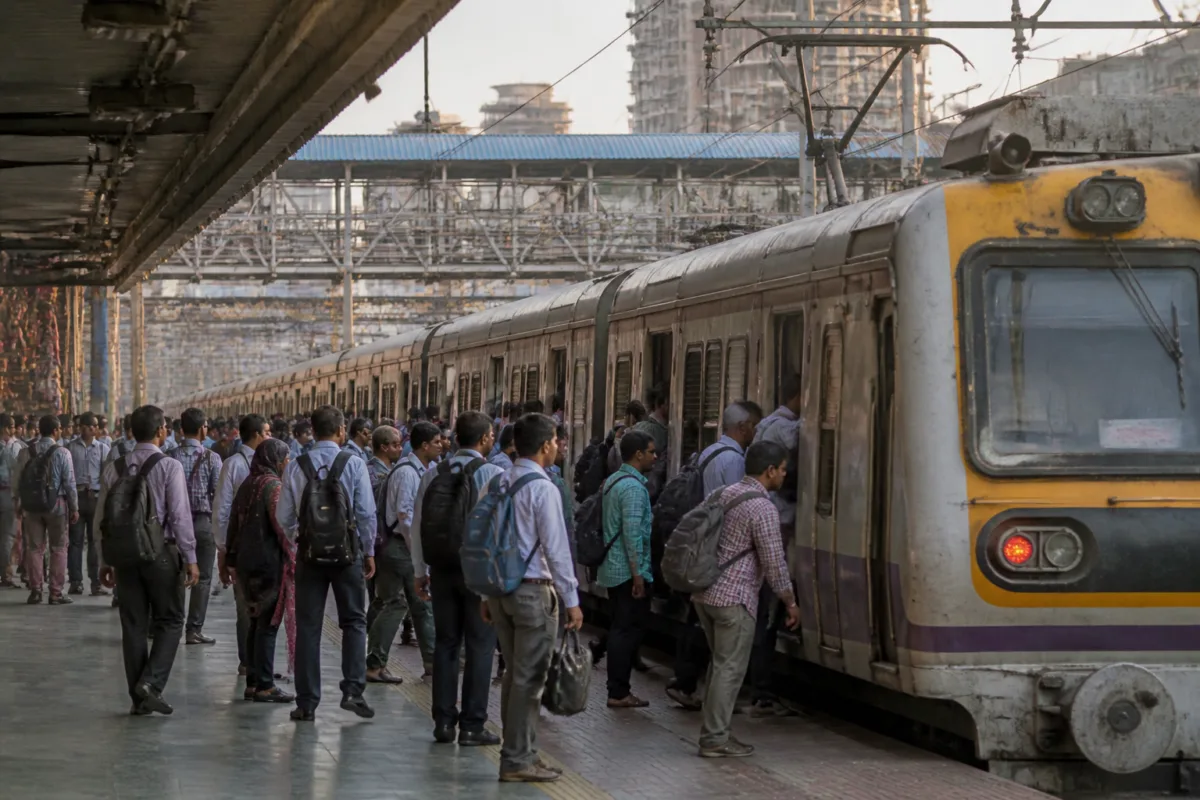
Indian Railways could carry 800 crore passengers in 2026-27, Railway Minister Ashwini Vaishnaw said, but the headline recovery masks a sharp divergence between long-distance and suburban travel.
The projected figure would bring annual passenger journeys close to the pre-pandemic level of 808.6 crore recorded in 2019-20. It would still remain below the railway’s historical peak of 843.9 crore passengers in 2018-19.
Passenger traffic fell to 125 crore in 2020-21 after the nationwide Covid-19 lockdown halted train services and operations were gradually resumed. It recovered to 729.3 crore in 2024-25 and 740 crore in 2025-26, according to the report. Vaishnaw said he expected passenger numbers to reach pre-Covid levels by the end of 2027.
The recovery, however, has not been uniform across passenger categories. A comparison of railway data for 2018-19 and 2024-25 shows that upper-class travel, covering all air-conditioned classes, rose by 102.2 per cent to 36.2 crore passengers. Second Class Mail and Express traffic increased by 8.7 per cent to 163 crore.
Suburban and Second Class Ordinary travel moved in the opposite direction. Suburban passenger traffic stood at 411.2 crore in 2024-25, down 67.2 crore, or 14 per cent, from 478.4 crore in 2018-19. Second Class Ordinary passengers fell to 118.9 crore from 197.7 crore, a decline of 39.9 per cent.
These figures matter because suburban services account for the largest share of railway journeys and are closely tied to daily commuting in major urban regions. The available data shows that the return of overall passenger volumes cannot, by itself, be read as a complete recovery of everyday rail mobility. A higher number of longer-distance and higher-class journeys is contributing significantly to the rebound, while two mass-market categories remain below their pre-pandemic levels.
The distance travelled by passengers has also changed. Total passenger journeys in 2024-25 were 13.6 per cent below the 2018-19 level, but total passenger-kilometres declined by only 2.1 per cent. Passenger-kilometres measure one passenger travelling one kilometre and stood at 11,57,174 million in 2018-19, compared with 11,32,500 million in 2024-25.
Using these totals, the average distance travelled per passenger increased from 137.1 km in 2018-19 to 155.3 km in 2024-25. A railway official who analysed the data said this indicated a shift towards longer journeys in the overall passenger traffic mix. The official added that the effect on passenger revenue would need to be analysed separately.
The distinction between passenger journeys and passenger-kilometres is important for planning. A system can approach its earlier passenger volume while carrying people over longer average distances. That pattern may point to a changed composition of demand, but the figures supplied in the report do not establish why suburban and ordinary journeys have not recovered at the same pace.
The data also does not identify the contribution of individual suburban networks, routes or train services. It provides no service-frequency, capacity, fare, station-access or peak-period information that could explain the decline in suburban traffic. Similarly, the figures do not show whether the increase in upper-class and Mail and Express travel reflects changed travel preferences, altered service availability or a different distribution of journeys after the pandemic.
For urban transport planning, the central issue is therefore not only whether Indian Railways reaches 800 crore passengers. It is also whether the recovery is broad-based across the services used by daily commuters and lower-cost intercity travellers. The category-wise gap shows that a return to aggregate passenger numbers may coexist with an incomplete recovery in high-volume everyday mobility.
The Railway Minister’s projection provides an overall target, while the available category-wise data highlights the need to examine what types of travel are driving that growth. Further assessment would require updated class-wise figures for 2025-26, along with route-level information on suburban and ordinary services. Until then, the 800-crore projection is best understood as a recovery in total journeys rather than evidence that every segment of the railway network has returned to its pre-Covid pattern.

