


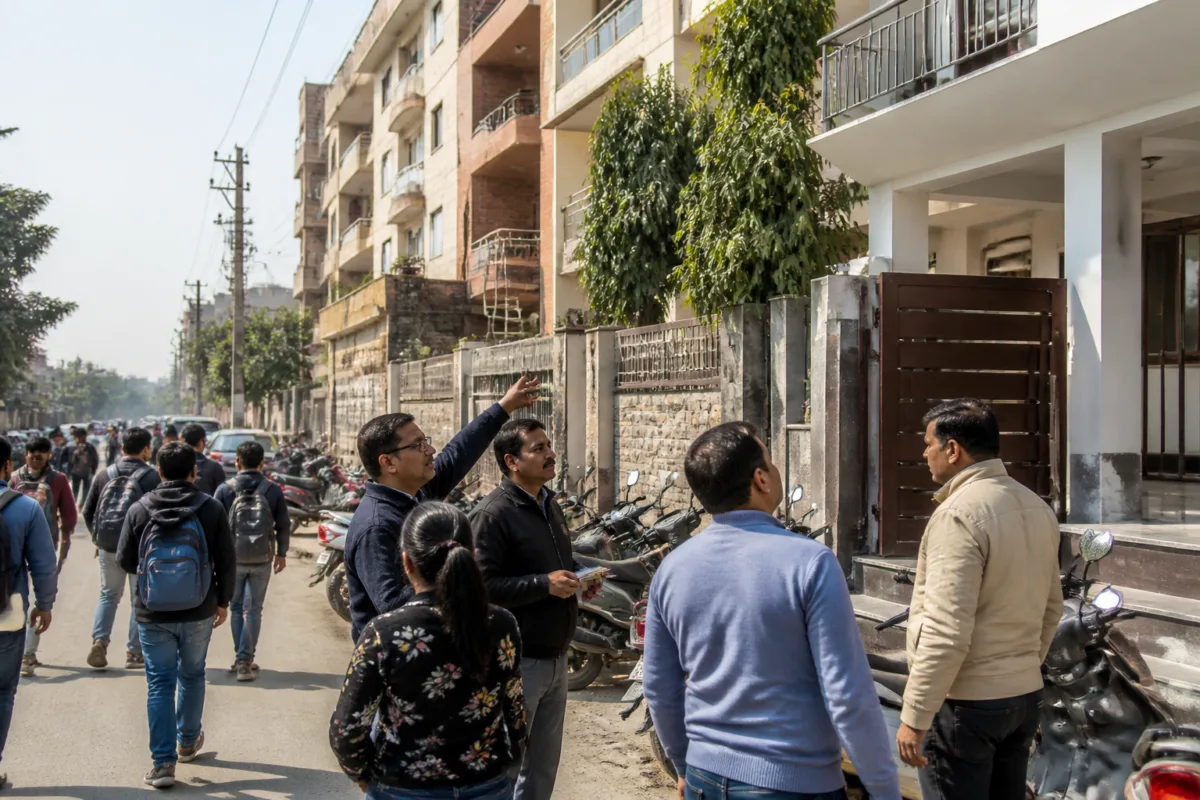
Jaipur coaching centres operating on the city’s Gopalpura Bypass have received no interim relief from sealing action, according to a report by Dainik Bhaskar, after the Supreme Court questioned the conversion of residential buildings into commercial establishments.
The report said the Supreme Court allowed the coaching centres to pursue remedies before the Rajasthan High Court or the Jaipur Development Authority (JDA) Tribunal, but declined to stop action against allegedly unauthorised premises. The court said responsibility for taking immediate action against illegal construction rests with the agencies created for that purpose.
A bench of Justice B.V. Nagarathna and Justice Sanjeev Sachdeva was hearing the matter in the Longnathan case on Monday, the report said. The court also directed the concerned municipal bodies in all states to submit compliance reports on action taken pursuant to court orders. The next hearing is scheduled for 6 January, according to the report.
The Jaipur case has brought renewed attention to how residential properties are being used for coaching and other commercial activities without corresponding changes in land use or building permissions. The Supreme Court questioned how a building could be treated as a residential house one day and become a hotel, shop or another commercial establishment later.
During the hearing, senior advocates Rajdeepak Rastogi, Sarthak Rastogi and Devesh Yadav reportedly referred to affidavits submitted by the JDA commissioner on 10 and 15 September and 15 November. The affidavits allegedly recorded notices issued to 134 coaching centres operating illegally on Gopalpura Bypass, the sealing of 57 centres and plans for further action against the remaining centres.
The report did not provide the individual names of the premises or the current status of each notice and sealing action. It also did not include the text of the affidavits or the Supreme Court order.
The lawyers also told the court that the Rajasthan Housing Board had built a coaching hub in Pratap Nagar at a reported cost of Rs 350 crore, but that the facility remained vacant. The report did not state why the hub was vacant, how many centres it was designed to accommodate or whether the affected coaching operators had been offered space there.
The court’s observations, as reported, extended beyond Jaipur. It expressed concern over the spread of unauthorised construction, land-use changes and commercial activity in residential areas across the country. According to the report, the court said that the resulting deterioration of residential neighbourhoods and growth of unauthorised construction were no longer limited to one city or state.
The issue has consequences for more than property compliance. When residential buildings are converted into high-intensity commercial premises, local authorities must address whether the surrounding road network, parking supply, pedestrian access, fire safety arrangements and public utilities can support the changed use. The report, however, did not provide site-specific data on traffic, occupancy, fire compliance or infrastructure capacity along Gopalpura Bypass.
The Supreme Court also criticised the practice of state governments introducing schemes during elections to regularise unauthorised construction, the report said. It observed that such promises can disadvantage residents and property owners who followed building and land-use rules, while rewarding those who violated them.
The court further indicated that cases involving unauthorised construction and commercial use of residential land should be heard by state high courts and that the accountability of officials should be examined. This places emphasis not only on action against individual premises but also on the enforcement systems that allow unauthorised uses to continue.
For Jaipur, the immediate question is whether the JDA will complete the action described in its affidavits and how affected coaching centres, students and property owners will be dealt with under applicable law. The reported compliance directions could also require urban agencies in other states to document how they have acted against similar land-use violations.
The available report establishes the court’s reported concerns and the figures cited during the hearing, but does not set out the full legal order, the applicable permissions for each coaching centre or the implementation status of the Pratap Nagar coaching hub. Those details will be important in assessing the final administrative and neighbourhood-level impact.

