


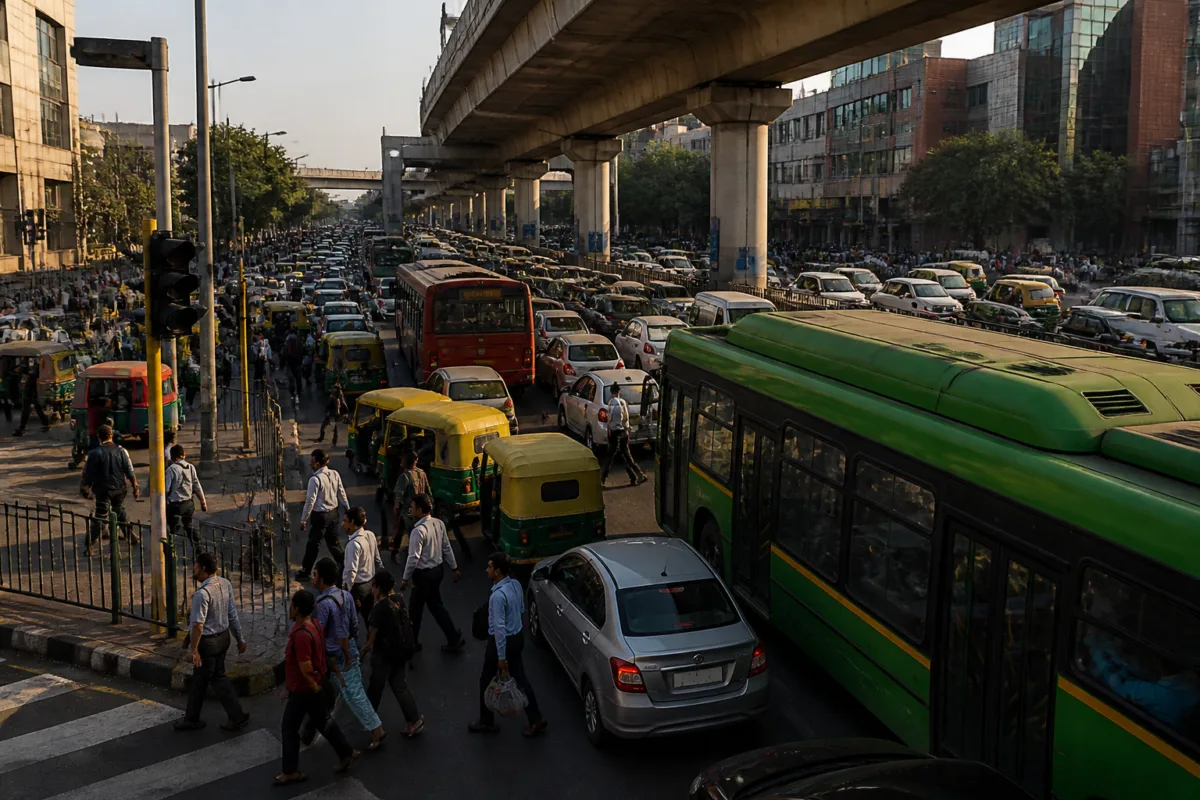
Delhi’s 62 identified traffic bottlenecks remain a significant challenge for mobility and air quality, with several planned corrective measures stalled by land constraints, narrow roads and conflicts with metro and other construction work, according to a report by Jagran.
The report says traffic police, the Public Works Department (PWD), the Municipal Corporation of Delhi (MCD), the Delhi Metro Rail Corporation (DMRC) and the Transport Department jointly identified the locations. A total of 215 corrective measures were planned to address the recurring disruptions.
A June report cited by Jagran said work had been completed at 34 locations, while 56 measures were considered impractical and dropped. The reasons included a lack of available land, narrow roads, conflicts with metro projects and other construction activity. The report also said that more than six months after the bottlenecks were identified, the problem had not been fully resolved.
The figures indicate that identifying congestion points is only one part of the problem. Implementing a remedy often requires changes to road geometry, pedestrian infrastructure, bus operations, parking management or junction design. These interventions fall under different agencies, making coordination central to any durable solution.
Traffic police can regulate vehicle movement, issue challans for illegal parking, assist with action against encroachments and manage traffic operations. Road widening, however, generally involves agencies such as the PWD, MCD, the National Highways Authority of India and other authorities. Foot overbridges, underpasses and flyovers also require separate planning and construction processes. Bus-stop relocation is handled by the Transport Department and the relevant bus-operating agencies.
The report cites Bhavbhuti Marg outside New Delhi Railway Station as an example of this institutional and physical complexity. Pedestrian crowds, irregular stopping by autorickshaws and buses, and activity around the station contribute to congestion. A proposed subway or foot overbridge could not progress because of the station’s redevelopment work, according to the report.
On Boulevard Road between Tis Hazari and Kashmere Gate, a proposed flyover was considered impractical because of the road’s limited width and a complex junction. Near Max Hospital in south Delhi, road widening was reportedly constrained by the absence of available land.
The locations listed in the report span central, north, east, south, west and New Delhi areas. They include major junctions and corridors such as Azadpur, Britannia Chowk, Mukarba Chowk, Anand Vihar ISBT, Ashram Chowk, Kalindi Kunj, Peeragarhi Chowk, Punjabi Bagh, Dhaula Kuan and Dwarka Link Road.
Congestion can increase the time vehicles spend moving slowly or idling, raising fuel consumption and emissions. The report therefore presents traffic management as part of Delhi’s air-pollution challenge, alongside sources such as crop-residue burning, dust and exhaust emissions. It does not provide an estimate of the additional emissions attributable specifically to the 62 bottlenecks.
The unresolved issue is not simply whether more projects are needed, but whether agencies can match each bottleneck with a feasible intervention. Where widening is impossible, the available responses may depend on better parking enforcement, redesigned junction operations, managed bus and autorickshaw stopping, pedestrian facilities or changes linked to ongoing redevelopment. The report’s examples show that these measures must be planned around existing land, transport and construction constraints rather than treated as isolated road projects.

