


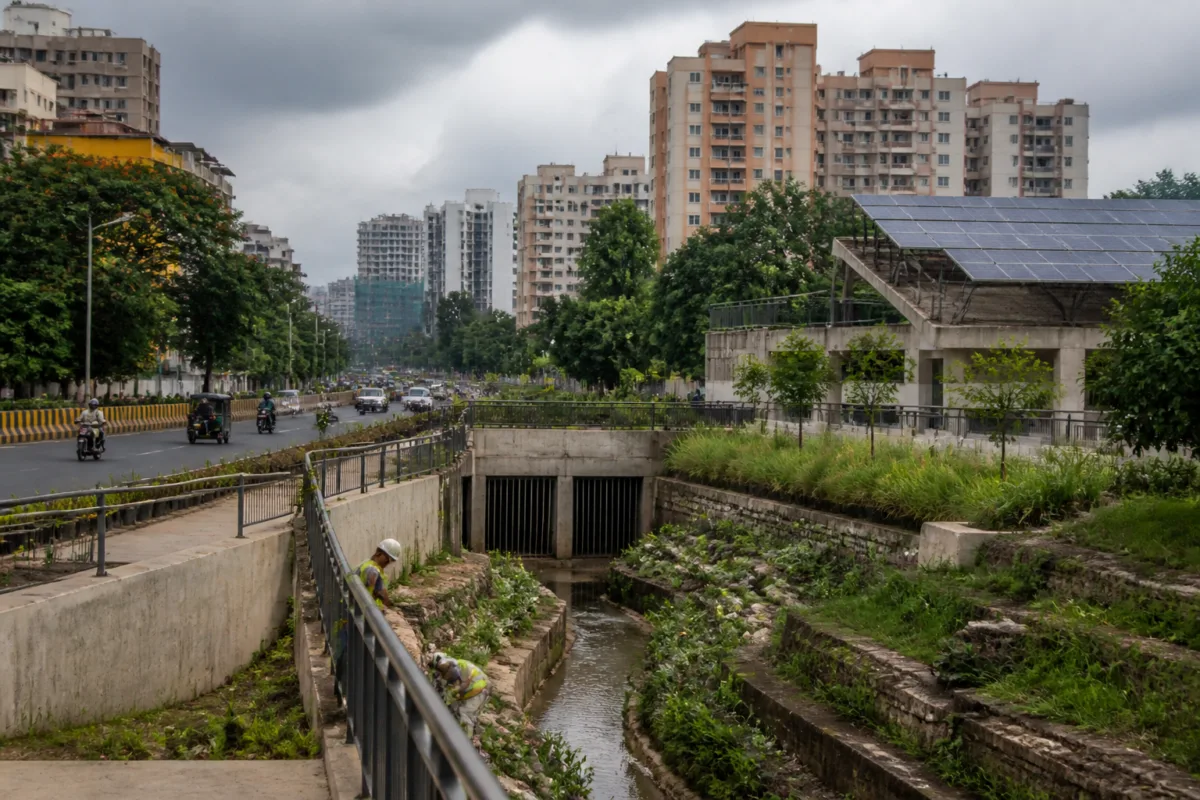
The collapse of climate talks in Antalya could make India’s next phase of climate action more dependent on domestic banks, government budgets and municipal finance departments, particularly for projects that protect cities and vulnerable communities but do not generate easy commercial returns.
The longest United Nations climate summit on record ended on November 22 after running 48 hours into overtime, without consensus on the proposed Antalya Pact, according to the Economic Times. Indian negotiators speaking for the Like-Minded Developing Countries said developed nations had indicated that climate finance was “dead in the water”.
The immediate effect is not expected to halt India’s renewable-energy investment. The Economic Times reported that India’s renewable capacity had crossed 300 GW in 2026, including 171.05 GW of solar capacity as of September 30. The report also said electric-vehicle financing had increased and that commercially viable mitigation projects could continue to attract private capital even without a successful outcome at the climate summit.
The larger difficulty is financing adaptation. Economic Times Climate data cited in the report put India’s tracked mitigation finance at Rs 6,68,500 crore in 2023-24, with domestic sources providing 88% of the total. Private players accounted for 68% of domestic mitigation funding. Adaptation finance was lower at Rs 1,51,000 crore, with 95% coming from domestic sources, largely through government expenditure.
That difference matters for urban infrastructure. Solar parks, battery storage and electric vehicles offer identifiable revenue or cost-saving opportunities, making them easier to finance commercially. Flood protection, drought resilience, coastal defences and urban cooling provide wider public benefits, but their returns are difficult to monetise. Municipalities and state governments therefore remain central to delivering them, even as they face competing demands on limited resources.
The report raises the question of whether disaster-response funds and municipal budgets can absorb the rising cost of climate resilience. Such projects often require long-gestation infrastructure investment and do not necessarily produce direct revenue. If international loans and grants become less available or more expensive, a greater share of the burden could fall on domestic public finance and local institutions.
The financing challenge also extends beyond adaptation. India’s steel, cement and other carbon-intensive exporters face additional costs under the European Union’s Carbon Border Adjustment Mechanism, which links charges to the embedded emissions of imported products. Indian companies will need to invest in cleaner production, emissions measurement and verification to protect their competitiveness, the report said.
The Economic Times also cited Reuters in reporting that restricted access to affordable green finance could widen the gap between companies able to secure low-cost capital and those that cannot. This could make industrial decarbonisation more uneven, particularly for businesses that need to upgrade processes while maintaining export competitiveness.
Carbon markets add another layer of uncertainty. Companies seeking to finance emissions reductions and demonstrate progress to overseas buyers will depend partly on the development of India’s domestic carbon-credit trading framework. The report said the absence of agreement at COP31 could increase uncertainty over the future sources of funding for carbon-cutting projects.
For India’s renewable-energy sector, the likely response identified in the report is greater reliance on local lenders, corporate balance sheets and long-term power-purchase agreements. That may sustain projects with clear commercial models. It does not, however, resolve the harder financing problem facing flood protection, urban cooling and other resilience measures whose benefits are widely shared but difficult to capture as revenue.
The post-COP31 financing question for India is therefore not limited to how much clean energy can be added. It is also about whether government and municipal institutions can secure affordable capital for the less bankable infrastructure needed to protect people, cities and productive assets from climate risks.

