


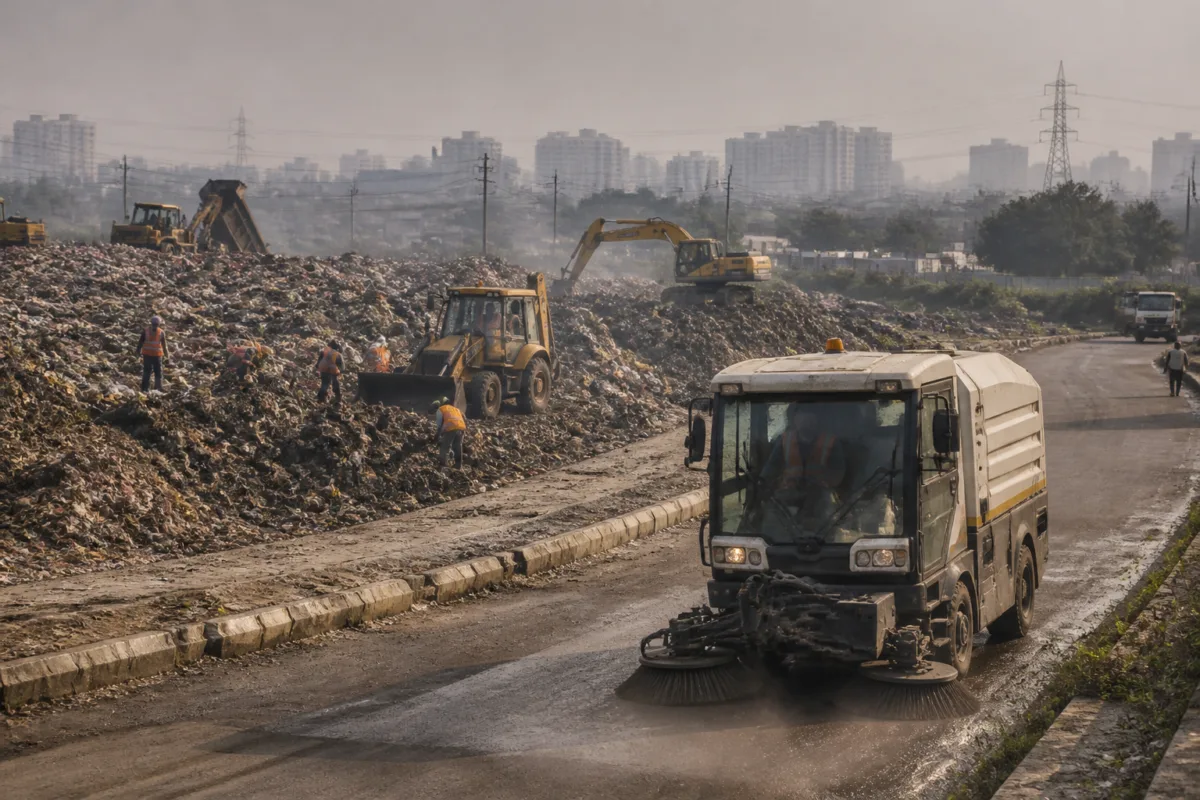
Delhi’s progress on several measures intended to reduce air pollution remains substantially below targets, with the largest gaps reported in landfill remediation, new waste-processing capacity, road-dust control and parking infrastructure. The findings are contained in the Air Quality Management Commission’s (CAQM) pollution-control report card for January to October 2026, as reported by Jagran.
The most significant shortfall concerns solid-waste management. Delhi had set a target of adding 650 tonnes per day of waste-processing capacity during 2026. By 31 October, the reported increase was zero.
The three landfill sites also remained well behind their remediation targets. At Okhla, 18.26 lakh tonnes of waste had reportedly been removed against a target of 27.45 lakh tonnes, leaving a gap of 9.19 lakh tonnes. At Bhalswa, 27.49 lakh tonnes had been cleared against a target of 48.42 lakh tonnes, with 20.93 lakh tonnes still outstanding. At Ghazipur, 16.53 lakh tonnes had been removed against a target of 39.12 lakh tonnes, leaving a gap of 22.59 lakh tonnes.
Together, the three sites had a disposal target of 114.99 lakh tonnes, of which 62.28 lakh tonnes had reportedly been achieved. This left 52.71 lakh tonnes still to be addressed by the end of October.
The report card covers 29 actions across vehicle emissions, industrial pollution, road dust, waste management, construction and demolition debris, and other pollution sources. CAQM gave Delhi and the states additional time during the remaining part of the year to accelerate implementation. The final 2026 report card is expected in January 2027, according to the report.
Parking and public transport also recorded uneven progress. Against a target of developing 266 parking sites during 2026, only 15 had been completed by 31 October, representing about 6 per cent of the target. The remaining gap was 251 sites.
Delhi had also planned to add 2,395 city buses to strengthen public transport. The reported addition was 1,703 buses, or 71 per cent of the target. The report links better parking management and public transport provision with efforts to reduce pollution from vehicles, although it does not quantify the emissions impact of the shortfall.
The expansion of electric-vehicle charging infrastructure was one of the areas where Delhi exceeded its stated target. The city had set a goal of 5,000 charging stations and recorded 6,000, according to the report card.
Road-dust control showed a more mixed picture. The target was to have 35 large mechanical road-sweeping machines, but 19 were available by the reporting date. For medium-sized machines, only one was recorded against a target of 57. Four small machines were available against a target of four.
The disparity suggests that the availability of equipment was not consistent across categories. However, the report does not establish how frequently the machines were deployed, the road length covered, or the reduction in particulate pollution achieved through sweeping.
Some regulatory and monitoring measures exceeded their targets. Industrial units were inspected 1,609 times against a target of 979 inspections. Inspections of diesel generator sets stood at 1,296 against a target of 539. The report also recorded the achievement of targets for installing online continuous emission monitoring systems and air-pollution-control devices.
Delhi met its target of creating 1,000 tonnes per day of construction and demolition waste-processing capacity. The use of processed debris, however, remained considerably below planned levels. Government agencies used about 2.07 lakh tonnes against a target of more than 9.90 lakh tonnes, while private agencies used around 3.08 lakh tonnes against a target of 12.09 lakh tonnes.
The report also recorded zero progress towards a combined target of 421 green crematoria across Delhi, Haryana, Rajasthan and Uttar Pradesh by 31 October. The targets were 49 in Delhi, 196 in Haryana, 53 in Rajasthan and 123 in Uttar Pradesh.
Delhi Mayor Pravesh Wahi, quoted by Jagran, said the Municipal Corporation of Delhi was continuing to identify and address sources of air pollution. He said 1,000 new machines had been deployed for cleaning and that work was under way on parking facilities and the paving of unpaved parking areas. He added that the civic body was attempting to eliminate factors that allow dust to become airborne.
The report card presents a city response with clear pockets of progress alongside major implementation gaps. The strongest performance was reported in industrial inspections, diesel-generator inspections, charging infrastructure and construction-waste processing capacity. The weakest areas were the addition of municipal waste-processing capacity, landfill clearance, medium-scale road sweeping, parking-site development and green crematoria.
For residents, these gaps affect more than air-quality targets. Delayed landfill remediation prolongs the presence of large waste accumulations near urban settlements, while inadequate processing capacity can increase dependence on disposal sites. Limited road-sweeping equipment and low reuse of processed construction debris point to operational and procurement challenges beyond the setting of formal targets. The report card’s final assessment in January 2027 will indicate whether the remaining targets were converted into completed infrastructure and measurable pollution-control outcomes.

