


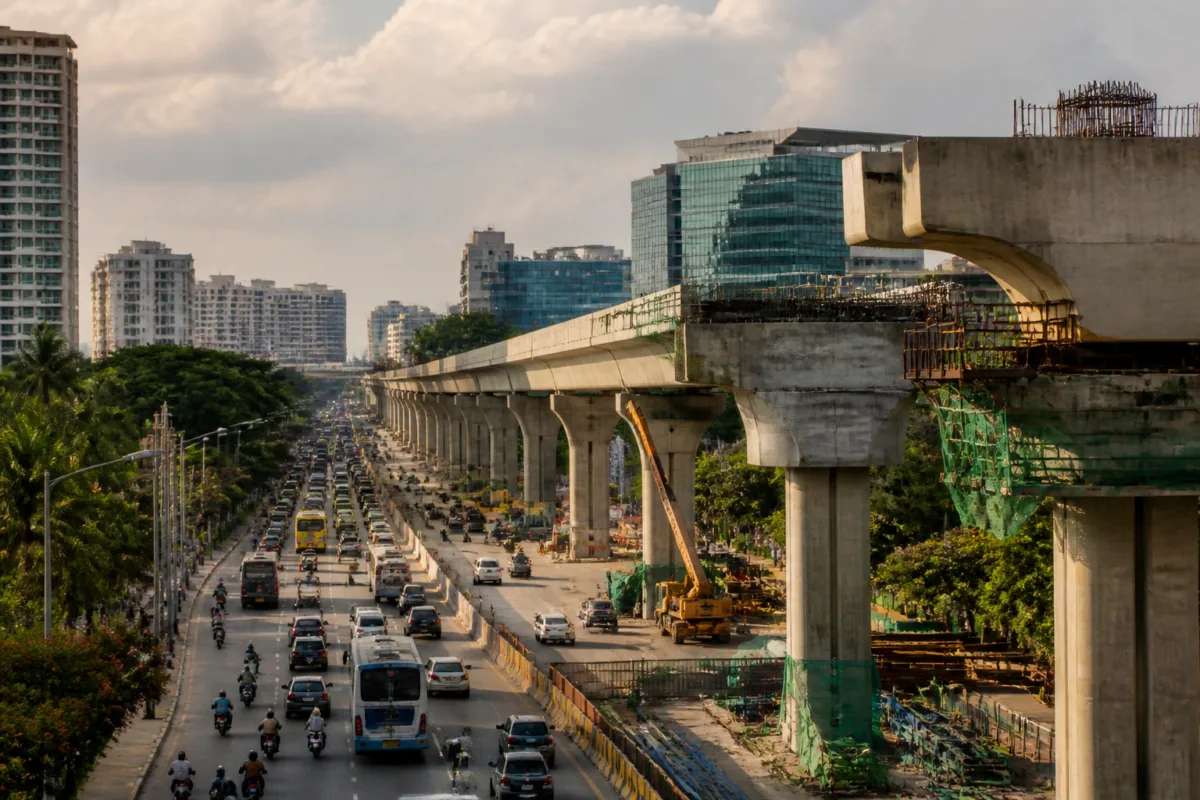
Bengaluru’s proposed 37.8-km Hebbal–Sarjapur Metro corridor, known as the Red Line or Phase 3A, could face a further two-year delay, with its completion timeline potentially moving from 2031 to 2033, according to a report by Vijay Karnataka.
The corridor is planned to connect Sarjapur in southeast Bengaluru with Hebbal in the north, passing through major employment, residential and central-city areas including Koramangala and the central business district. Its proposed alignment is intended to provide a high-capacity public transport link between two rapidly growing parts of the city that currently depend heavily on road-based travel.
The report said the Karnataka Cabinet approved the Phase 3A proposal in December 2024 and that the state submitted it to the Union government for approval. The proposal has reportedly not yet received approval from the Ministry of Housing and Urban Affairs. A revised detailed project report was submitted by the state government and Bengaluru Metro Rail Corporation (BMRCL) in January 2026, according to the report.
The revised proposal reduced the estimated project cost from Rs 28,405 crore to Rs 25,999 crore. It also reduced the length of the underground station sections and dropped one proposed station. The report said the Union government had responded that approval would be processed according to the applicable rules rather than being granted in haste.
A BMRCL official, quoted by Vijay Karnataka, said the corridor’s completion period could be extended by another two years because of the continuing delay. The report also quoted Bengaluru city development minister Krishna Byre Gowda as warning that prolonged approval delays could increase the project cost and the financial burden on the state.
The corridor is planned as a combination of elevated and underground construction. Of the total 37.8 km, an elevated section of 20.52 km would run from Sarjapur towards Koramangala via Doddakannಹalli or Dommasandra, Carmelaram, Bellandur, Iblur and Agara. It would then enter an underground section near Koramangala.
The proposed 14.28-km underground section would run from Koramangala’s 2nd Block through Dairy Circle, NIMHANS, Shanthinagar, Town Hall, KR Circle, Basaveshwara Circle, the Bengaluru Golf Course and Palace Guttahalli towards Mekhri Circle. A further 3-km elevated section would emerge near Mekhri Circle, pass through Ganganagar and run along Ballari Road to the proposed Hebbal interchange hub.
The cost comparison is complicated by the mix of construction methods and the corridor’s urban setting. The state government has argued that metro projects cannot be assessed only by comparing the cost per kilometre. The proportion of underground and elevated alignment, land acquisition requirements, ground conditions and the year in which approval is granted can all affect the estimate, the report said.
According to figures cited in the report, Bengaluru Metro Phase 1 cost about Rs 193 crore per kilometre, while Phase 2, which included underground sections, cost about Rs 352 crore per kilometre. The entirely elevated Phase 2A and 2B corridors were estimated at Rs 254 crore per kilometre, while Phase 3 was estimated at Rs 350 crore per kilometre. The underground section of Phase 3A is expected to cost about Rs 695 crore per kilometre.
The high cost of the underground component makes approval timing particularly important for the project’s financial planning. The state government has said that a delay could raise the estimate further. If approval is secured, the government’s stated target is to invite tenders and begin construction by the end of the following year, the report said.
The proposed Red Line is significant because it would link Sarjapur’s technology and residential districts with northern Bengaluru through a direct rapid-transit corridor. Its alignment also places substantial emphasis on underground construction through dense central areas, where acquiring surface space for an entirely elevated route would be difficult.
The report said the last central approval for a new Bengaluru Metro project came in August 2024 for Phase 3. Apart from land acquisition, construction on that project had not begun at the time of publication. It also stated that no construction work on a new metro line had begun in Bengaluru during the previous four and a half years. The continued wait for Phase 3A approval therefore affects not only the Red Line’s schedule but also the pace at which the city expands its rapid-transit network.
Until the Union government grants approval, the 2033 completion date remains a reported possibility rather than a formally confirmed revised deadline. The project’s next decisive step is approval of the revised proposal, followed by tendering, construction mobilisation and land-related work.

