


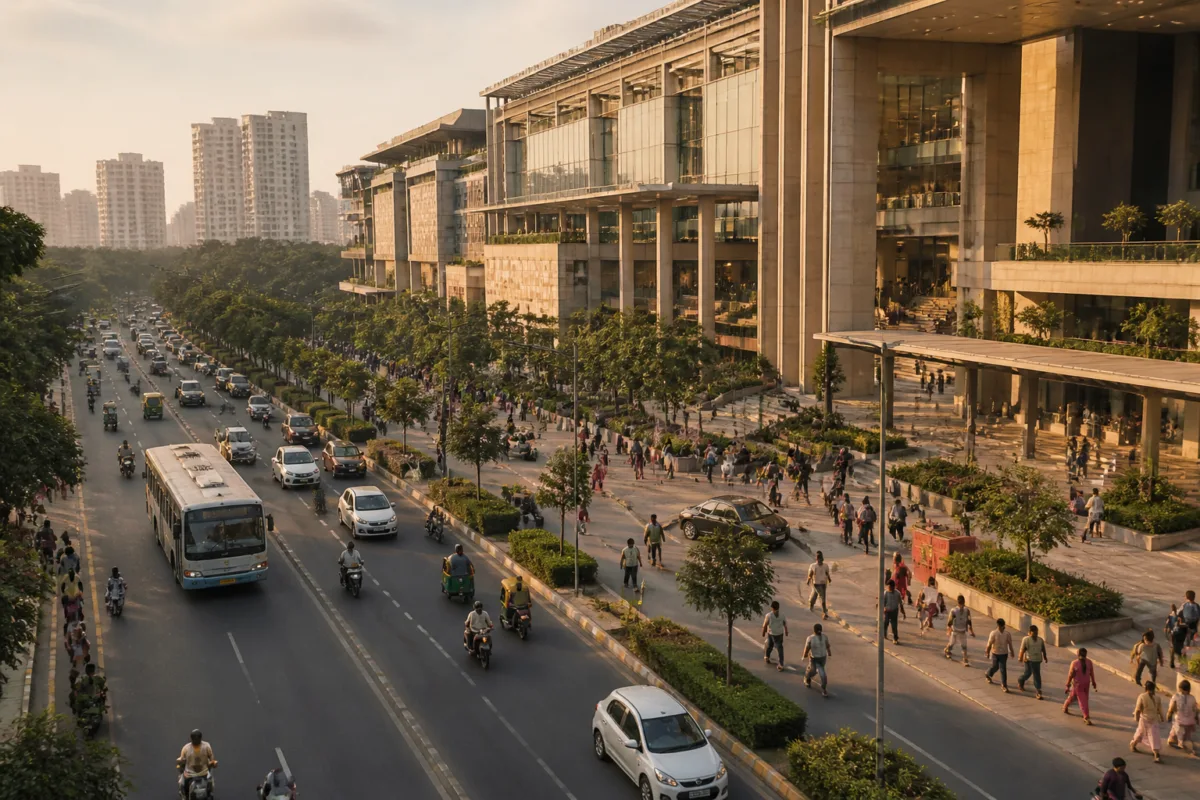
India’s retail expansion is set to add nearly 43.7 million sq. ft. of new space across the country’s top seven cities by 2030, according to a JLL estimate cited by The Realty Today. The projected pipeline is placing greater attention on whether connectivity, parking, utilities and supporting urban services can keep pace with new commercial development.
The expansion follows a strong leasing period. Retailers leased 9.36 million sq. ft. between January and September 2026, 5.6% higher than in the same period a year earlier and the strongest nine-month performance in four years, the report said. Delhi-NCR accounted for 26% of leasing during the period, followed by Mumbai and Bengaluru.
Fashion and apparel represented 31% of leasing, while food and beverage accounted for 18% and entertainment for 15%. These figures indicate that demand is spread across shopping, dining and leisure uses rather than being limited to conventional retail stores.
The distribution of leasing also points to a change in the way retail is being accommodated within cities. High streets accounted for 46.3% of leasing, marginally ahead of shopping malls at 45.9%. The figures suggest that retailers are using multiple formats and that new supply will need to respond to the access, catchment and tenant-mix conditions of individual locations.
Harinder Singh Hora, founder chairman of Reach Group, said the demand profile was influencing the design of retail developments. He cited features such as double-height atriums, open-to-sky spaces, wider circulation corridors, strategically positioned anchor stores and clearly defined dining and entertainment zones as elements that can affect how visitors move through a development.
The report also cited Deepak Kapoor, director of Gulshan Group, who said retailers were assessing the catchment, accessibility and wider offer of a destination before establishing outlets. In this account, food, entertainment and leisure are becoming important components of the visitor journey alongside shopping.
Mixed-use development is another part of the emerging model. The Realty Today reported that developers are increasingly integrating retail with residential, commercial and lifestyle uses. Such projects are intended to create a more consistent consumer base and make retail part of everyday urban activity rather than treating it as a standalone destination.
Abhishek Trehan, executive director of Trehan IRIS, said the new supply would be judged by its relevance to the catchment rather than by scale alone. He identified seamless access, an appropriate mix of uses and the flexibility to respond to changing consumer habits as important considerations for mixed-use developments.
The infrastructure question becomes more significant as retail growth extends beyond established metropolitan centres. The report said developers were examining emerging urban markets where organised retail infrastructure remains limited, but also noted the need to assess the size and spending capacity of each catchment before committing to large projects.
Umang Jindal, chief executive officer of Homeland Group, said additional retail space would need to be supported by better connectivity, planned urban development, adequate parking, reliable utilities and other infrastructure capable of handling higher footfall. He also stressed that developments in emerging cities would need to be aligned with genuine consumption demand and longer-term urban growth.
The report cited similar concerns from Amish Bhutani, managing director of Group 108, who pointed to connectivity, efficient layouts, spatial design and planned amenities as factors that could shape the next generation of retail destinations.
The projected supply therefore raises an implementation issue beyond the volume of construction. New malls, high-street projects and mixed-use developments will depend on how well they connect to surrounding neighbourhoods, accommodate visitors and integrate with existing urban systems. The available report does not provide project-level details on proposed locations, transport capacity, parking standards or utility planning, leaving those factors to be assessed individually as developments move forward.

