


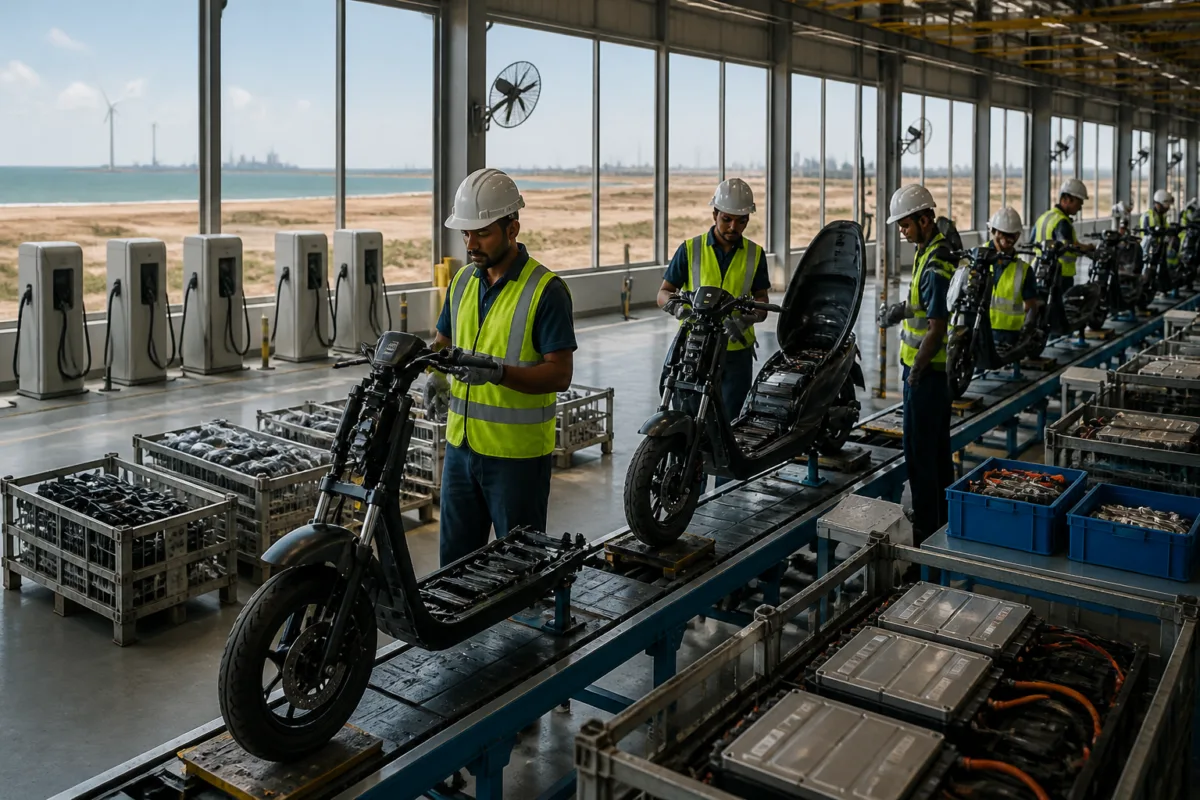
VinFast’s plan to manufacture electric scooters in Tamil Nadu from the first half of 2027 could widen the state’s role in India’s electric-vehicle supply chain while increasing pressure for supporting charging, dealership and service infrastructure.
The Vietnamese electric-vehicle maker plans to introduce two electric scooter models in India in the first half of 2027, with production at its facility in Thoothukudi, according to company officials cited by PTI and reported by Moneycontrol. A production line for electric two-wheelers has already been installed at the facility, Anurag Saxena, Market CEO for two-wheelers at VinFast India, said.
The company is studying the Indian electric two-wheeler market and plans to begin with battery-powered scooters. Saxena said the vehicles would have a minimum range on a single charge, but did not disclose the expected range. He also said the scooters could include a battery-swapping option. Dealership partnerships across cities are reportedly being developed, with trials in the final stages.
This places distribution and charging access alongside manufacturing as central parts of VinFast’s proposed Indian expansion. The company’s V-GREEN arm is setting up charging stations and partnering with existing charging operators for both two-wheeler and four-wheeler customers, officials told PTI. The group has said it plans to invest USD 2 billion in India across various sectors, including charging infrastructure, after investing USD 500 million so far, according to the report.
The charging strategy is significant for electric two-wheelers, which depend on convenient access to power for daily use and commercial operations. VinFast officials said the company would continue offering free charging until 2029, a long-term battery guarantee and the option to take back pre-owned VinFast vehicles after the registration period. The report did not provide details on the proposed charging network’s size, locations, tariff structure or interoperability with other operators.
VinFast is also expanding its four-wheeler plans. The company currently sells four electric car models in India — the VF 6, VF 7, MPV 7 and Limo Green — and plans to introduce at least two more battery-powered models. Tapan Ghosh, CEO of VinFast Asia for the four-wheeler business, said the VF 5 is expected to launch in India early next year and that the company intends to introduce at least two car models annually.
The company plans to gradually raise production at its Thoothukudi facility to its stated annual capacity of 50,000 vehicles. Ghosh said the site could eventually be expanded to produce 1.5 lakh four-wheelers annually. VinFast is also considering using the Indian plant to serve other Asian markets.
The scale-up could have implications for industrial land, logistics and supplier networks in southern Tamil Nadu. The company recently signed an agreement with the state government to acquire another 500 acres for future expansion, according to the report. However, the report does not specify the acquisition price, development schedule, approvals, construction status or the infrastructure commitments associated with the additional land.
Local sourcing is another unresolved part of the expansion. Ghosh said VinFast currently sources 15 per cent of its inputs locally and aims to double that share. A higher local-content ratio could increase opportunities for Indian component manufacturers, but the company has not detailed which components it expects to source domestically or when the target will be achieved.
VinFast officials said the company’s monthly sales in India had risen to 2,500-3,000 units from an initial 500 units. The report does not identify the period covered by those figures or provide a model-wise breakdown. Similarly, the company’s target of securing a sizeable share of India’s electric two-wheeler and four-wheeler markets by 2030 remains a stated business objective rather than an independently assessed forecast.
For cities, the proposed scooter launch will ultimately depend less on factory capacity alone than on the availability of reliable charging or swapping points, after-sales service and dealerships across urban markets. VinFast’s plans indicate an effort to develop those networks alongside manufacturing, but the coverage, operating model and delivery timeline of the proposed systems have yet to be disclosed.

