


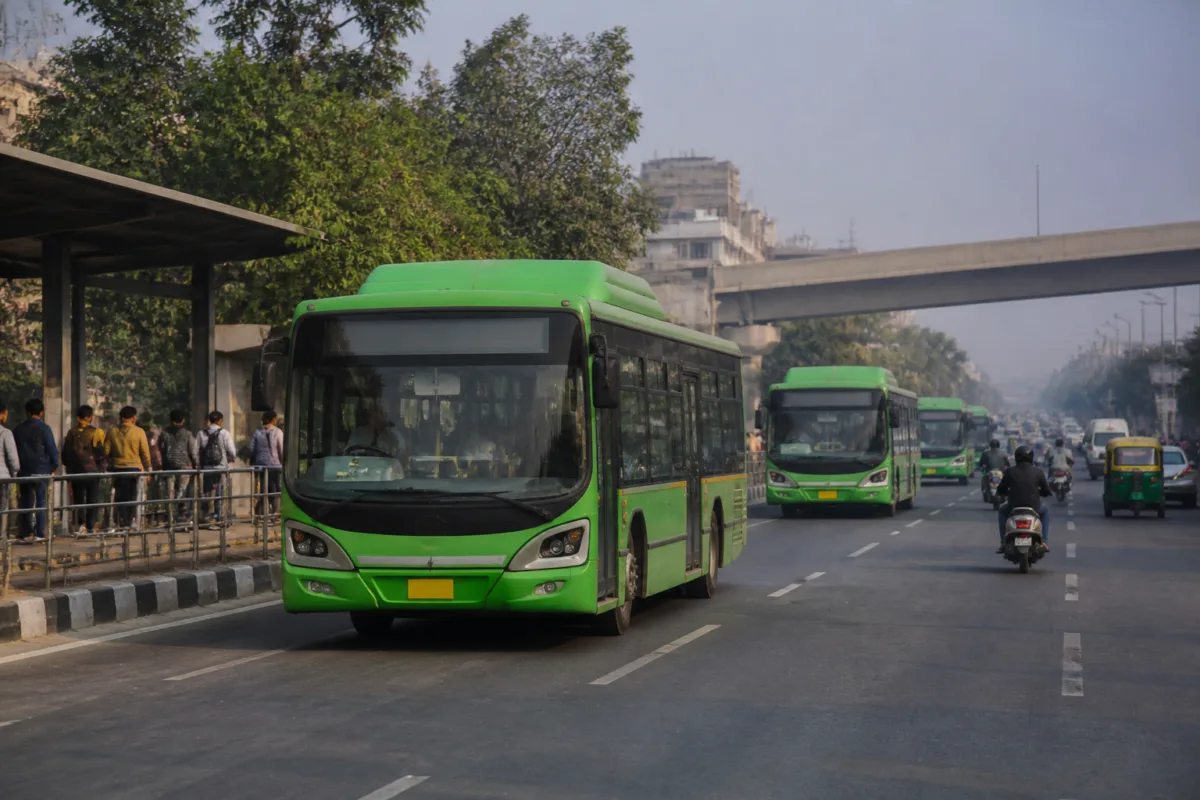
Delhi has added more than 5,000 electric buses since January 2022, but the city’s public-transport fleet remains below the level needed to meet current demand, according to a report by Jagran.
The report said around 2,000 electric buses were introduced between January 2022 and January 2025. A further 3,338 buses have been added during the current government’s 21-month tenure, taking the total number of electric buses introduced since January 2022 to more than 5,000.
Despite this faster pace of procurement, Delhi’s target of having 14,000 buses by 2030 remains a major challenge. The report said the city currently has 7,088 buses when buses operated by the Delhi Integrated Multi-Modal Transit System, or DIMTS, are included. It described this as roughly half the fleet needed according to current requirements.
The figures highlight the difference between adding electric vehicles and building a public-transport system with sufficient capacity. A growing electric fleet can support cleaner urban mobility, but it does not by itself resolve shortages in route coverage, service frequency or the number of buses available to commuters. The report said the government would need to continue pursuing the 14,000-bus target rather than treating the recent increase as sufficient.
Delhi began introducing electric buses in January 2022. The reported expansion has accelerated across successive government periods, with the report attributing about 2,000 additions to the three years from January 2022 to January 2025 and 3,338 additions to the subsequent 21 months.
The inclusion of DIMTS buses in the overall fleet count also indicates that the city’s available bus capacity is spread across more than one operating arrangement. For passengers, however, the relevant measure is whether enough buses are running on the routes and at the times when they are needed.
The remaining gap is substantial. A fleet of 7,088 buses would need to grow by nearly 7,000 to reach the stated 14,000-bus goal. The report did not provide a detailed procurement schedule, route-wise capacity assessment or timeline for closing that gap. It also did not specify how many buses in the reported total are operational at any given time.
The challenge for Delhi, therefore, is not only the speed of electric-bus deployment but also sustained fleet expansion and effective service deployment. Until the gap between the current fleet and the 2030 target narrows, bus availability will remain a central constraint on the city’s public-transport system.

