


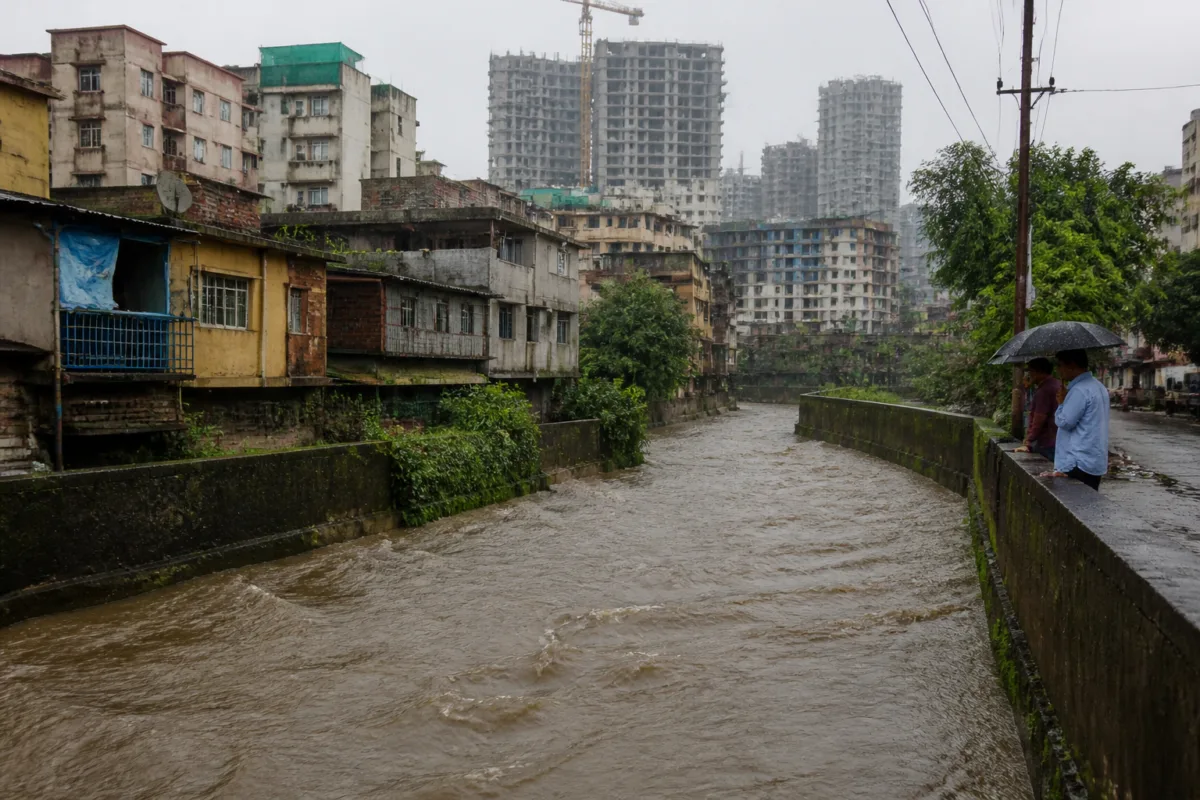
Pune municipal officials have told the civic general body that permission was granted to divert 47 natural streams in the city after applications from builders, according to a report by Sakal. The disclosure has raised questions about how changes to natural drainage channels are assessed and monitored as heavy rain continues to cause flooding in central Pune and its suburbs.
The issue surfaced during a discussion in the Pune Municipal Corporation’s general body on provisions of the Unified Development Control and Promotion Regulations (UDCPR) and changes made by the state government. The discussion also included concerns over increased floor space index (FSI) provisions.
Municipal corporator Arvind Shinde asked how many changes had been made to the regulations between 2022 and 2026 and how many streams had been diverted during the previous four to five years, the report said.
At first, city engineer Aniruddha Pawaskar reportedly said that information on the number of diverted streams was not available. Shinde and other corporators questioned how the administration could lack the data when flooding was occurring in Pune and stream diversions were being discussed.
The administration subsequently stated that approval had been granted for the diversion of 47 streams. When asked who the diversions were intended to benefit, officials reportedly said they were carried out for citizens. However, when asked who had submitted the applications, Pawaskar said the permissions had been granted after applications from builders, according to the report.
The available account does not identify the streams, their locations, the dates of the approvals, the developers involved or the technical conditions attached to the permissions. It also does not establish whether every diversion was unlawful or whether the projects received other required clearances. The reported exchange does, however, point to a significant civic-record and flood-management concern: the administration initially said the relevant information was unavailable before providing the figure of 47.
Natural streams and drainage channels form part of a city’s stormwater network. Altering their alignment can affect how quickly rainwater moves through developed areas, particularly when intense rainfall exceeds the capacity of roadside drains and underground infrastructure. In Pune, the reported flooding of residential societies and damage to citizens’ property has made the condition and continuity of drainage routes a recurring public concern.
The disclosure also links land development approvals with flood risk. Builder applications may seek changes to stream alignments for particular projects, but the public interest question is whether each proposal was assessed at the catchment level rather than only at an individual plot or project level. The report provides no details of such assessments, hydrological studies, compensatory drainage works or post-approval inspections.
For residents, the immediate unresolved issue is not only the number of diversions but where they occurred and how they changed local drainage. Publicly identifying the 47 streams, the approval basis, responsible departments and mitigation measures would allow citizens and elected representatives to assess whether the diversions have increased exposure to flooding or environmental damage.
The civic administration’s reported statement therefore places record-keeping and disclosure at the centre of Pune’s urban flood-management debate. Without location-wise and project-wise information, the impact of the permissions cannot be independently assessed, while the lack of readily available data makes coordinated planning for future heavy rainfall more difficult.

