


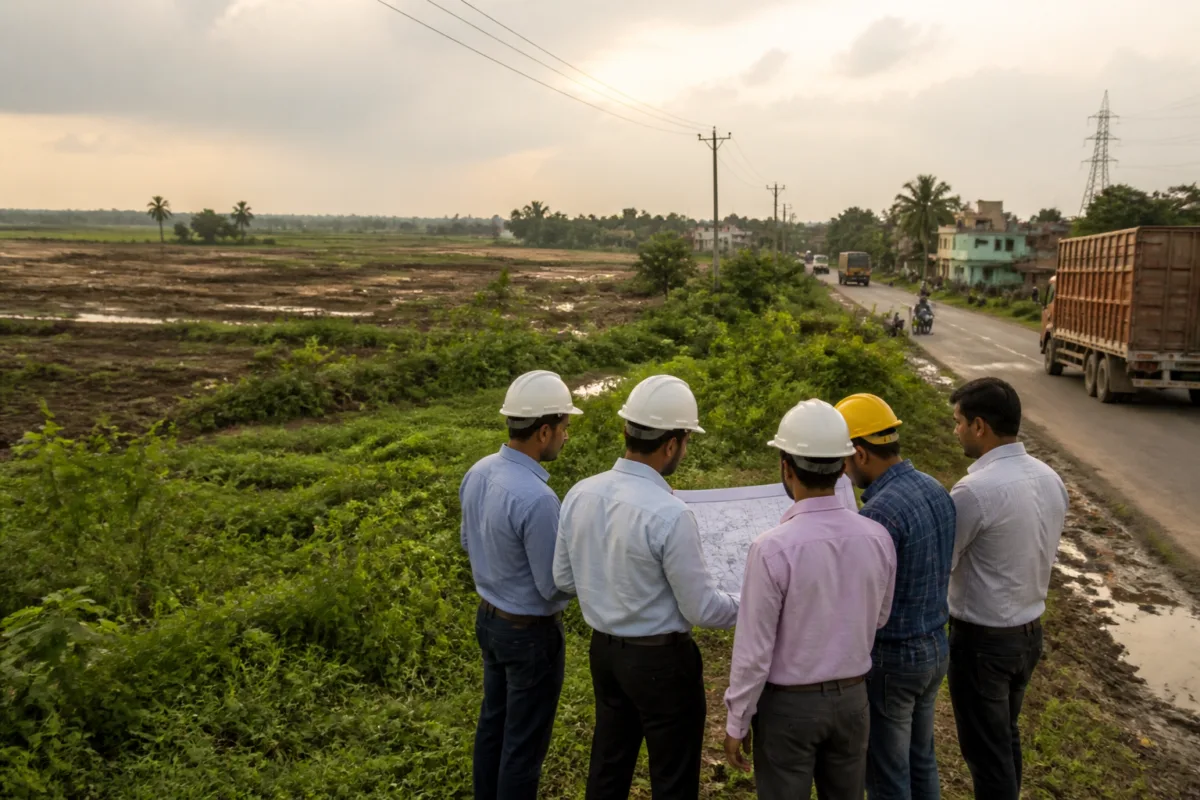
Union minister Sukanta Majumdar has said Ashok Leyland will establish a heavy-vehicle manufacturing plant in Singur, West Bengal, with work expected to begin soon. The proposal could revive the site’s industrial prospects nearly two decades after Tata Motors withdrew its Nano project, but key details needed to assess its feasibility remain undisclosed.
Majumdar, the Union minister of state for education, made the announcement on Saturday after Prime Minister Narendra Modi’s programme at IIT Kharagpur. He said Ashok Leyland was “coming to Singur” and would set up a truck manufacturing plant, adding that work would begin soon.
The statement follows West Bengal Chief Minister Suvendu Adhikari’s remarks on November 5 that the state government had held preliminary discussions with Ashok Leyland about a heavy-vehicle manufacturing unit in Singur. Adhikari had cautioned at the time against premature announcements and said the government would prioritise projects capable of implementation rather than publicity-driven memorandums of understanding.
Neither the minister’s announcement nor the information available in the report sets out the proposed plant’s investment value, land requirement, production capacity, employment potential or construction schedule. The account also does not include a formal statement from Ashok Leyland confirming the project.
That absence of detail is significant because Singur’s industrial history is closely linked to questions of land acquisition, project execution and public confidence. The Left Front government, led by then chief minister Buddhadeb Bhattacharjee, acquired around 997 acres for Tata Motors’ proposed small-car factory. A prolonged agitation against the acquisition of farmland contributed to Tata Motors abandoning the project in 2008 and shifting production to Sanand in Gujarat.
The agitation, led by Mamata Banerjee when she was in opposition, became a major political turning point in West Bengal. Her Trinamool Congress came to power in 2011, ending the Left Front’s 34-year rule. Following a Supreme Court verdict, the state government returned the acquired land to unwilling farmers, while the abandoned factory infrastructure was dismantled.
A new heavy-vehicle plant would therefore represent more than an additional manufacturing investment. It would place industrial land use, access infrastructure and the state’s ability to convert political announcements into functioning projects back at the centre of the Singur debate. A truck manufacturing facility would also require supporting systems for freight movement, worker access, utilities and supply-chain operations, although the available information does not specify how those requirements would be addressed.
Majumdar presented the proposal as part of the BJP’s effort to bring industry back to Singur and revive industrialisation in West Bengal. He also criticised successive state governments over missed industrial opportunities, citing the semiconductor sector, and accused the Trinamool Congress government of failing to translate industrialisation promises into concrete projects.
The proposal’s credibility will depend on evidence beyond political statements: a formal company confirmation, a defined project site, approvals, investment commitments, a land and rehabilitation position where relevant, and a public implementation schedule. Until those details emerge, the announcement indicates a proposed industrial direction for Singur rather than a confirmed manufacturing facility under construction.

