


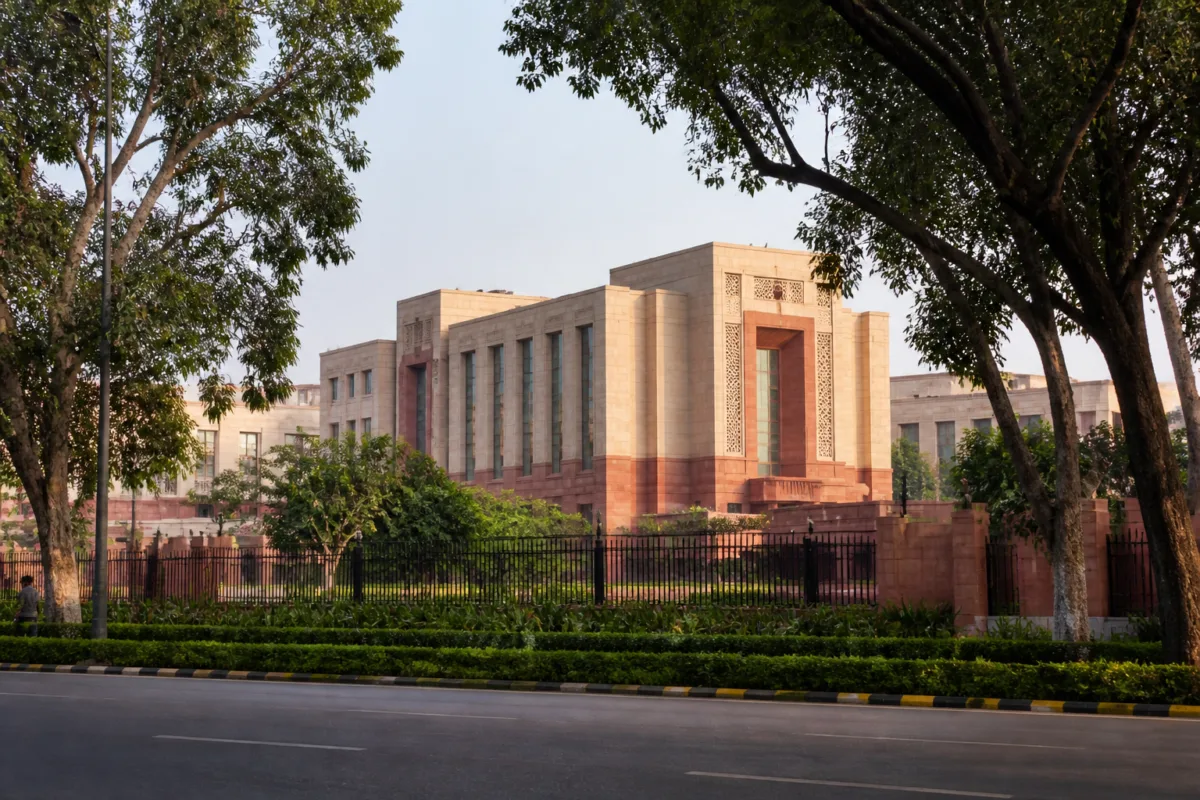
The Delhi High Court will hear on November 23 a petition seeking protection for an over-century-old mosque inside the Krishi Bhawan compound, where the Centre has proposed removal of the structure as part of the Central Vista redevelopment project.
Justice Anish Dayal deferred a petition filed by Mohd Yasir after noting that another plea concerning the Qadeemi Masjid, also referred to as Masjid Krishi Bhawan, is scheduled to come up next week. Yasir’s petition says the 266-square-yard mosque remains functional and faces an imminent threat of demolition.
The case places a legal dispute over a religious structure within a wider redevelopment exercise involving government land and office complexes in central Delhi. The court has not ruled on whether the mosque can be removed.
The Centre’s counsel argued that the present petition attempts to expand the scope of an earlier proceeding. In that earlier matter, the Centre said a permanent religious structure within a government office complex was impermissible and incompatible with the secular character of government property.
The petitioner’s counsel, M Sufian Siddiqui, argued that the Union government lacks authority to demolish the mosque, although it is not a protected monument. He relied on a 1945 agreement between the then authorities and the predecessor of the Delhi Waqf Board concerning use of the premises.
According to the petitioner, the government must first establish a material breach of that agreement before seeking to re-enter or recover possession of the site. The plea also argues that the agreement must be lawfully determined, that any recovery process should follow due procedure and that an independent authority should establish the legal basis for demolition.
During the hearing, the court questioned the scope for judicial intervention where ownership was not disputed. It observed that the government appeared to have a plan to reconstruct the surrounding areas and asked how the court could intervene if the property was not protected and ownership was clear.
The petitioner, however, contended that ownership alone did not settle the government’s power to remove the structure. The plea said that the principle of secularism did not provide an independent source of executive power to demolish religious institutions and criticised what it described as continued statutory inaction by the Delhi Waqf Board.
The November 23 hearing is expected to determine how the two petitions will be considered and whether the court will examine the legal safeguards attached to the mosque’s continued use. The proceedings may also clarify how redevelopment plans on government premises interact with pre-existing agreements and claims relating to religious sites.
For the moment, the mosque’s legal status and the Centre’s authority to remove it remain contested. The court’s next hearing will be important in establishing whether the dispute is treated primarily as a property and redevelopment matter, a question of religious-site protection, or both.

