


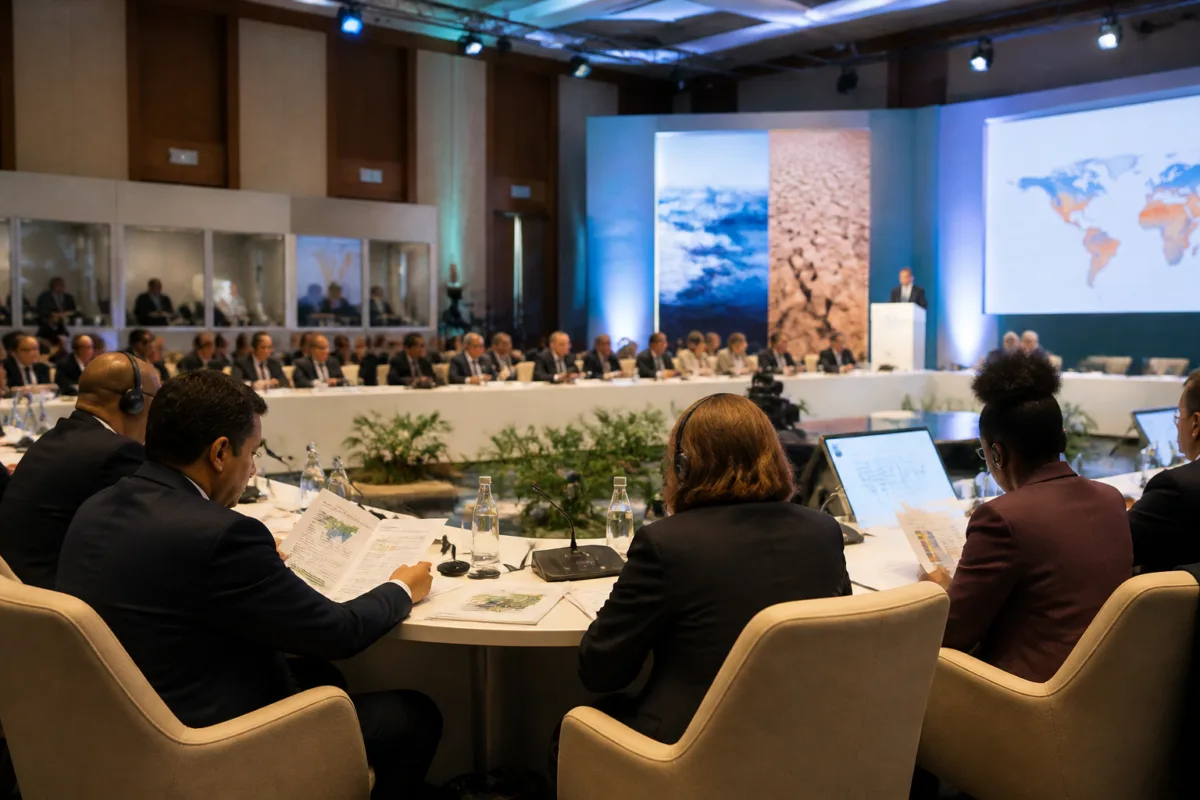
The second Global Stocktake under the Paris Agreement was launched at a ministerial-level event during COP31 in Antalya, Turkey, on November 18, beginning a two-year assessment of whether countries are on track to cut emissions, adapt to climate impacts and support vulnerable nations.
The process, known as GST2, is scheduled to conclude at COP33 in 2028 and will be the final five-yearly stocktake before 2030. It will draw on countries’ Biennial Transparency Reports before moving into a technical assessment phase in 2027. Its findings are expected to guide new national climate plans and international cooperation.
According to Down To Earth, countries broadly agreed that the world is falling short of the Paris Agreement’s 1.5°C temperature goal and is increasingly likely to enter a period of warming overshoot. However, negotiations remain divided over how quickly fossil-fuel use should decline, how long any overshoot should last and who should finance climate action.
Developed countries and the Least Developed Countries called for an accelerated transition away from fossil fuels and argued that the overshoot should be short, shallow and reversible. Developing countries, including India, China, the Philippines and Ghana, linked the challenge to historical emissions, inadequate finance and the need for technology transfer. They called for GST2 to reflect equity and the principle of common but differentiated responsibilities and respective capabilities.
India’s environment minister, Bhupender Yadav, questioned why the world remained at risk of crossing the 1.5°C threshold despite visible progress. South Africa said a larger overshoot would require substantially greater finance, mitigation and loss-and-damage support. Ghana called for grant-based capital rather than additional debt, while Kenya warned that adaptation must not remain secondary to mitigation.
The stocktake will also examine whether national adaptation plans are translating into physical protection for communities and infrastructure. Since the first Global Stocktake, 32 additional developing countries have submitted such plans, taking the total to 83, including 29 Least Developed Countries and 17 Small Island Developing States, the report said. A further 146 developing countries have plans in progress, while four have submitted second-generation plans.
The UAE Framework for Global Climate Resilience provides a common structure for tracking adaptation across water, food, health, ecosystems, infrastructure, livelihoods and cultural heritage. It also considers stages including risk assessment, planning, implementation and learning. The challenge, however, is moving from planning to delivery through stronger government systems, local participation and accessible finance.
Finance is expected to be a central fault line in GST2. Citing World Bank International Debt Statistics and a Devex analysis, Down To Earth reported that net transfers from 13 major multilateral development banks to low- and middle-income countries, excluding China, turned negative in 2025 after remaining positive from 2007 through 2024. This means developing countries paid more in principal and interest than they received in new funding.
The report also cited analysis presented under the Vulnerable Twenty group, which found that countries with higher climate-vulnerability scores face a probability of more than 50 per cent of requiring International Monetary Fund support, compared with roughly 15 per cent for countries with lower scores. It said poorer countries can also face borrowing costs of 6-12 per cent, compared with 3-5 per cent in richer nations.
A separate dispute concerns the timing of the Intergovernmental Panel on Climate Change’s Seventh Assessment Report. Developed countries and the Least Developed Countries want it delivered quickly to inform GST2, while India, China, Saudi Arabia and Russia have opposed compressed timelines, saying they could limit developing-country review and inclusiveness. India has also called for scientific assessments from developing countries to be recognised alongside IPCC reports.
The negotiations will therefore determine not only how progress is measured, but whether adaptation commitments produce funded protection for cities, infrastructure and vulnerable communities. The stocktake’s effectiveness will depend on how its findings connect scientific assessment with finance, technology transfer and implementation at national and local levels.

