


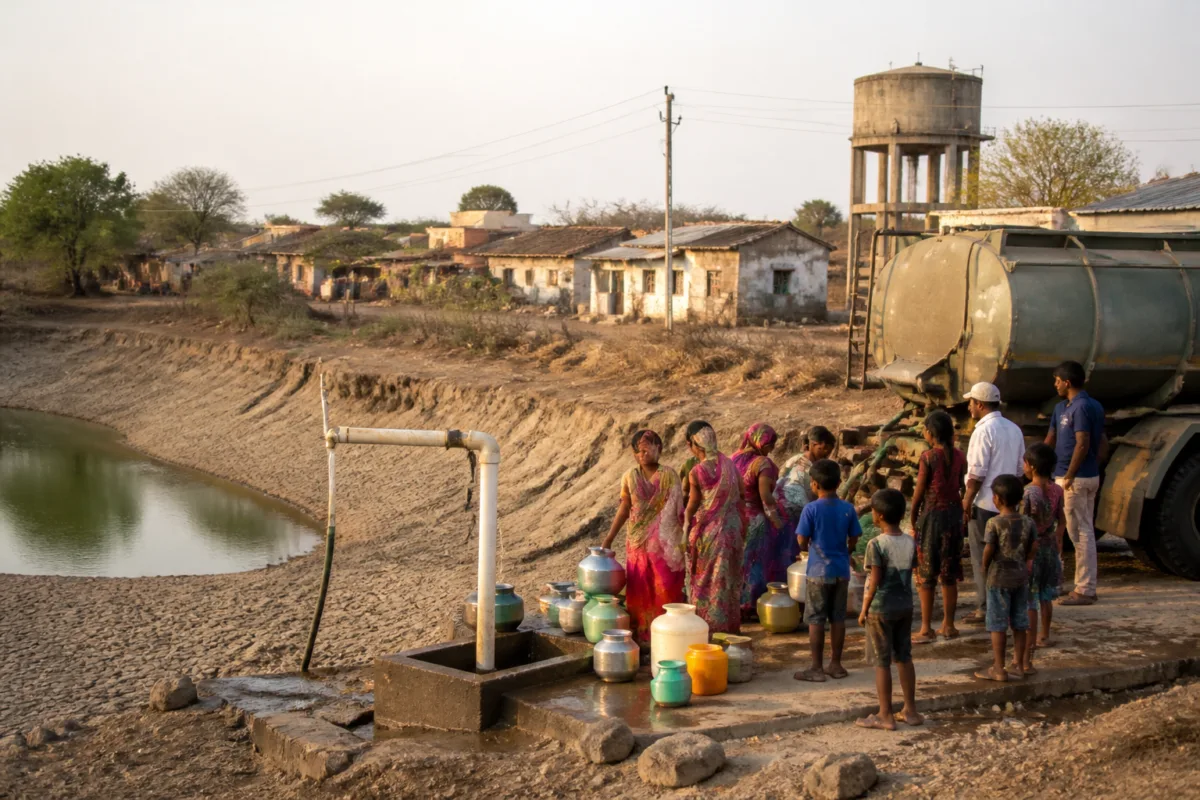
Maharashtra has added six talukas to its drought-affected list, taking the total number of talukas covered by the state’s drought mitigation programme to 310, according to Revenue Minister Chandrashekhar Bawankule.
The newly included talukas are Vikramgad, Wada, Dindori, Chiplun, Hatkanangale and Gadhinglaj. The minister, who heads the state government’s drought mitigation sub-committee, said the areas would receive relief measures and assistance after assessments of drought conditions.
The government is also reviewing recommendations concerning another 13 talukas. Officials have been directed to conduct surveys and verify the recommendations before a decision is taken on extending drought relief to those areas, Bawankule said.
The measures include financial and administrative support for rural drinking-water infrastructure. The state has sanctioned Rs 488 crore to complete pending rural drinking-water supply schemes, according to the minister. Authorities have also been directed to restore electricity connections to rural water-supply schemes disconnected over unpaid bills. Current dues are to be collected without insisting on the immediate payment of previous arrears, he said.
The decision is intended to revive schemes affected by power disconnections and improve the availability of drinking water in drought-hit communities. Bawankule also said banks and microfinance institutions had been instructed not to pressure affected farmers to repay loans during the crisis.
Separately, the Maharashtra government has announced a three-year water-conservation initiative covering 15,000 villages. The programme is intended to improve groundwater availability, strengthen local water-storage capacity and reduce the impact of recurring shortages.
Bawankule said the state would follow a “maximum water conservation at minimum cost” approach, with an emphasis on restoring existing water infrastructure rather than relying only on new construction. The report does not provide a project-wise allocation, implementation schedule or monitoring framework for the village-level initiative.

