


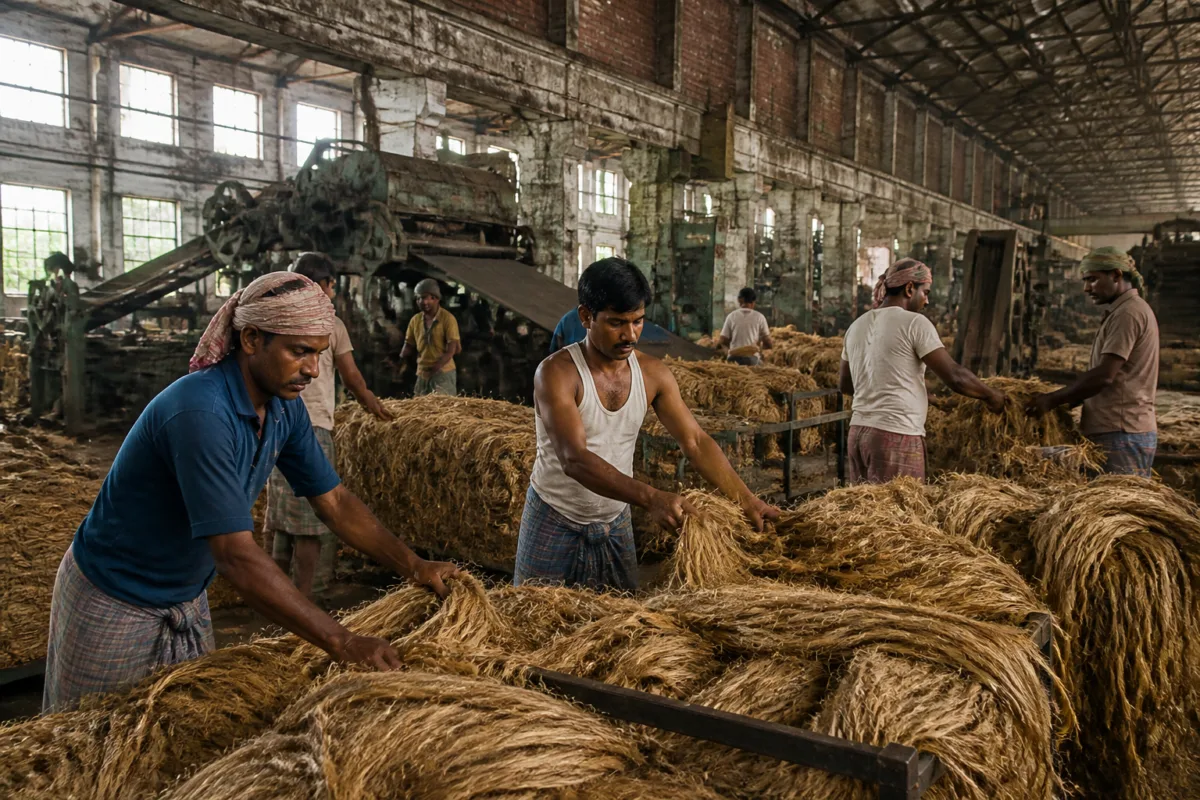
Bengal’s jute industry is facing a sharp raw-material cost squeeze, with prices more than double the minimum support price (MSP), even as north Bengal’s tea growers struggle with prices below the cost of production, a Times of India report said.
Fort Gloster Industries chairperson and former Indian Tea Association chairperson Hemant Bangur told the newspaper that raw jute was trading at around Rs 12,500-Rs 13,000 a quintal, compared with an MSP of about Rs 5,900-Rs 6,000. The gap is benefiting growers who can hold out for higher prices but is raising costs for mills.
West Bengal has 82-83 jute mills, producing about 12 lakh tonnes of processed jute and employing 10-11 lakh workers, according to the report. The state grows about 40% of India’s raw jute and accounts for more than 95% of the country’s eco-friendly, biodegradable jute bags used for packaging, Sarda group chairperson Ghanshyam Sarda said.
Sarda estimated the jute economy at approximately Rs 30,000 crore and said it supports more than 12 lakh mill workers and their family members. More than 10 lakh farmers and their families are also involved in raw jute, according to his account.
The present squeeze is linked to limited availability after mills entered the season with low raw-jute inventories. Jute experts told the newspaper that a regulator’s order last year requiring traders to hold zero stock contributed to an empty pipeline. The new crop may therefore replenish depleted inventories rather than create a substantial surplus.
Indian Jute Mills Association chairperson Raghabendra Gupta said the problem began in 2025-26, when raw-jute prices rose to three times the MSP before easing to their current level of more than double the MSP. He attributed the increase partly to last year’s low crop.
The industry is seeking stronger action against hoarding and clearer stock controls. Ganges Jute director Abhishek Poddar expects the Centre to start an anti-hoarding drive and set a stock limit for jute. Sarda also called for strict surveillance by central agencies, warning that prolonged supply pressure could hurt manufacturers and the state economy.
The pricing problem is different in north Bengal’s tea industry. Producers are reportedly selling below the cost of production, and the crop does not have an MSP mechanism equivalent to the one for raw jute. At growers’ request, the Tea Board has sent the Union commerce ministry a proposal for a minimum sustainable price.
Bangur said tea’s main difficulty was the limited number of buyers at auctions, describing the market as concentrated. He said around 10-11 buyers purchase more than half of India’s tea. India produces about 1,370 million kg of tea and consumes around 1,100 million kg domestically, according to the report.
Together, the two cases show how different market structures can create opposite pressures across agricultural and manufacturing chains. Jute farmers have an incentive to delay sales when market prices rise well above the MSP, while mills face higher input costs and potential disruption. Tea growers, by contrast, are seeking a minimum sustainable price because market returns are reportedly below production costs.
For Bengal, the immediate stakes extend beyond farm incomes. Jute mills are significant employers and supply packaging products positioned as biodegradable alternatives. Any prolonged disruption could therefore affect workers, manufacturers and buyers dependent on jute products. The Tea Board’s proposal and any central action on jute stocks will determine whether the two sectors receive institutional responses to their contrasting price problems.

