


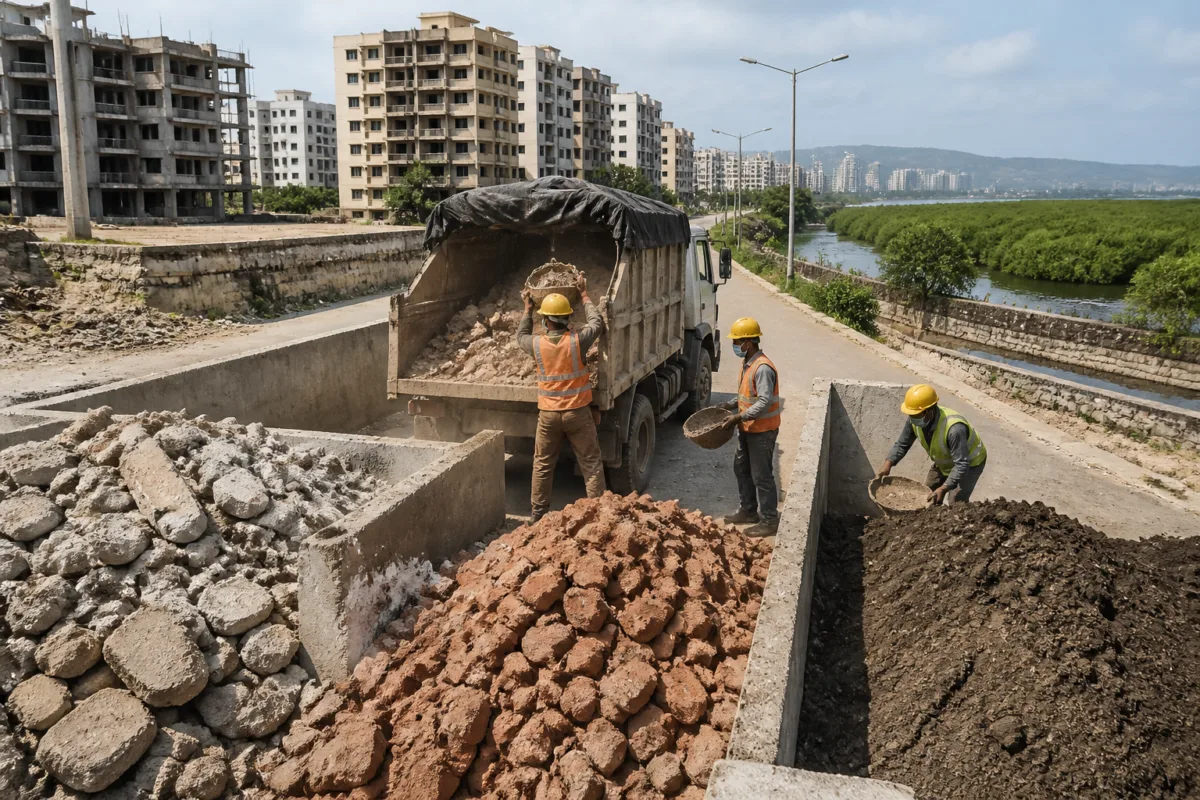
Navi Mumbai’s construction and demolition (C&D) waste management system is under scrutiny after the Maharashtra Pollution Control Board (MPCB) referred a citizens’ complaint to the Navi Mumbai Municipal Corporation (NMMC), seeking corrective action and an action-taken report.
The complaint, filed by Sajag Nagrik Manch through the Maharashtra government’s Aaple Sarkar grievance portal, alleges that residents do not have a clearly defined and accessible mechanism to dispose of debris generated during home renovations, repairs and redevelopment projects.
The organisation has asked the civic body to clarify the location of authorised collection centres, processing and recycling facilities, permitted transporters and the procedures available to residents handling smaller quantities of construction waste. It said its questions were raised after an earlier Right to Information application did not produce satisfactory information.
An MPCB officer forwarded the grievance to NMMC’s Environment Department and directed the civic body to examine the matter, take appropriate action, inform the complainant and submit a copy of its action-taken report to the Board. The supplied report does not state whether NMMC has submitted that report or announced any new disposal arrangements. Repeated attempts to contact an NMMC official were reported to have gone unanswered.
The issue is significant because Navi Mumbai is experiencing redevelopment, demolition and infrastructure activity that generates substantial quantities of construction debris, according to the complaint. Sajag Nagrik Manch warned that unclear procedures and inadequate facilities could encourage illegal dumping in wetlands, mangrove areas, creek-side locations, vacant plots and natural drainage channels.
Such dumping can create more than a cleanliness problem. Debris placed in drainage channels can obstruct stormwater movement, while disposal near wetlands, mangroves and creeks can place additional pressure on environmentally sensitive areas. The complaint, however, presents these as risks associated with gaps in the current system; the report does not provide an independently verified assessment of the scale of illegal dumping or environmental damage.
The organisation has called for an integrated C&D waste management policy covering NMMC and areas administered by the City and Industrial Development Corporation (CIDCO). Its proposals include authorised debris collection centres, processing and recycling facilities, and a “Debris on Call” service through which residents could arrange legal collection from household repair and renovation sites.
It has also sought an online permission and digital-pass system to track debris transport, mandatory waste-management plans for large construction and redevelopment projects, and digital records for debris generated by government agencies. These demands point to a broader accountability question: residents and project owners need to know who is authorised to collect construction waste, where it can be taken and how its final disposal or processing can be verified.
Pradeep Kashalkar of Sajag Nagrik Manch said the absence of an effective official debris-management system was a concern for a city recognised as the cleanest in the country. He argued that cleanliness standards should include scientific management of construction waste, rather than focusing only on roads and public spaces.
The MPCB referral gives the complaint a formal administrative route, but the next stage will depend on NMMC’s response and the contents of its action-taken report. Until the civic body publishes clear procedures, facility details and accountability arrangements, residents undertaking small repairs and larger redevelopment projects may continue to face uncertainty over lawful debris disposal.

