


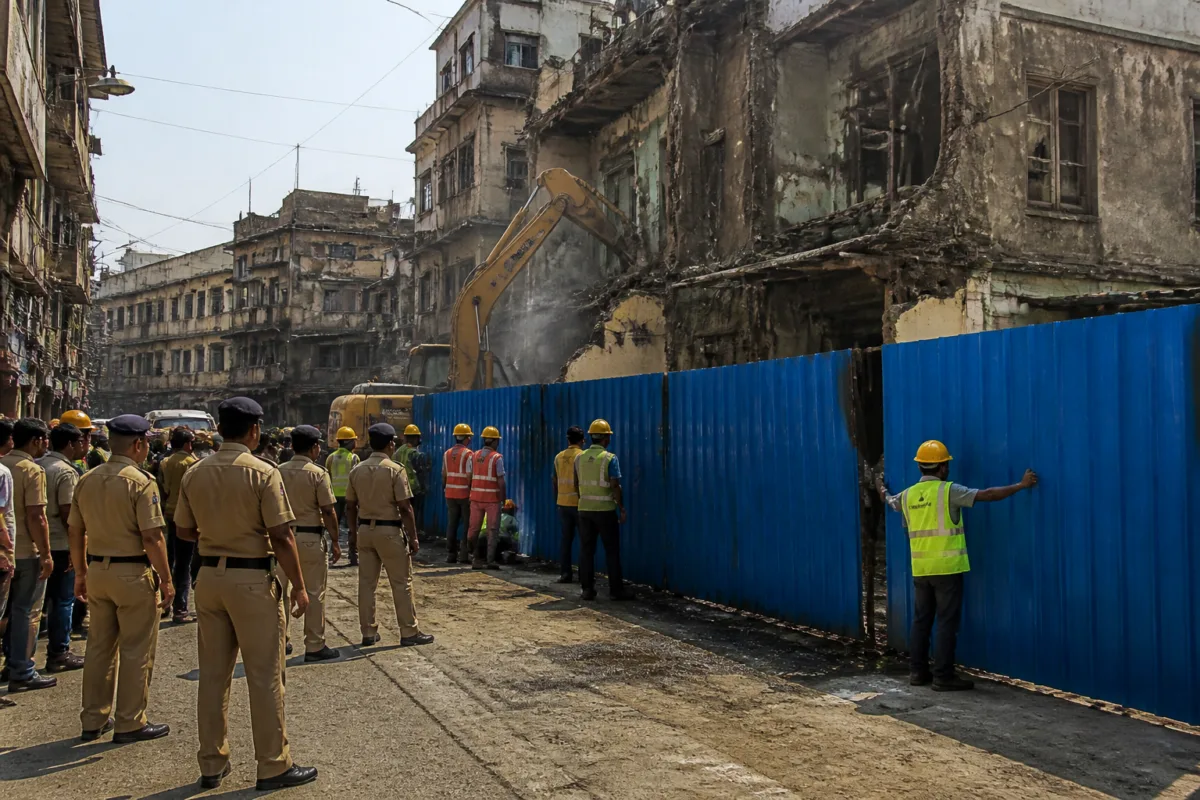
The Brihanmumbai Municipal Corporation has begun demolishing the dilapidated Haji Ismail Haji Habib Musafirkhana building on Pakmodia Street in Mumbai’s Bhendi Bazaar, bringing renewed attention to how the civic body identifies and acts against dangerous or unauthorised structures.
BMC officials said the building was classified as C1, a category indicating that it was dangerous and required demolition. The work proceeded peacefully under heavy police security, with BMC staff and police personnel deployed at the site. The structure was enclosed with blue tin sheets during the operation.
The building is also associated with Dawood Ibrahim and his family, who lived there in the 1970s. That history has drawn attention to the demolition, but the civic significance of the action lies in the building’s reported condition and its classification under the BMC’s dangerous-structure framework.
The demolition comes alongside figures obtained under the Right to Information Act that raise broader questions about the BMC’s enforcement capacity. According to a ward-wise summary report prepared by the civic body’s Encroachment and Removal Department on October 26, 214,917 complaints were registered through the Realtime Encroachment Management System between March 1, 2016, and October 26, 2026.
Of these complaints, 116,228 were classified as duplicates. The remaining 98,689 complaints included 29,916 cases in which demolition was deemed necessary. Action had been completed in 13,211 cases, equivalent to about 6.15 per cent of all complaints registered through the system.
The Realtime Encroachment Management System was introduced on March 1, 2016, to allow citizens to report unauthorised constructions. The RTI information was sought by activist Shakeel Ahmed Shaikh from the BMC’s Encroachment and Removal Department, Eastern Suburbs.
The number of complaints classified as duplicates is a significant part of the enforcement picture. The available report does not explain the criteria used for that classification, leaving open questions about how repeated, related or overlapping complaints are filtered before cases move towards inspection and action.
The figures also distinguish between complaints, cases where demolition was considered necessary and demolitions actually completed. That distinction is important for interpreting the data: a complaint does not automatically establish that an unauthorised structure exists or that demolition is legally warranted. However, the gap between the 29,916 cases identified as requiring demolition and the 13,211 cases in which action was completed indicates a substantial enforcement backlog in the reported records.
The issue has significance for Mumbai’s neighbourhoods because dangerous buildings, unauthorised additions and encroachments can affect access, fire safety, structural security and the functioning of public spaces. The source report referred to previous deadly incidents involving structures and establishments in the city, including the Kamala Mills compound fire, the Bhanu Farsan Mart fire, the Hotel City Kinara fire, the Hussaini building collapse in Bhendi Bazaar and the Sai Siddhi building collapse in Ghatkopar.
The Bhendi Bazaar demolition therefore illustrates two linked aspects of urban enforcement: the need to remove individual structures classified as dangerous, and the need for a transparent system to process the much larger volume of citizen complaints. The available information confirms the demolition and the RTI figures, but does not provide the BMC’s explanation for the duplicate classifications, the reasons for pending demolitions or a ward-level breakdown of completed action.

