


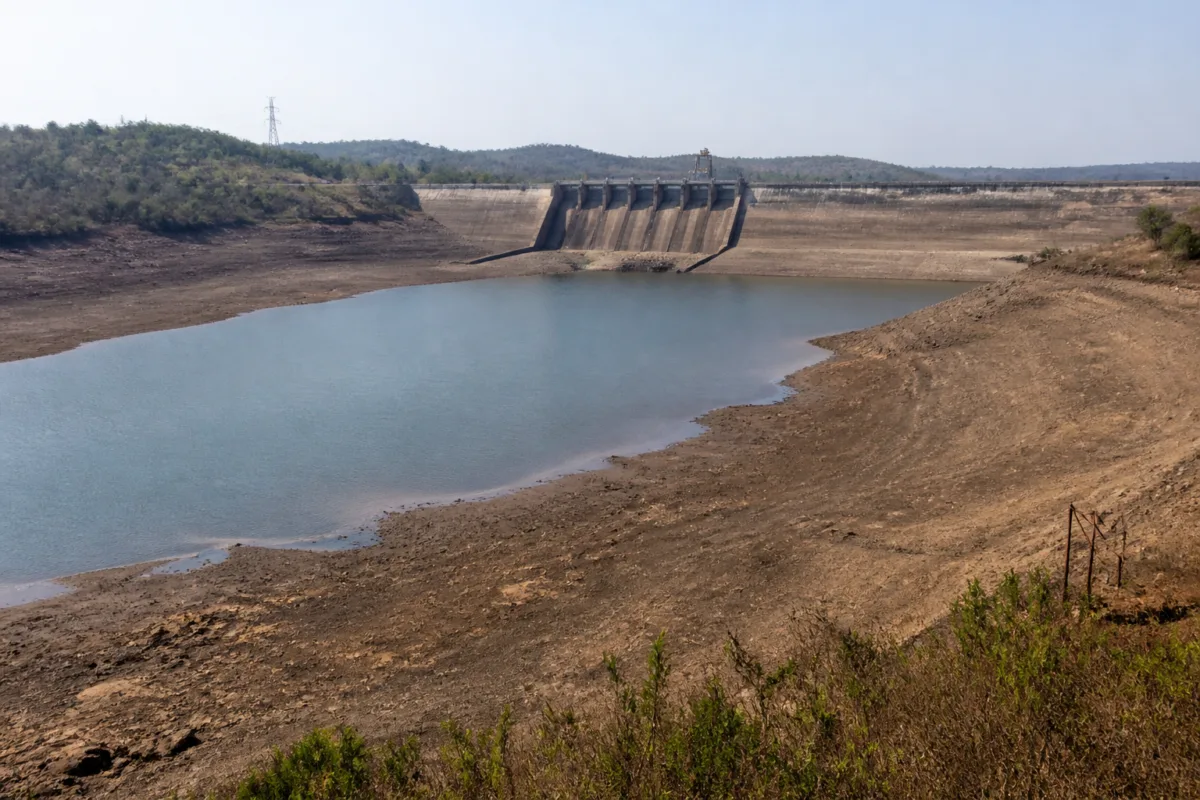
Usable water storage in reservoirs across Maharashtra’s Amravati and Nagpur revenue divisions has fallen to roughly half of planned capacity, according to a Water Resources Department report cited by Loksatta. The decline is particularly sharp in reservoirs that supply Nagpur and Amravati, raising concern about water availability later in the financial year.
The two divisions together have 670 large, medium and small projects with a planned storage capacity of 8,710 million cubic metres. The available usable storage is reported at 4,684 million cubic metres, placing the combined level in the 51–55% range. During the same period last year, storage in Vidarbha’s reservoirs was close to 90%.
Amravati division has 283 projects with 2,061.53 million cubic metres of water remaining, equivalent to 51.65% of project capacity. The corresponding level last year was 90.55%.
The figures are significant for urban water planning because the Upper Wardha reservoir, which supplies Amravati city, is reported to have only 40.69% storage. The comparable level last year was 98.85%.
Nagpur division has a somewhat higher aggregate level, but it has also recorded a substantial year-on-year decline. Its 387 projects hold 2,622.69 million cubic metres, or 55.58% of capacity. Storage in the division’s 16 large projects stands at 56.98%, compared with 89.38% last year.
The Totladoh reservoir, which supplies Nagpur city, has 21.75% storage, against 99.53% during the same period last year. The Bawanthadi project in Bhandara district has 16.52% storage, according to the report.
These numbers indicate that the position of individual supply reservoirs can be considerably weaker than the division-wide average. For city administrations and water utilities, that distinction matters: aggregate regional storage does not necessarily reflect the reserve available to a particular urban distribution system.
The report attributes the decline to the current storage position and warns that Vidarbha could face water scarcity during summer. It does not provide details on municipal supply schedules, reservoir-release plans, rainfall forecasts, emergency allocations or conservation measures. Those institutional steps will determine how the lower storage levels translate into household, commercial and industrial water availability.
The year-on-year comparison also shows why reservoir monitoring needs to be read alongside city-level water planning. A fall from nearly full storage to between one-fifth and two-fifths in reservoirs serving major cities leaves less operational flexibility if inflows remain weak. The available data establish the scale of the storage decline, but further official information is needed on projected demand, allocations and contingency planning for Nagpur and Amravati.

