


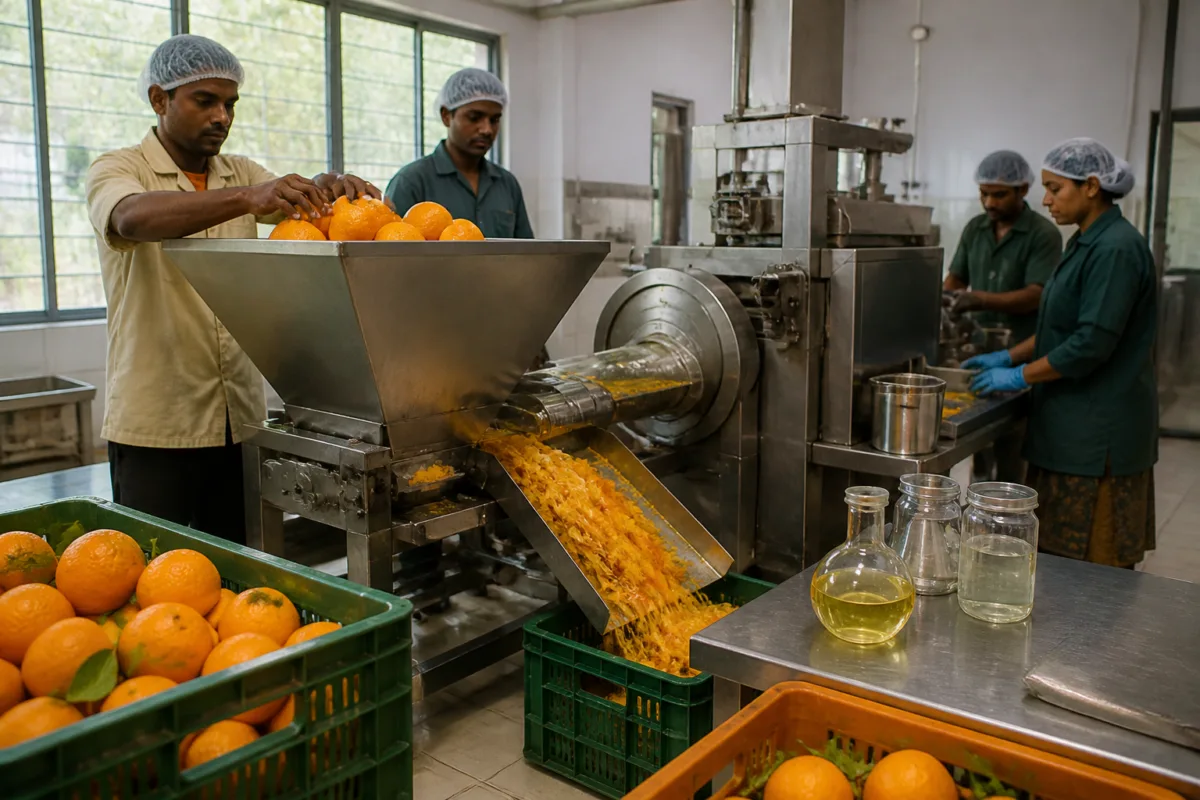
Orange peel processing technology developed by Visvesvaraya National Institute of Technology (VNIT), Nagpur, has received a patent, according to a report by Loksatta. The technology is designed to recover aromatic oil and other value-added products from orange peels, including fruit that is damaged, fallen or likely to fetch a low market price.
The process was developed by VNIT’s Swaha Centre of Excellence, with a project led by Professor Sachin Mandavgane of the institute’s chemical engineering department. The project received financial support from the Department of Science and Technology. Dr Lakshmi Zhadgaokar and Pratik Shinde also contributed to the technology, the report said.
Unlike conventional processing methods that may use high temperatures or pressure, the VNIT process extracts aromatic oil without either, according to the report. The claimed benefit is that the oil retains its natural fragrance and chemical properties while producing a low-moisture, high-purity output.
The system is designed to process whole oranges through a hopper, without requiring the peel to be removed separately first. Along with aromatic oil, the process produces fibrous material from the peel. Juice that is not suitable for consumption can be used to produce hydrosol and fermented liquid, allowing multiple products to be obtained from a single fruit.
A trial was conducted at Anagondi in Katol taluka of Nagpur district. Loksatta reported that the technology was tested on groups of 1,000 oranges each. VNIT developed the technology in 2024 and subsequently applied for a patent, which has now been granted, the report said. The project also received an excellent rating from an evaluation committee.
The reported process points to a possible decentralised model for orange-growing regions, where processing units could handle fruit that is unsuitable for fresh sale and convert peel waste into industrial inputs. Such a model could link agricultural production with small-scale processing and rural entrepreneurship while reducing the volume of organic material discarded after sorting or consumption.
However, the report does not establish the technology’s commercial cost, processing capacity, energy use, product yields, regulatory approvals or market demand for the oil and other outputs. It also does not state whether a commercial plant has been commissioned or whether the patent has been licensed. The immediate significance of the development is therefore as a patented processing option and a potential waste-to-value pathway, rather than as evidence of an operating industry at scale.

