


Odisha’s governance partnership with Development Innovation Lab-India (DIL-India), under the University of Chicago Trust, will focus on improving public-service delivery through research, technology and evaluation under a two-year memorandum of understanding signed on Wednesday.
The agreement was signed at Lok Seva Bhawan by Subhashree Nanda, additional secretary in the planning and convergence department, and Leni Chaudhari, executive director of the University of Chicago Trust. Chief secretary Anu Garg, development commissioner-cum-additional chief secretary Deoranjan Kumar Singh and other senior officials were present.
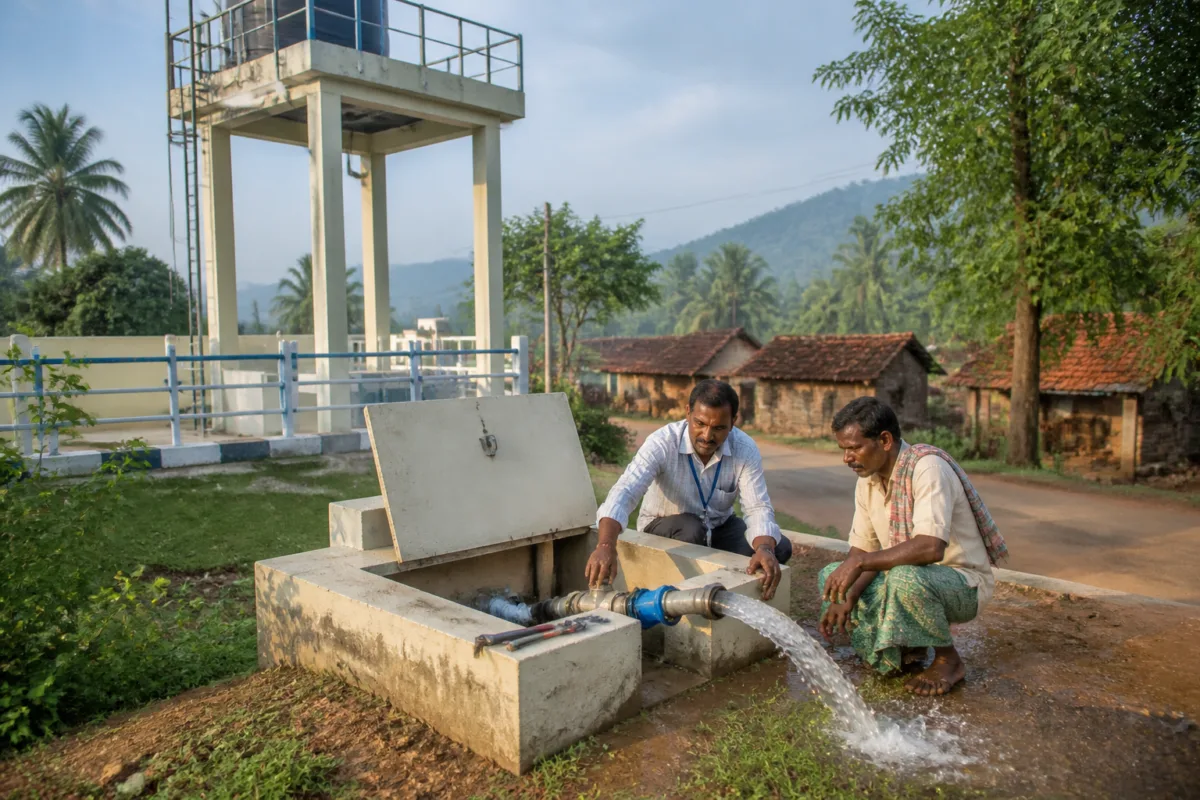
According to the state government, DIL-India will provide technical and research support to identify, test and scale innovations linked to Viksit Odisha Vision 2036 and 2047. The initial areas include localised weather advisories for farmers, safe drinking-water systems in rural piped-water schemes, and policy monitoring based on rigorous evaluation and data-driven analysis.
The weather-related work is expected to build on AI-based monsoon forecasting under the Krushi Samruddhi initiative and the KRUSHI 360 framework. The stated objective is to provide more localised agro-advisories and heat forecasts. The partnership will also support in-line chlorination in rural water-supply schemes through training and monitoring, the government said.
The water component is significant for the operation of rural piped-water systems, where treatment, monitoring and reliable service delivery are essential to maintaining safe supplies. However, the report does not provide targets for the number of schemes or households to be covered, baseline water-quality data, or a timetable for implementation.
Garg said the collaboration would strengthen data-driven governance and climate resilience. Singh said the technical assistance and research could later be extended to other departments. DIL-India officials said innovations would be tested and refined before being considered for wider implementation.
A steering committee headed by the development commissioner-cum-additional chief secretary will oversee the collaboration. It will review implementation and evaluation progress through meetings held twice a year. The committee’s role will be important in determining whether the proposed pilots produce measurable improvements before any broader scale-up across Odisha.

