


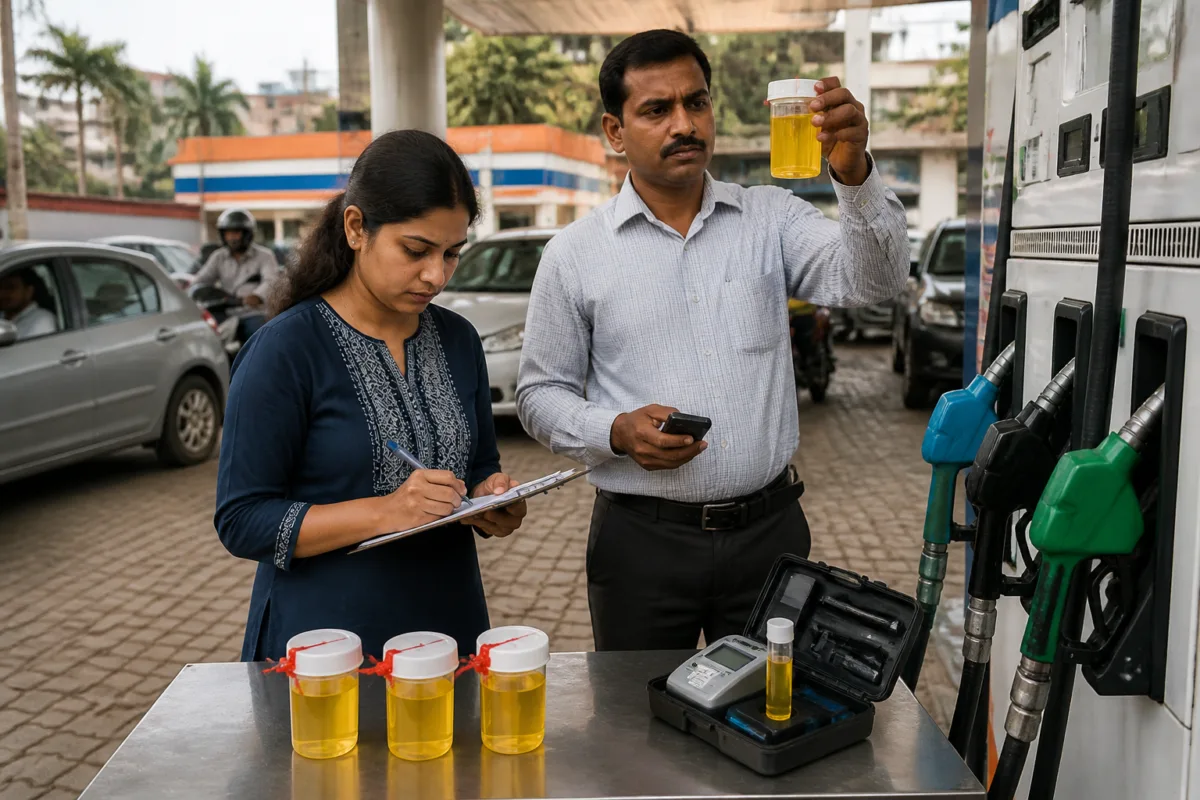
Karnataka has asked the Union government to review its E20 petrol programme after state-commissioned tests reportedly found ethanol levels above 20% in several fuel samples, renewing questions about fuel standards, testing and vehicle compatibility.
In a letter to Union petroleum minister Hardeep Singh Puri, Karnataka food, civil supplies and consumer affairs minister Rizwan Arshad said the state supported ethanol blending but opposed over-blending. He said the transition required fuel infrastructure and vehicles that were compliant with higher ethanol content.
According to the letter, state officials inspected 63 outlets operated by Indian Oil Corporation, Bharat Petroleum Corporation, Hindustan Petroleum Corporation and Mangalore Refinery and Petrochemicals in September. Samples were sent to laboratories operated by three public-sector oil marketing companies. Reports had been received for 42 samples, but none stated the ethanol content, the state said.
The oil companies reportedly told Karnataka that research octane number was the compliance parameter, while acknowledging that Indian Standard IS 17021 requires ethanol content to be measured. The state also said the companies questioned the sampling procedure and sample density. Karnataka rejected that objection, saying officials had followed Clause 8 of the Motor Spirit and High-Speed Diesel Order, 2005, and handed over sealed counterpart samples at the outlets.
Fresh samples sent to laboratories accredited by the National Accreditation Board for Testing and Calibration Laboratories produced a wider variation, according to Arshad. Of 14 samples tested, 11 reportedly contained more than 20% ethanol. The highest level was stated to be above 31%, while the lowest was 13.5%. The state said higher ethanol levels were also detected in premium petrol sold at prices ranging from Rs 120 to Rs 140 a litre.
Arshad said the inspections appeared to have had a deterrent effect and that the blend may since have been corrected, but called for continuous checks. Karnataka has sought clearer fuel labelling, an E10 option, regular testing and compensation, according to the report.
The minister also opposed two notifications concerning fuel dispensers. One, dated December 18, 2025, doubled verification intervals from 12 months to 24 months. Another, dated May 8, 2026, allowed government-approved private centres to verify dispensers, a function previously carried out by government inspectors. A legal metrology survey cited by the state found 101 outlets dispensing fuel beyond the permissible error.
Karnataka said any correction to the E20 programme should provide adequate time and support for upgrading vehicles, fuel infrastructure, dispensers, storage systems and testing facilities. It urged the Union government to consult states before proceeding.
The state’s account was challenged by Murugesh R Nirani, a senior BJP functionary and former minister. He dismissed the claim that samples contained up to 31.2% ethanol, alleging that the testing methodology was flawed. Nirani said sampling should include representatives of fuel outlets, oil marketing companies, the state food and civil supplies department and the Union government.
The competing claims leave the accuracy of the reported ethanol levels and the sampling process unresolved. The dispute nevertheless places fuel quality monitoring, dispenser verification and the readiness of vehicles and supply infrastructure at the centre of Karnataka’s request for a review of the E20 rules.

