


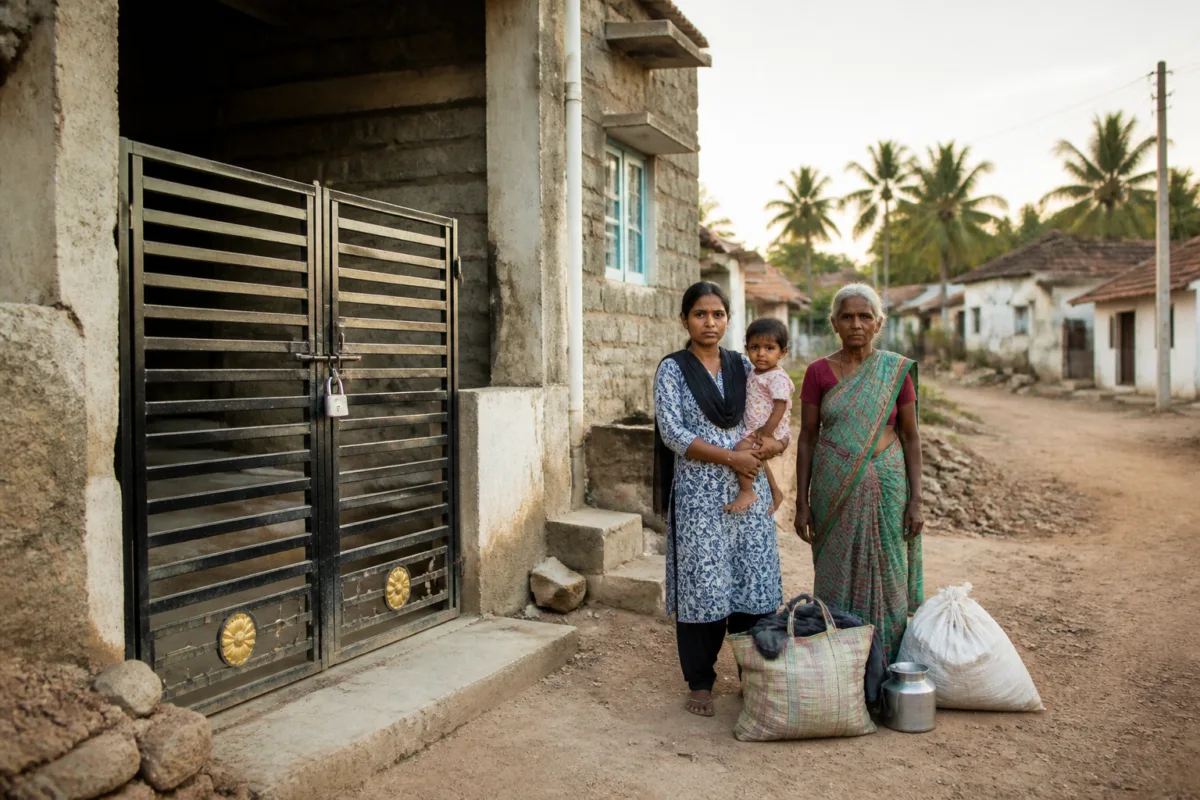
Families in parts of Jagalur taluk of Karnataka’s Davanagere district have reportedly been left without a place to live after finance companies sealed their homes over unpaid loan instalments, with one case prompting the district administration to intervene.
Residents of Honnamaradi, Marenahalli and Jagalur Gollarahatti villages told Prajavani that lenders had locked or sealed their houses after repayment defaults. The families said they were living outdoors or in small structures outside their homes while coping with financial distress linked to drought conditions.
Sakkamma of Honnamaradi said her late husband, Gudibandheppa, had mortgaged their house to borrow ₹5 lakh for household needs. She said ₹1.70 lakh had been covered by insurance and that she had repaid 18 instalments before being unable to pay for two months. According to her account, finance-company staff later sealed the house.
Sakkamma said her daughter, who has recently given birth, and a newborn grandchild were staying with the family in a small bathing room outside the locked house. She expressed concern about the child’s exposure to cold and wind.
Gowramma of Marenahalli told the newspaper that she had also borrowed ₹5 lakh to build a house and had stopped paying 10 instalments after the family’s financial situation deteriorated. She said finance-company representatives accompanied by police came to the house about 15 days before the report and locked it. The family was subsequently living by the roadside, she said.
The reported seizures have drawn attention because they occurred amid drought conditions and an alleged government direction against forced recovery of loans from farmers. Local residents alleged that financial institutions were misusing powers available under the Securitisation and Reconstruction of Financial Assets and Enforcement of Security Interest Act, 2002, commonly known as the SARFAESI Act. The allegation was reported by Prajavani and was not independently examined in the account.
The Act provides a legal framework for enforcement of security interests and recovery of secured loans. The report said local residents alleged that the process was being used against poor rural households without adequate safeguards. The specific legal status of each loan, the notices issued to the borrowers and the orders authorising the sealing of the houses were not provided in the report.
One case led to a reported intervention by Davanagere Deputy Commissioner G. M. Gangadharaswamy. The district administration called Gowramma and a representative of the finance company to the deputy commissioner’s office for discussions, according to R. Keerthikumar, a revenue inspector at the tahsildar’s office.
Keerthikumar said the company had been instructed to give the borrower time to repay the loan and to open the house immediately. The report did not state whether the other affected families received similar directions or whether their homes had been reopened.
The cases show how a repayment dispute can quickly become a housing-security issue when the home itself is pledged as collateral. For families already affected by drought, the loss of access to a house can create additional risks for children, older people and postpartum mothers, while also making it harder to protect household belongings and resume regular work.
The immediate administrative intervention offers relief in at least one reported case, but several questions remain unresolved. These include whether the lenders followed the required notice and possession procedures, whether insurance claims connected to deceased borrowers were processed, and what temporary protection is available to families unable to meet repayments during a drought. The report did not include responses from the finance companies named by the residents or details of any broader district-level review.

