


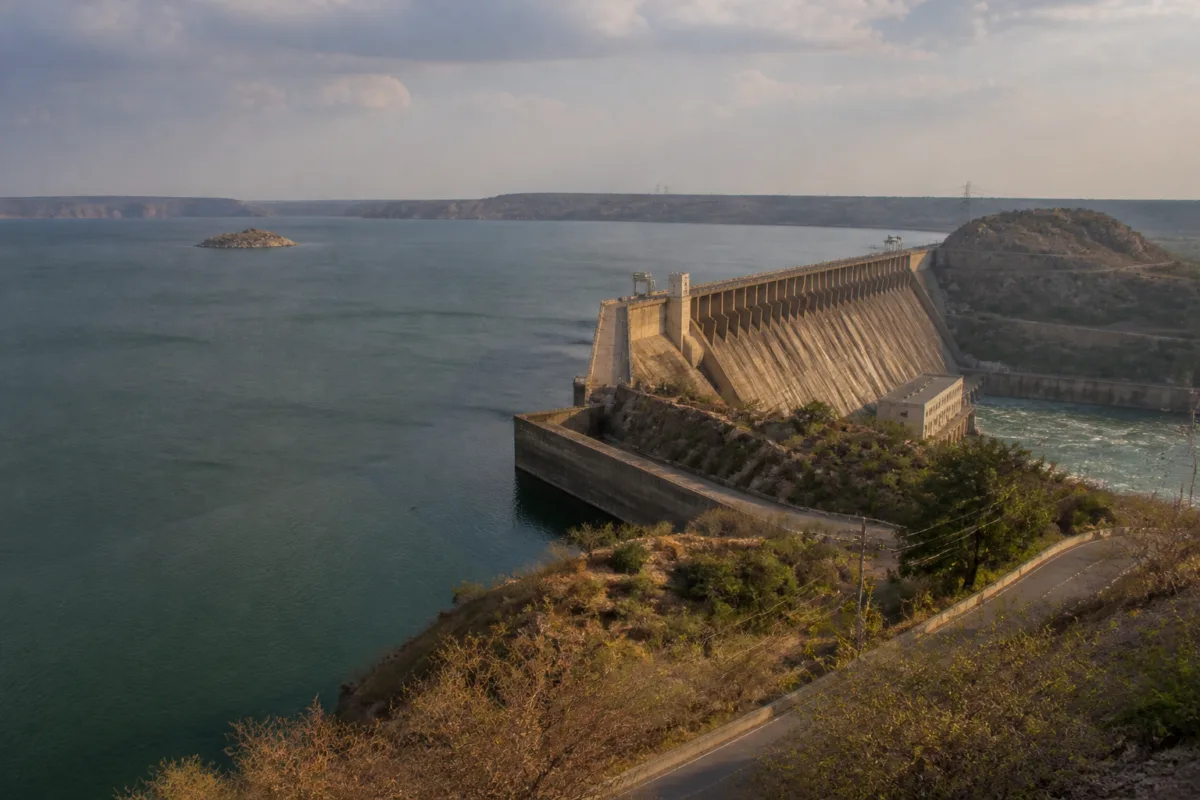
BRS working president KT Rama Rao has alleged that an unauthorised tunnel and pipeline project near Nagarjuna Sagar is being developed to divert Krishna river water to Andhra Pradesh, and has called on the Krishna River Management Board (KRMB) to intervene.
Speaking at a press conference at Telangana Bhavan on Wednesday, Rama Rao alleged that a tunnel was being excavated near Vijayapuri South and that the project could draw about nine thousand million cubic feet (TMC) of water from Nagarjuna Sagar. He claimed that the proposed diversion could include water from below the reservoir’s dead storage level, which he said would threaten Telangana’s irrigation and drinking-water interests.
The allegations have not been independently established in the report. The account also does not include responses from the Telangana government, the Andhra Pradesh government or the KRMB on the alleged construction, its permissions or the proposed water transfer.
Rama Rao alleged that the construction had continued for nearly a year without the necessary approvals. He further claimed that a drinking-water project was being used as a cover for a 1,650-km pipeline network intended to facilitate large-scale diversion. He asked Telangana Chief Minister A Revanth Reddy and irrigation minister Uttam Kumar Reddy to disclose what steps had been taken to stop the alleged works.
He also demanded that the KRMB immediately examine and stop what he described as an unauthorised project. According to the report, Rama Rao said the BRS would approach the Central government, pursue legal action if required and hold public meetings in Nalgonda and Mahabubnagar districts.
The dispute is rooted in the wider contest over the distribution and use of Krishna basin waters between Telangana and Andhra Pradesh. Rama Rao referred to the historical use of the Pothireddypadu head regulator and alleged that Telangana had faced inequitable treatment since the period of united Andhra Pradesh. He also cited the original Eleswaram proposal, which he said envisaged a 161 TMC project with irrigation potential for nearly 10 lakh acres before later changes affected Nalgonda district and Telangana’s interests.
Rama Rao said Telangana had been promised irrigation for 8.8 lakh acres through the Nagarjuna Sagar project, while alleging that Andhra Pradesh received irrigation benefits over a substantially larger area. He asked the Telangana government to disclose whether it had formally approached the KRMB for protection of the state’s water rights and for allocation of the remaining 40 TMC for drinking-water needs.
The demands also cover water allocations for Hyderabad, Mahbubnagar, Nalgonda and Khammam, as well as any formal protest against the alleged Andhra Pradesh diversion. These details are important because the dispute involves both irrigation releases and drinking-water planning, although the report does not provide official allocation records or engineering documents supporting the allegations.
Rama Rao linked the issue to Hyderabad’s reported water stress. He alleged that about 8,000 water tankers were being booked daily in the city and that roughly 2.5 lakh bookings had been made during October. He said the shortage was affecting educational institutions and public services. The report does not include an official assessment of tanker demand or the government’s response to these figures.
He also alleged that nearly 250 TMC of Krishna water had been allowed to flow towards Andhra Pradesh and the sea without adequate operation of irrigation pumps. That claim, like the allegations about the tunnel and pipeline, requires confirmation from official water-release records and the agencies responsible for reservoir management.
The immediate institutional question is whether the alleged works exist, what their approved purpose and design are, and whether any state or inter-state authority has granted permission. A formal response from the Telangana and Andhra Pradesh governments, along with an examination by the KRMB, would be needed to establish the project’s status, expected water demand and possible effect on Nagarjuna Sagar operations. Until then, the claims remain part of a political dispute over Krishna water management rather than confirmed evidence of an active diversion project.

