


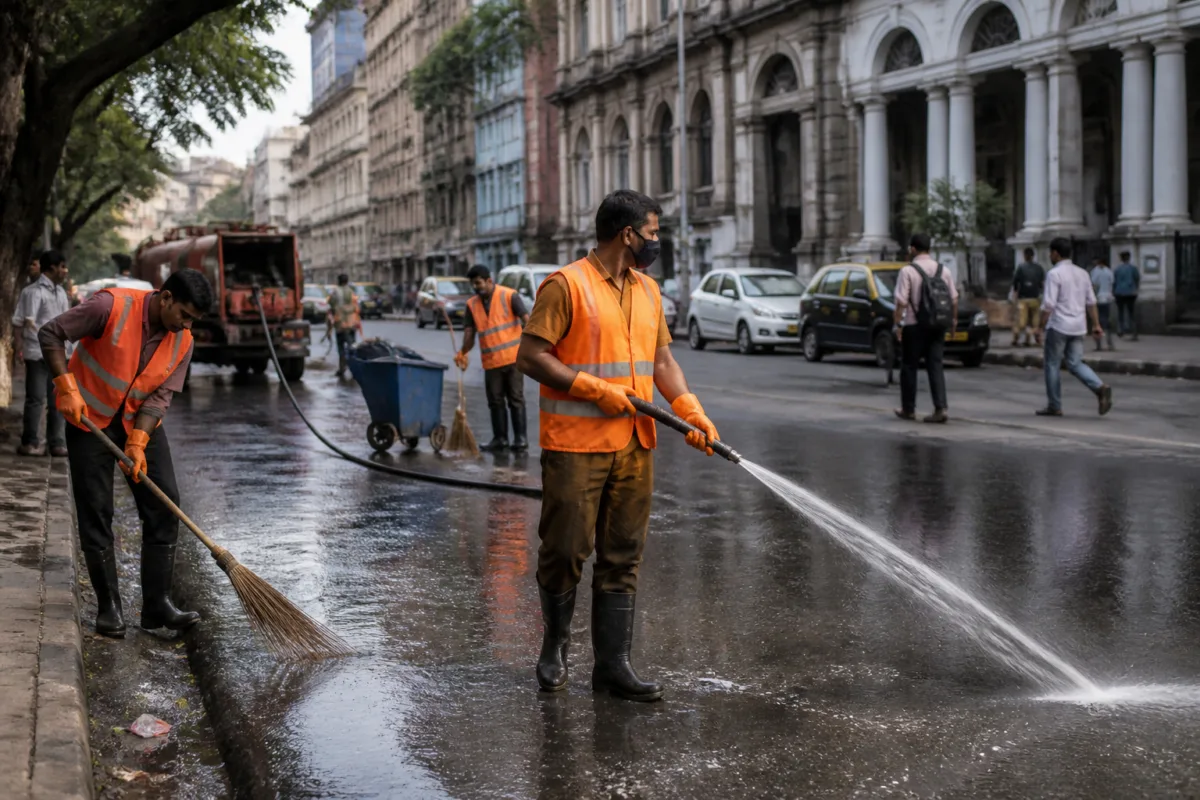
The Bombay High Court has criticised the Brihanmumbai Municipal Corporation (BMC) for cleaning and sprucing up Mumbai’s roads during visits by important guests, questioning why residents should not receive the same civic standards throughout the year.
A bench of Justices Girish Kulkarni and Neela Gokhale cited Ballard Estate in south Mumbai, where roads were cleaned and washed ahead of a visit by important guests. The bench asked why the civic body could not maintain similar standards for citizens across the city instead of carrying out short-term drives.
The observations were made during a hearing on air pollution and toxic gas emissions from the Kanjurmarg dumping ground. The court proposed an internal audit of the entire site within 15 days, with assistance from experts including the National Environmental Engineering Research Institute (NEERI). The proposed audit is expected to examine existing operations, identify shortcomings and recommend measures to control pollution, foul odour and gas emissions.
The bench also called for attention to the timing of activities that could generate foul odour. The court’s concerns relate to the large quantities of waste and plastic accumulated at the site, as well as the movement of plastic waste into the sea and back onto Mumbai’s shores during the monsoon.
The Maharashtra government was asked to clarify its policy on plastic. The bench also suggested considering a complete ban on plastic bags in Mumbai, arguing that reducing plastic generation at source would be preferable to treating waste after it has been produced.
The court further raised concerns over the volume of waste generated in slum areas. According to the report, it observed that nearly 40 per cent of the approximately 3,000 metric tonnes of garbage generated daily came from such settlements. The bench emphasised scientific segregation of waste at source and suggested a pilot project that could later be replicated across Mumbai.
The BMC informed the court that it was undertaking awareness efforts related to segregated waste collection. The bench suggested using television, cinema halls, social media and bus stops for short public campaigns explaining waste segregation and citizens’ role in the process.
The court indicated that it would issue operative directions on these issues. The reported proposals place routine road maintenance, landfill pollution control, plastic reduction and source segregation within the same civic-governance discussion, rather than treating cleanliness as a temporary response to high-profile visits.

