


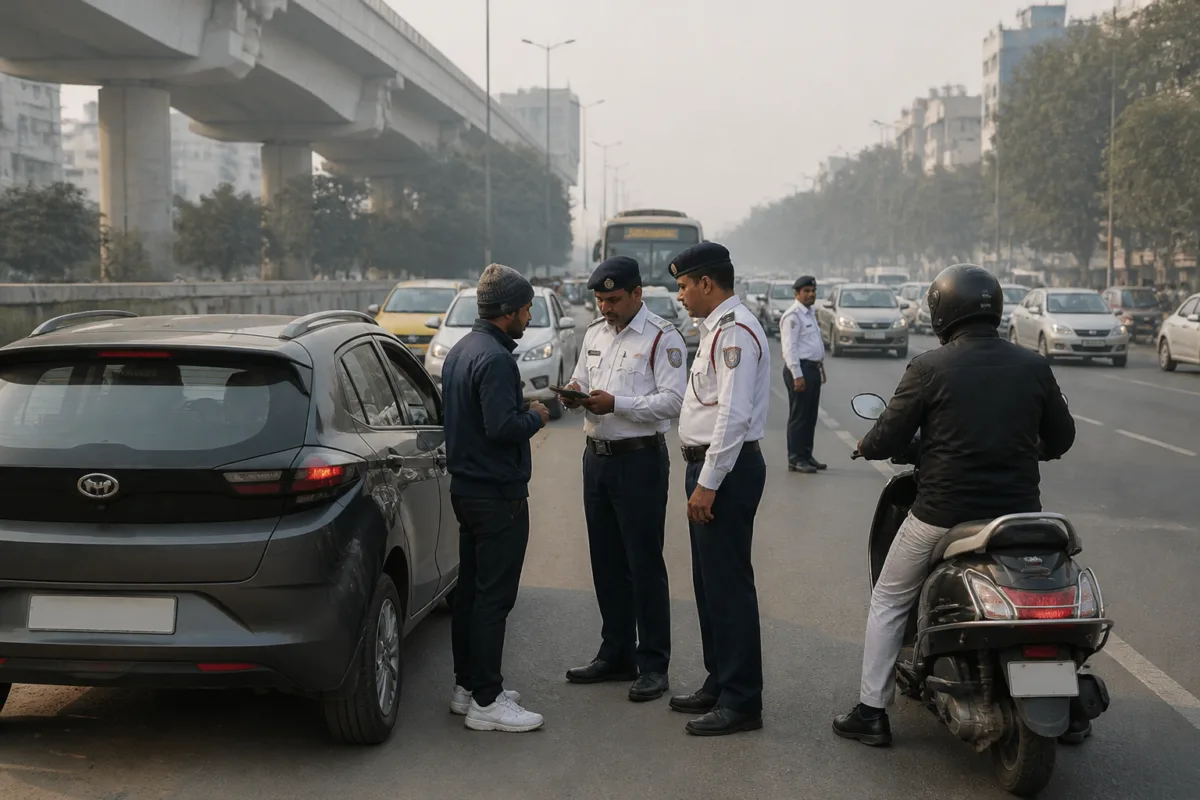
Delhi Traffic Police issued 3,048 Pollution Under Control Certificate, or PUCC, challans during a week-long enforcement drive from November 8 to November 15. The action across the traffic circles of the northern range was linked to directions issued by the Commission for Air Quality Management and rules under the Graded Response Action Plan, placing routine vehicle certification inside the city’s wider emergency air-quality response.
The number is significant not simply because it records a police operation. It shows how Delhi’s clean-air framework reaches motorists: through roadside enforcement, document checks and penalties issued by traffic personnel. It also reveals the administrative distance between a pollution-control rule and the point at which a resident experiences it. For the motorist, the policy appears as a requirement to hold a valid PUCC certificate. For the city, it is one part of an institutional system intended to control emissions from vehicles.
The Times of India report said the drive was conducted across all traffic circles of the northern range. It did not specify how many vehicles were checked, how many traffic personnel were deployed, how many vehicles were found without valid certificates, or whether the challans related to expired, missing or otherwise non-compliant PUCC documents. Those details matter because the total number of challans, by itself, cannot establish the scale of non-compliance across Delhi or the effect of the drive on air pollution.
The report also did not state the value of penalties imposed, the number of vehicles taken off the road, or whether vehicle owners subsequently obtained valid certificates. Without those figures, the 3,048 challans are best understood as an enforcement output rather than a measured environmental outcome. They tell readers how many cases were recorded during the operation, but not how much pollution was prevented or reduced.
That distinction is central to understanding the role of PUCC enforcement. A certificate is an administrative mechanism for checking whether a vehicle meets the applicable pollution standards at the time of testing. A challan records a failure to meet a legal requirement identified during enforcement. Neither figure, without additional information, can show the overall condition of Delhi’s vehicle fleet or the contribution of the drive to ambient air quality.
DCP Sachin Kumar Singhal said special emphasis was placed on creating awareness among commuters about the importance of valid PUCC certificates and their role in controlling vehicular emissions. The statement indicates that the operation had two stated purposes: enforcement and public awareness. This is important because compliance systems depend not only on penalties but also on whether residents understand what is required, where certification can be obtained and why the document is linked to air-quality regulation.
However, the supplied report does not provide evidence on how the awareness component was delivered or measured. It does not say whether officers distributed information, conducted roadside briefings, directed motorists to testing centres or recorded any change in compliance after the drive. As a result, awareness remains an announced objective rather than a demonstrated result in the available evidence.
The reference to the Commission for Air Quality Management and the Graded Response Action Plan places the drive within Delhi’s broader air-pollution governance structure. CAQM directions and GRAP rules provide the regulatory context for actions taken when air quality becomes a serious administrative concern. Traffic police, meanwhile, operate at the enforcement end of that structure. Their role is to identify violations on the road and initiate action against vehicle owners or drivers who do not meet the relevant requirement.
This division of responsibility is a recurring feature of urban environmental governance. One institution frames or directs the response, while another must translate it into thousands of individual interactions across roads, junctions and traffic circles. The effectiveness of the system therefore depends on coordination, clear rules and the ability to enforce them consistently. The report confirms the enforcement action, but it does not provide information about coordination with pollution-control agencies, transport authorities, vehicle-testing centres or municipal bodies.
The geographical reference to the northern range also matters. The drive was not described as a citywide operation covering every traffic unit in Delhi. It was reported as an exercise across the traffic circles of one police range. That makes the figure operationally useful, but limits what can be inferred from it. A total of 3,048 challans in the northern range cannot be treated as a citywide estimate of PUCC violations without comparable figures from other ranges and information about the duration and intensity of enforcement elsewhere.
The report also provides no baseline against which the result can be assessed. There is no previous-week figure, monthly average, year-on-year comparison or breakdown by traffic circle. Without such a baseline, it is not possible to determine whether the drive represented an unusually high level of non-compliance, a normal enforcement pattern or a temporary increase linked to the GRAP-related action. Data of that kind would help distinguish between a one-off campaign and a sustained compliance programme.
That missing context points to a larger institutional question: whether pollution-control enforcement is being treated as a campaign or as a continuous urban service. A week-long drive can identify violations and raise visibility, but the report does not establish whether checks continue at the same level after November 15. Nor does it say whether the authorities plan follow-up inspections, publish compliance data or track repeat violations. Those are the details that would show whether the operation changes behaviour beyond the period of heightened enforcement.
There is also an unresolved citizen-facing question. The report identifies valid PUCC certification as important, but does not explain the compliance pathway for residents whose certificates have expired or whose vehicles fail a test. It does not provide information about the availability of testing facilities, the process for obtaining a certificate, the time required, or the consequences of failing to secure one after receiving a challan. These details determine whether enforcement is experienced as a workable compliance system or only as a penalty mechanism.
The same limitation applies to the environmental claim. The DCP’s statement connects valid PUCC certificates with controlling vehicular emissions, but the supplied material does not quantify the emissions involved, identify the vehicle categories targeted or report any air-quality change following the drive. It would therefore be inaccurate to claim that the operation improved Delhi’s air quality. The evidence supports a narrower conclusion: traffic police conducted a documented enforcement drive intended to strengthen compliance with vehicle pollution-certification requirements under the city’s air-quality response framework.
The 3,048 challans nevertheless provide a useful administrative signal. They show that Delhi’s air-quality response is not confined to large measures such as restrictions on construction, industrial activity or traffic movement. It also operates through routine regulatory checks applied to individual vehicles. That makes enforcement capacity, record-keeping and public communication important parts of urban air governance, even when the immediate action is a traffic challan.
What remains unknown is as important as what has been reported. The available account does not establish the number of vehicles inspected, the proportion found without valid PUCC certificates, the financial value of the challans, the number of repeat offenders, or any measured effect on emissions. It also does not indicate whether similar action was taken across Delhi’s other traffic ranges. Those figures would be necessary to evaluate the reach, consistency and environmental effectiveness of the programme.
For now, the week-long drive confirms that Delhi Traffic Police are using roadside enforcement to implement CAQM directions and GRAP-linked pollution-control requirements. The next meaningful measure of the policy will not be the headline total alone, but whether authorities disclose comparable data over time, explain the compliance process to residents and demonstrate that enforcement extends beyond a single campaign. The available evidence establishes an enforcement action; it does not yet establish its wider air-quality impact.

