


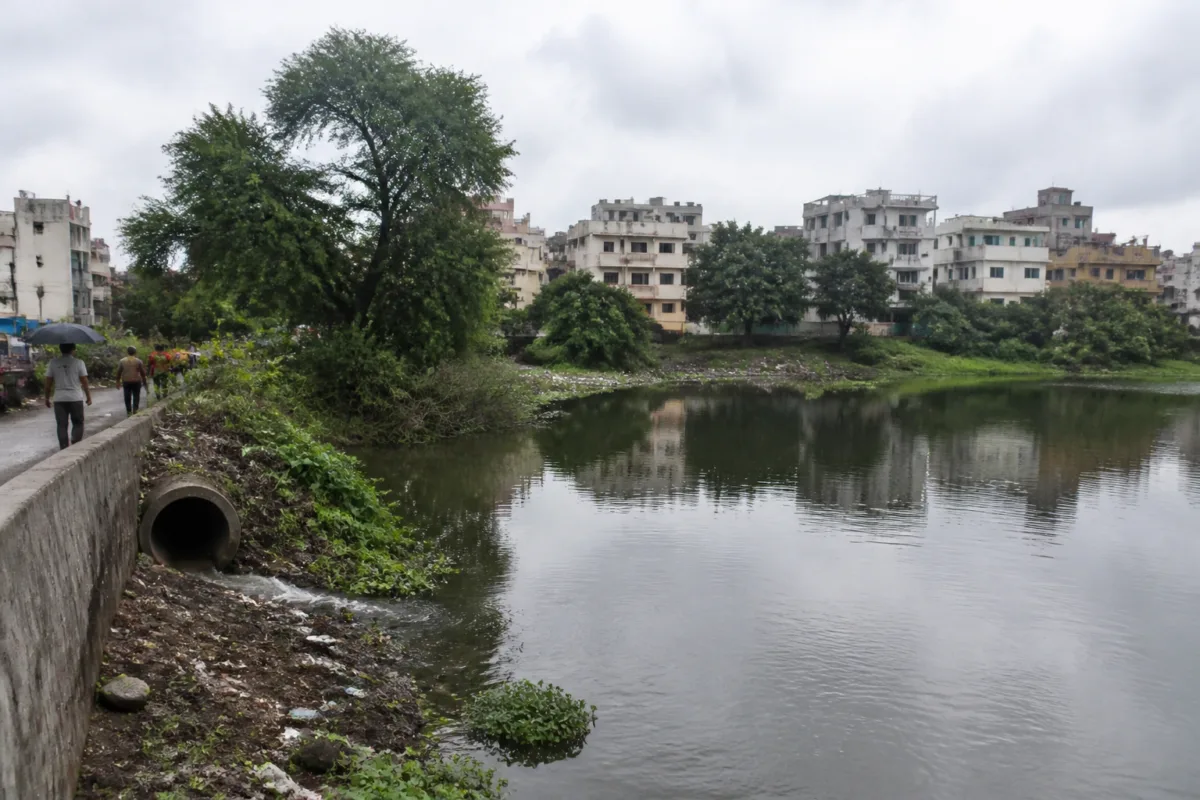
A demand to restore Harantale Lake and remove encroachments from natural drains in Lohgaon, Viman Nagar and Kalwad has exposed a wider urban problem in Pune: water bodies and drainage channels are being treated as separate local complaints rather than as parts of one connected environmental and public-health system. The issues were raised by corporator Aishwarya Surendra Pathare at a Pune Municipal Corporation General Body meeting, where she called for action against pollution, unauthorised construction and the alleged discharge of hotel waste into drains.
The immediate concerns are geographically linked. Harantale Lake is located in Lohgaon, while the natural drains highlighted in the report pass through or affect Viman Nagar, Kalwad and Lohgaon. Pathare sought restoration and beautification of the lake, alongside regular cleaning, desilting and the removal of encroachments from natural drainage channels in Ward No. 3. Her demands place heritage conservation, stormwater management, wastewater control and neighbourhood health within the same civic conversation.
That connection matters because a lake and a natural drain do not function only as isolated sites on a municipal map. They form part of the movement and storage of water through an urban area. When drains are narrowed by encroachments, blocked by waste or used for sewage disposal, the effects can extend beyond the immediate location. The supplied report does not establish the full hydrological relationship between Harantale Lake and the drains, but it shows that local representatives are presenting them as environmental assets requiring coordinated protection.
Harantale Lake’s heritage status is central to the demand for a long-term plan. Pathare said the waterbody was once known as the “Lake of Flowers” and has historical and cultural significance for Lohgaon. She also referred to Lohgaon’s ‘C’ category tourism status, arguing that the area’s historical and natural assets should be conserved rather than allowed to deteriorate.
The proposed response is broader than a one-time clean-up. Pathare called for a detailed assessment of the lake’s water quality, possible mixing of drainage water, unauthorised water extraction, cleanliness and biodiversity. She also sought a conservation and rejuvenation plan covering regular cleaning, beautification and long-term measures to maintain water quality and protect the ecosystem.
This list is significant because it identifies several different administrative problems. Water-quality testing is a technical and monitoring function. Investigating drainage-water mixing requires examination of connections between sewage lines, stormwater channels and the lake. Controlling unauthorised extraction involves enforcement and oversight. Cleaning and desilting require recurring municipal operations, while biodiversity protection and beautification involve longer-term planning. Treating all of these as a single beautification project would leave important questions unanswered.
The drainage issue carries a similar institutional complexity. Pathare alleged that some hotels in Viman Nagar were directly discharging food waste and wastewater into natural drains. She also said sewage water was entering drains at certain locations. The report does not identify the establishments, quantify the discharge or provide an official inspection finding. Those claims therefore remain allegations attributed to the corporator, rather than independently established findings in the supplied material.
Even with that limitation, the alleged practice points to a basic urban-management challenge: the gap between the existence of environmental rules and the capacity to enforce them at property level. Waste from hotels, sewage connections, drain maintenance and encroachment control may involve different civic departments or enforcement mechanisms. A lasting response would require those responsibilities to be aligned, although the report does not specify which departments have been assigned action or whether inspections have begun.
Pathare linked the condition of the drains to public-health concerns and informed the General Body that more than 100 dengue cases had reportedly been detected in Viman Nagar over the preceding two months. The supplied report does not identify the health department’s data source, define the affected area or establish a causal connection between the reported cases and the drains. That distinction is important. Poor drainage and stagnant water can be public-health concerns, but the report itself does not prove that the alleged pollution caused the reported dengue cases.
The episode nevertheless shows how environmental degradation is experienced at street level. Residents encounter foul smells, unhygienic conditions, waste-filled channels and potentially stagnant water as one combined neighbourhood problem. Administrative systems may divide these into sanitation, public health, stormwater, building regulation and environmental complaints. For citizens, the boundaries are less visible. A response that addresses only one part can leave the underlying condition unchanged.
The call for permanent measures is therefore the most important element of the intervention. Pathare said temporary action would not be sufficient and urged the concerned departments to complete the necessary work at the earliest. In practical terms, the demands described in the report imply a shift from event-based cleaning to recurring management: routine water-quality assessment, drain inspection, desilting, waste-disposal enforcement and action against encroachments.
The report provides no evidence that such a coordinated programme has been approved, funded or scheduled. It also does not state whether the PMC has carried out a technical assessment of Harantale Lake, identified the source of wastewater entering the drains or issued notices to the hotels mentioned in the allegation. These are not minor details. Without them, it is difficult to distinguish between a civic announcement, an inspection exercise and actual implementation.
The governance question is especially relevant because natural drains are often vulnerable to incremental encroachment. A channel may remain visible in parts while its width, flow or connection to other drainage paths is reduced elsewhere. The supplied material does not document the extent or age of encroachments in Ward No. 3, so no conclusion can be drawn about the scale of the problem. It does, however, identify encroachment removal as a specific demand before the municipal General Body.
Similarly, lake restoration can mean different things. It may involve removing accumulated waste, preventing sewage inflow, stopping unauthorised water extraction, improving the surrounding public space or restoring ecological functions. Pathare’s request for a detailed assessment suggests that the lake’s problems have not yet been reduced to a single cause. The call for biodiversity protection also indicates that the proposed intervention is intended to go beyond visual beautification.
Lohgaon’s tourism classification adds another layer to the debate. If the area’s heritage and natural assets are part of its tourism identity, deterioration has implications for both conservation and the public use of the neighbourhood. But the report does not provide a tourism plan, visitor data, budget allocation or heritage-management framework. The classification can support the case for attention, but it does not by itself guarantee restoration or protection.
What the available evidence confirms is narrower and more important than a promise of transformation. A municipal representative has formally raised the condition of Harantale Lake and natural drains before the PMC General Body. She has sought a lake assessment, a conservation and rejuvenation plan, removal of drain encroachments, regular cleaning and desilting, proper disposal of hotel waste, and action against establishments allegedly releasing untreated wastewater. She has also connected the issue to reported dengue cases in Viman Nagar, while the supplied report does not independently verify that link.
The next test is administrative follow-through. The key developments to monitor are whether the PMC conducts the requested water-quality and drainage assessment; whether it identifies and acts against unauthorised discharge and encroachments; whether a funded conservation plan for Harantale Lake is prepared; and whether health and sanitation authorities verify the reported dengue figures. Until those steps are documented, the story remains a clear warning about the vulnerability of Pune’s urban water systems, but not evidence that a permanent solution has begun.

