


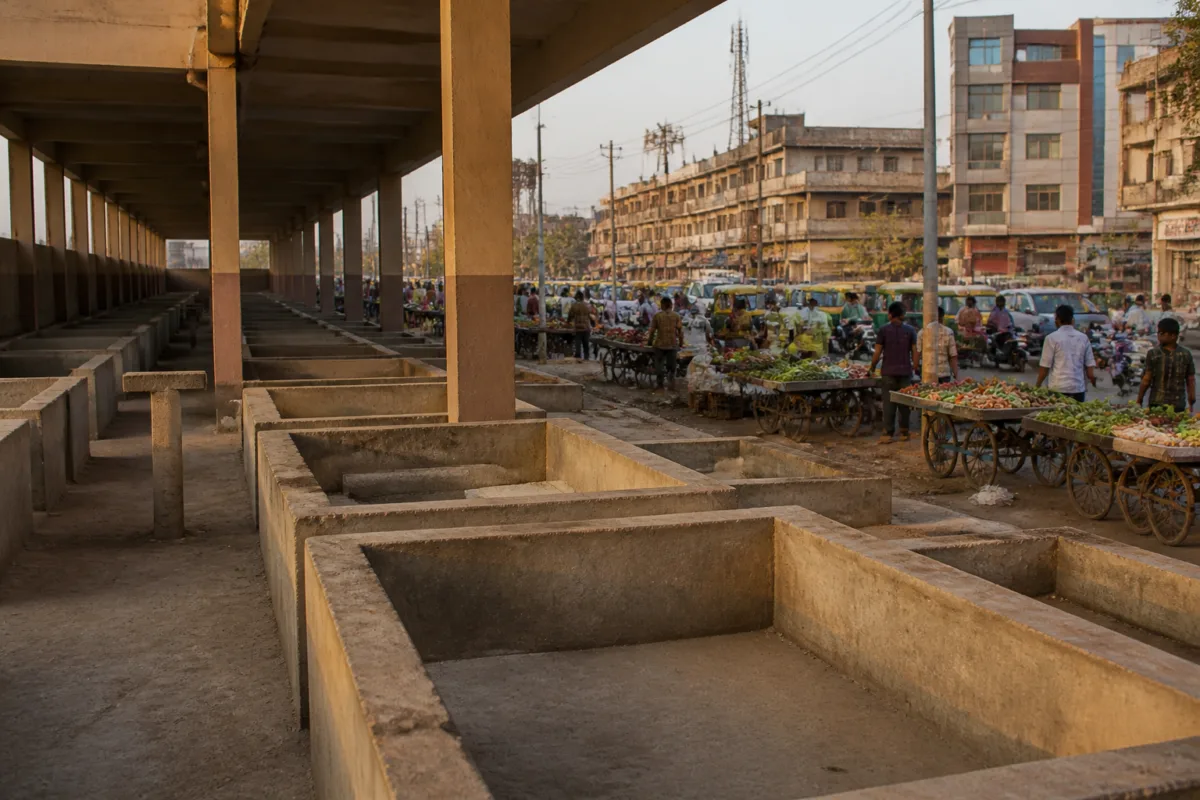
Ahmedabad Municipal Corporation’s plan to fill unused stalls in 19 vegetable markets with fruit, food and cutlery vendors exposes a wider urban problem: building formal infrastructure does not automatically move commerce away from roads and footpaths. The markets were created at a cost of more than Rs 68 crore to reduce traffic congestion and control roadside encroachments, but many stalls remain vacant because traders and customers have not shifted to them.
According to a report by Gujarat Samachar, the municipal corporation is now preparing to allocate the vacant spaces to additional categories of vendors. Municipal Commissioner has instructed officials to determine rents for different types of traders. Vegetable vendors are expected to be considered first, followed by fruit sellers. If stalls remain vacant after those allocations, food stalls and other traders may also be permitted to operate from the markets.
The decision is not simply an administrative adjustment. It is an attempt to repair a market system that the original project did not fully understand. The corporation built the markets to create organised locations for vegetable sellers and to remove informal trading from roads and footpaths. Yet the report says many vendors have continued to trade from their traditional locations, while the formal markets have struggled to attract both sellers and buyers.
That gap between infrastructure and actual urban behaviour is central to the Ahmedabad case. A market is not only a collection of constructed stalls. It is also a network of customers, suppliers, transport routes, daily routines and informal relationships. If any of those links are disrupted, a physically complete market can remain commercially empty.
The report identifies location as a key reason for the poor response. Several of the new markets were built away from the places where vendors had traditionally sold their goods. Traders were therefore concerned that they would not receive enough business in the new locations. Customers, who were accustomed to buying vegetables from established roadside or neighbourhood points, were also reluctant to travel to markets located farther away.
This creates a difficult contradiction for the municipal corporation. The formal markets were intended to clear public spaces and improve traffic conditions, but their underuse means that the original street-level activity has not disappeared. Vendors remain on roads and footpaths, where their presence can contribute to congestion and encroachment, while the public investment intended to reorganise that activity is not delivering its planned outcome.
The issue also shows why relocation projects cannot be judged only by construction completion. From an engineering perspective, the corporation has created 19 markets. From an urban management perspective, however, the more important question is whether those facilities are accessible, commercially viable and accepted by the people expected to use them. The report indicates that these conditions have not been adequately secured.
The financial scale makes the problem more significant. The corporation has spent more than Rs 68 crore on the markets. The report does not provide a market-wise breakdown of the expenditure, the number of stalls, occupancy rates or the exact locations of all 19 facilities. It also does not specify how many vendors have declined relocation or how much revenue the corporation currently collects from occupied stalls. These missing details make it difficult to measure the full financial and operational impact, but the broad failure is clear: substantial public spending has not yet produced the intended shift in vending activity.
The proposed expansion to fruit, food and cutlery vendors is therefore both a practical response and an acknowledgement that the original allocation model has not worked. By widening the permitted categories, the corporation is trying to increase footfall and improve the commercial use of the facilities. However, changing the tenant mix does not by itself resolve the location problem identified in the report. A food stall or cutlery shop may also struggle if the market remains disconnected from established customer movement.
The sequence proposed by the corporation is important. Vegetable vendors will receive priority, followed by fruit sellers. Only after these categories are accommodated will food stalls and other businesses be considered. This suggests that the corporation still intends to preserve the markets’ original role in managing fresh produce trade before introducing broader commercial activity.
Rent-setting will be the next administrative step. Officials have been instructed to determine category-wise rents for vegetable, fruit and food traders and other vendors. The report does not state the proposed rent levels, the basis on which they will be calculated or whether rents will vary according to the size and location of individual stalls. Those details will matter because the affordability of the space will directly affect whether vendors are willing to relocate and remain there.
A formal stall can impose costs that an informal roadside location may not. Traders may have to pay rent, bear additional transport expenses, move goods farther each day or adjust to lower customer volumes. Unless the formal market offers a sufficient commercial advantage, a vendor may see relocation as a financial risk rather than a municipal service. The source report does not provide a detailed cost comparison, but the reluctance of traders to shift indicates that the new sites have not yet matched the economic logic of the old ones.
Customer movement is equally important. Vegetable and fruit markets depend on frequent, convenient purchases. Buyers often choose locations that are close to homes, workplaces, transport routes or other daily activities. If markets are difficult to reach, customers may continue buying from vendors who remain near established neighbourhood routes. This can leave formal stalls without the footfall needed to sustain them, even when the facilities themselves are ready.
The Ahmedabad case also raises a question about how the corporation assessed demand before construction. The report attributes the vacancy to administrative planning weaknesses and the distance of the markets from traditional selling locations. It does not say whether vendors were consulted before sites were selected, whether customer travel patterns were studied or whether a phased pilot was attempted. Without that information, it is not possible to determine which specific planning process failed. But the outcome suggests that construction decisions were not sufficiently aligned with the existing geography of trade.
For municipal administrations, this distinction is important. Street vending is often treated as an obstruction to be removed, while the commercial system supporting it receives less attention. Roads and footpaths are public spaces that must remain accessible, but vendors also depend on visibility, customer proximity and established supply chains. A relocation programme that addresses only the physical occupation of public land can fail if it does not account for these economic and behavioural conditions.
The corporation’s current approach focuses on better use of completed assets. Allocating stalls to more categories could create a broader market ecosystem and potentially draw more customers. Fruit sellers could complement vegetable vendors, while food and cutlery traders could add further activity. Yet these outcomes remain unconfirmed. The report says the corporation is planning the allocations after rents are fixed; it does not report that new traders have already agreed to move in or that footfall has increased.
That distinction matters for public accountability. The proposed allocation is a plan, not evidence that the markets have become successful. The next measurable milestones will be the publication of category-wise rents, the number of stalls offered, the number accepted by vendors, occupancy levels after allocation and whether roadside vending decreases around the original locations. None of these results is available in the supplied report.
The episode also underlines the need to evaluate infrastructure through use rather than appearance. A newly built market may look like a completed civic project, but its success depends on occupancy, daily transactions and its ability to perform the public function for which it was created. In this case, the intended public functions were traffic improvement, control of encroachments and organised vending. The report indicates that those goals remain incomplete.
Ahmedabad’s vacant vegetable markets therefore represent more than unused municipal property. They show how urban projects can lose effectiveness when formal planning is separated from the everyday geography of livelihoods and consumption. The corporation is now trying to adapt the facilities by bringing in more categories of traders, but the central challenge remains unchanged: making the markets commercially useful enough for vendors and convenient enough for customers.
The available evidence confirms the scale of the investment, the vacancy problem, the continued presence of roadside trading and the proposed administrative response. It does not establish whether the new strategy will succeed. That will depend on the rents fixed by the corporation, the willingness of vendors to accept the locations and the ability of the markets to generate sustained customer movement. Until those results are recorded, the Rs 68-crore project remains an unresolved test of Ahmedabad’s approach to formalising street commerce.

