


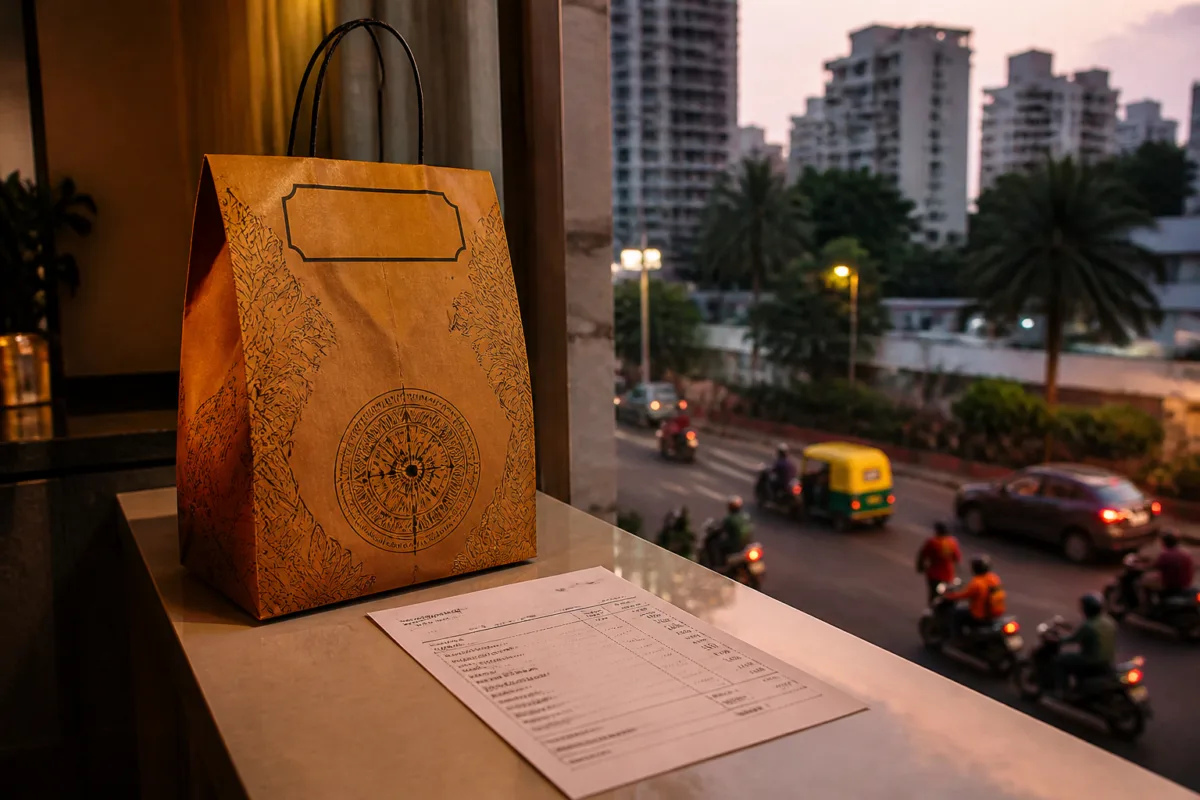
A Bengaluru consumer commission’s order against Meghana Foods has turned a Rs 15.75 takeaway-bag charge into a wider question about who should pay when packaging serves both a customer’s practical need and a restaurant’s advertising purpose. The Bangalore Urban IV Additional District Consumer Disputes Redressal Commission held the restaurant responsible for unfair trade practice and deficiency in service after a customer argued that he had been charged for a bag carrying the restaurant’s name, logo and brand identity.
The case began with a food-delivery order placed on May 8, 2026, by Pranava KN, a 25-year-old resident of Girinagara. According to the report, he ordered paneer biryani from Meghana Foods through Zomato. The restaurant’s address was listed on Dr Rajkumar Road in Rajajinagar. The invoice separately showed a “Restaurant Packaging Charge” of Rs 15. With CGST and SGST, the amount became Rs 15.75.
The total restaurant invoice was Rs 451.50. The customer also said that the order included a separate platform fee of Rs 17.58. His complaint, however, was not primarily about the size of the packaging charge. It focused on the nature of the bag supplied in return for that payment. Photographs submitted to the commission showed packaging bearing the restaurant’s name, logo and other brand identity.
That distinction is important. A takeaway bag can be understood as a functional part of delivering food from a restaurant to a customer. But when the bag is visibly branded, it can also operate as an advertising surface after the order leaves the restaurant. In the customer’s argument, he had therefore paid for an item that simultaneously promoted the business to other people who saw him carrying it.
The commission accepted the complaint against Meghana Foods after the restaurant did not appear or file its version despite receiving notice. It was placed ex parte. The commission noted that the complainant’s evidence, including the tax invoice, photographs of the branded bag and packaging, legal notice and a certificate, remained unchallenged.
The reported order also records that the customer had first raised the issue with the restaurant and Zomato by email and later sent a legal notice on August 5. Neither responded, according to the complaint. A notice to Zomato was returned unserved, and the complainant later said he did not wish to pursue the case against the platform. The complaint against Zomato was consequently dismissed as not pressed.
The commission’s reasoning centred on the combination of payment and promotion. It observed that if the restaurant’s position was genuine, it could have supplied packaging without its name and logo. The commission also said that the practice “should not continue hereafter”. The ruling therefore went beyond treating the charge as a minor billing dispute: it considered the branded packaging relevant to whether the customer had been made to support the restaurant’s promotional activity.
The order illustrates how consumer disputes often begin with a small transaction but become questions about the design of everyday urban services. Food delivery is not only a digital exchange between an app and a customer. It also involves restaurants, delivery workers, packaging suppliers, tax invoices, platform fees and the physical movement of branded material through public space. Each part of that chain can create a charge, a responsibility or a point of consumer confusion.
The case also shows the importance of itemised invoices. The restaurant invoice separately identified the packaging charge, allowing the customer to challenge it as a distinct transaction rather than as an unexplained part of the food price. The reported facts do not establish how widely similar charges are applied across the sector, nor do they establish whether other restaurants use plain or branded packaging under comparable billing arrangements. The order is therefore evidence of a specific dispute, not proof of an industry-wide practice.
The institutional route is equally significant. The customer approached the consumer commission seeking a declaration of unfair trade practice, a refund of Rs 15.75, compensation for unfair trade practice, deficiency in service, harassment and mental agony, litigation costs, and a direction that the restaurant stop charging for branded promotional packaging. The Consumer Protection Act, 2019, provided the legal framework cited in the reported order.
The commission ordered Meghana Foods to pay Rs 5,000 as global compensation. That amount covered the Rs 15.75 refund, compensation and litigation costs. It also ordered a further Rs 5,000 as punitive damages under Section 39(1)(g) of the Consumer Protection Act, 2019. The punitive-damages amount is to be deposited in the commission’s consumer legal aid account.
The two sums are due within 45 days of the order. If payment is not made within that period, interest at 8% will apply from the date of the order. The reported order states that the direction was issued on November 12 and that the commission was composed of president Vijaykumar M Pawale and members Chandrashekar S Noola and K Anita Shivakumar.
The case’s larger urban relevance lies in the fact that consumer protection is experienced through routine systems rather than only through major disputes. A resident ordering a meal, paying a platform fee and receiving a branded bag is participating in a service economy whose terms are often assembled across several entities. The consumer may see one final bill, while the transaction itself contains separate charges and separate actors.
That fragmentation can make accountability difficult. In this matter, the complaint was directed at both the restaurant and the delivery platform, but the customer ultimately pursued the case only against the restaurant. The commission’s finding, as reported, was based on the restaurant’s invoice, the packaging evidence and the absence of a response from the restaurant. It did not establish liability against the platform because the complaint against Zomato was dismissed as not pressed.
The order also raises a practical question about consent and disclosure. A customer may agree to pay for necessary packaging if the charge is clearly shown. The dispute here was whether that consent remains meaningful when the packaging is also a branded promotional object. The commission’s response indicates that a transparent charge alone may not settle the question where the supplied item provides a separate commercial benefit to the seller.
At the same time, the reported material does not answer several questions that would be necessary for a broader policy conclusion. It does not set out a sector-wide rule on branded takeaway bags, quantify similar complaints, or explain whether the restaurant had a general packaging policy. It also does not record Meghana Foods’ defence because the restaurant did not appear before the commission. Those limits matter when interpreting the order beyond the individual case.
What the case does establish is narrower and more concrete. A consumer commission found that charging a customer for packaging carrying the restaurant’s own branding amounted to unfair trade practice and deficiency in service on the evidence before it. The restaurant was ordered to pay Rs 10,000 in total, including punitive damages, and to meet the direction within the specified period.
The next test is implementation. The restaurant must deposit the two ordered amounts within 45 days, failing which 8% interest will apply from the date of the order. That compliance deadline will determine whether the dispute ends with a financial penalty or becomes a further enforcement matter before the consumer commission.

