


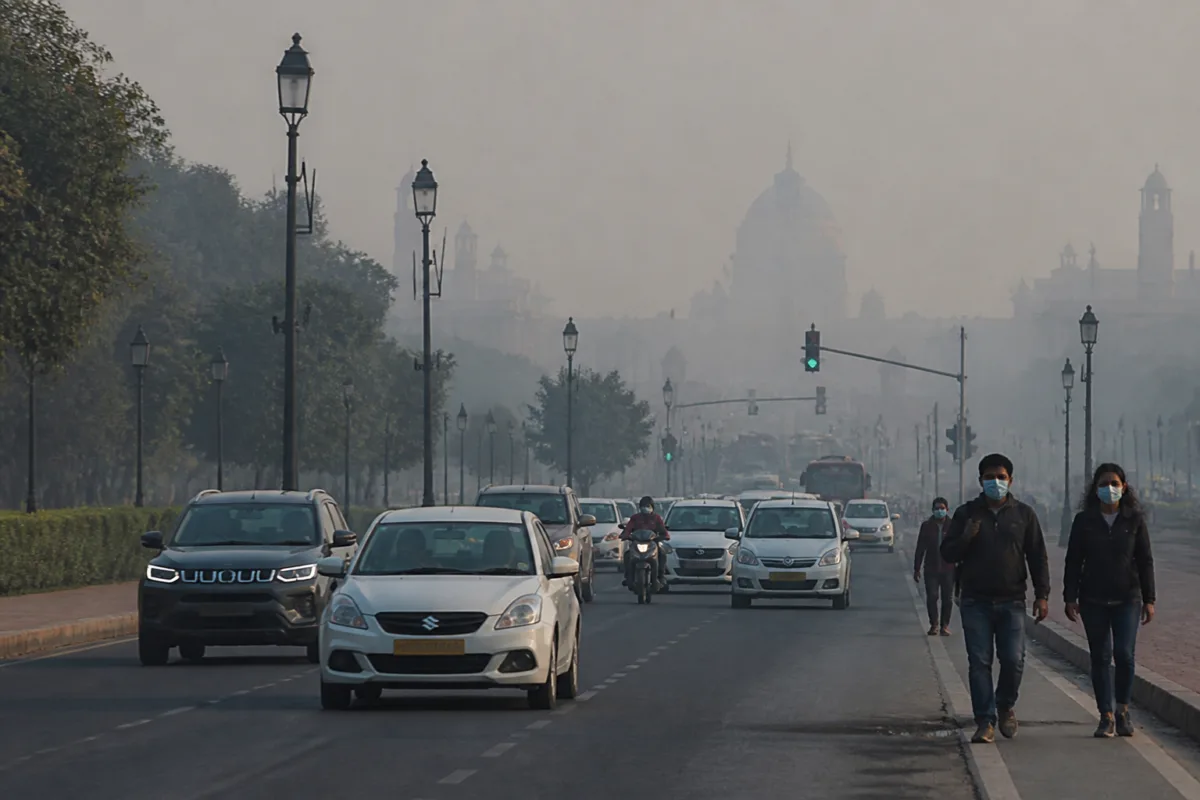
Delhi’s air quality remained in the ‘poor’ category on Tuesday morning, with the city recording an Air Quality Index (AQI) of 246 at 7:05 am, according to the Central Pollution Control Board (CPCB). Siri Fort recorded the capital’s worst reading at 341, placing it in the ‘very poor’ category.
The CPCB data showed that several monitoring stations recorded AQI readings above 300. Commonwealth Sports Complex reported an AQI of 338, followed by NSUT Jaffarpur at 336, ITO at 335, Talkatora Garden at 326, Pusa at 322 and Burari Crossing at 318.
Other stations in the ‘very poor’ category included Chandni Chowk at 316, NIH Narela at 313, North Campus at 310 and Delhi Technological University at 303. Light smog blanketed parts of the national capital on Tuesday morning.
Particulate matter PM2.5 remained the prominent pollutant, according to the CPCB. Under the national classification system, an AQI between 201 and 300 is considered ‘poor’, while readings between 301 and 400 fall in the ‘very poor’ category. AQI readings from 401 to 500 are classified as ‘severe’.
Cantonment Area recorded the lowest AQI among the stations listed, at 151, which falls in the ‘moderate’ category. Air quality was also classified as moderate at IMD Lodhi Road, where the AQI was 182; Major Dhyan Chand National Stadium, at 185; Badarpur, at 188; and Okhla Phase-2, at 192.
The Delhi government has deployed sprinklers and said it is taking measures to curb air pollution. The Commission for Air Quality Management in National Capital Region and Adjoining Areas had ordered the implementation of Stage III of the Graded Response Action Plan on November 6, after the city’s AQI crossed 400 and entered the ‘severe’ category.
The latest readings have also triggered a political dispute over the causes of Delhi’s pollution and the reliability of monitoring data. The ruling BJP blamed the previous Aam Aadmi Party government for the capital’s poor air quality. AAP Delhi president Saurabh Bharadwaj, meanwhile, alleged on Sunday that the government’s AQI data had been manipulated.
Bharadwaj claimed that readings from monitoring stations did not reflect conditions in several parts of the capital. “The pollution levels published in newspapers today expose alleged manipulation in the government’s AQI data,” he said, referring to a reading that showed IIT Delhi recording the city’s highest AQI despite being a green and clean campus. The allegation was reported as part of the ongoing political dispute and was not independently established in the supplied report.
The CPCB’s station-level readings and the government’s pollution-control measures remain the immediate markers of Delhi’s air-quality situation. Stage III of GRAP continues to provide the applicable framework for response after the earlier escalation into the severe category.

