


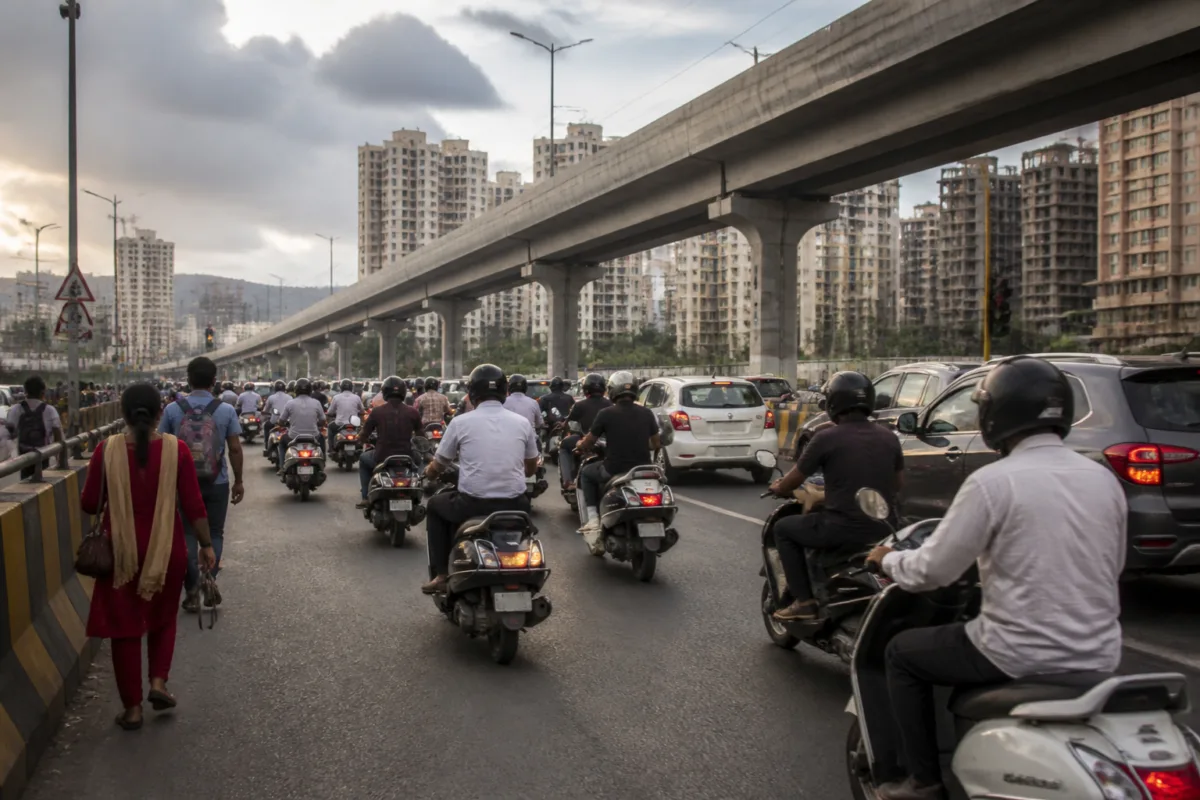
Navi Mumbai’s road-death figures point to a sustained safety crisis in a city where roads, flyovers and highways have expanded rapidly but the risks faced by everyday road users remain severe. Police data cited in a recent study shows that 855 people died in road accidents in 2024, 2025 and the first ten months of 2026, with young two-wheeler users accounting for the largest identified group of victims.
The figures are not being presented as a single isolated accident spike. They form a continuing pattern. Navi Mumbai recorded 329 road deaths in 2024 and 283 in 2025. In the first ten months of 2026, 243 people had died. The latest figure is already substantial before the year’s final two months are included, although the supplied report does not provide a full-year comparison or explain whether the totals were compiled using an identical methodology across all three periods.
The police response is significant because it moves the issue beyond routine traffic enforcement. Police Commissioner Milind Bharambe directed the traffic department to examine the causes of the accidents. The study was conducted under the leadership of Deputy Commissioner of Police Dr Rahul Khade and examined 672 minor and major accidents between October 2025 and October 2026. Its purpose, as described in the report, was to identify patterns behind the deaths rather than merely record them.
## Navi Mumbai road deaths are concentrated among vulnerable users
The most important finding concerns who is dying. Of the 243 deaths recorded in 228 accidents between January and October 2026, 120 involved two-wheeler riders or passengers. That represents 53 per cent of the reported deaths. The study further observed that 80 per cent of the deceased two-wheeler users were young people.
This makes two-wheelers central to the city’s road-safety problem. The data does not establish a single cause for these deaths. It does, however, show that people using motorcycles and scooters are bearing a disproportionate share of the fatal consequences of road travel. The distinction between riders and passengers is also important: the risk is not confined to the person controlling the vehicle but extends to those travelling with them.
Pedestrians were the second-largest identified group, accounting for 80 deaths, or 35 per cent of the total. Together, two-wheeler users and pedestrians represented 200 of the 243 deaths recorded in the study period. The report therefore presents a road-safety problem concentrated among people with limited physical protection in a collision.
The remaining deaths included 13 in accidents occurring outside the road environment and 33 in other types of accidents, according to the report. Four cyclists and six people involved in accidents connected with three-wheeled vehicles were also recorded among the fatalities. These categories are not necessarily mutually exclusive in the way they are described in the supplied material, so the figures are best read as the study’s reported classification rather than reconstructed into a new total.
The available evidence also raises a question about how road expansion is being experienced at street level. Navi Mumbai’s physical network includes roads, flyovers and highways, and the city is described as developing rapidly. Yet a larger network does not automatically mean a safer network. The reported deaths suggest that the safety performance of the system must be assessed through the experience of riders and pedestrians, not only through the scale or speed of infrastructure construction.
## What the accident timing reveals
The study’s time-of-day analysis adds another layer to the problem. Between 6 am and noon, 31.14 per cent of the accidents occurred. The period from midnight to 6 am accounted for 28.51 per cent, while 21.49 per cent occurred between noon and 6 pm. The supplied report does not state the share for the remaining evening period, so no complete 24-hour distribution can be inferred from the published figures.
The relatively high proportion recorded during the early-morning period and overnight is important because it shows that the risk is not limited to conventional daytime traffic. At the same time, the data does not identify whether these accidents involved speeding, impaired driving, poor visibility, road design, fatigue, enforcement gaps or any other specific factor. Those causes should not be assumed from the timing alone.
That limitation is central to understanding what the police study does and does not establish. It identifies the groups most affected and the periods in which accidents were recorded, but the supplied report does not provide a road-by-road map, a breakdown by vehicle speed, details of junction design, information on lighting, or the enforcement action taken in each category. It therefore offers a strong diagnostic starting point, rather than a complete causal account.
The decision by the police leadership to order a cause analysis matters for precisely this reason. Fatality numbers tell the city the scale of the failure, but they do not by themselves identify the interventions required at specific locations. A study that links each death to road geometry, traffic movement, vehicle type, time, lighting and enforcement would offer a more operational basis for action. The current report confirms that an examination has been ordered and undertaken, but it does not disclose such a detailed remedial plan.
## The institutional challenge behind Navi Mumbai’s road deaths
Road safety in a growing city is not managed by one number or one agency. The report names the police commissioner and the traffic department as the institutions responding to the problem, and identifies the deputy commissioner who led the accident study. Their role is clear in traffic enforcement, accident analysis and directing measures to reduce deaths. The supplied material does not specify the responsibilities of municipal authorities, highway agencies or road-owning bodies in the locations covered by the study.
That institutional division is relevant because the deaths involve different kinds of road users and different parts of the transport network. A two-wheeler fatality may involve rider behaviour, vehicle condition, traffic enforcement or road design. A pedestrian death may involve crossing conditions, footpath continuity, lighting, vehicle speeds or the location of traffic movement. The report does not assign responsibility for individual incidents, and no such conclusion can be drawn from the aggregate figures alone.
The data nevertheless makes one administrative priority difficult to ignore: road-safety policy must focus on vulnerable users. Two-wheeler riders, passengers, pedestrians and cyclists appear in the study not as marginal categories but as the groups carrying the greatest human cost. This is a different question from how many vehicles a road can accommodate or how quickly traffic can move. It asks whether the network protects people who are exposed when a collision occurs.
The three-year pattern also complicates any simple claim that the problem is either worsening or improving. Deaths fell from 329 in 2024 to 283 in 2025, but 243 deaths were recorded in just the first ten months of 2026. Because the source does not provide a comparable month-by-month series or a final 2026 total, it is not possible to calculate a definitive trend for the full period. What can be said is that the number recorded by October 2026 remained high enough to prompt a formal police analysis.
This distinction matters in public reporting. A fall between two full years can coexist with a serious level of deaths in the following partial year. Conversely, a partial-year total should not be converted into a full-year projection without evidence. The police study provides a basis for urgency, but the supplied information does not establish whether the underlying risk is increasing, stable or changing geographically.
## The bigger urban question
Navi Mumbai’s road-death data exposes a structural question for rapidly expanding urban regions: how should infrastructure growth be measured when the people using the network continue to face a high risk of death? Roads and flyovers may improve connectivity, but their public value is weakened when pedestrians and two-wheeler users remain disproportionately vulnerable.
The study’s importance lies in making that vulnerability visible. It connects the headline number of 243 deaths in ten months to the identities of those who died, the periods when accidents occurred and the police decision to investigate causes. It also shows why accident reporting should move beyond incident-by-incident coverage. Repeated deaths among the same categories of users indicate a system-level issue that requires patterns to be tracked and acted upon.
The evidence currently confirms three points: road fatalities in Navi Mumbai remain substantial; two-wheeler users and pedestrians account for most of the deaths identified in the 2026 study; and the police have begun a formal examination of the causes. It does not yet establish which roads, design features, behaviours or enforcement failures are responsible for the largest share. The next important development will be the disclosure of the study’s detailed findings and the specific safety measures that authorities decide to implement.

