


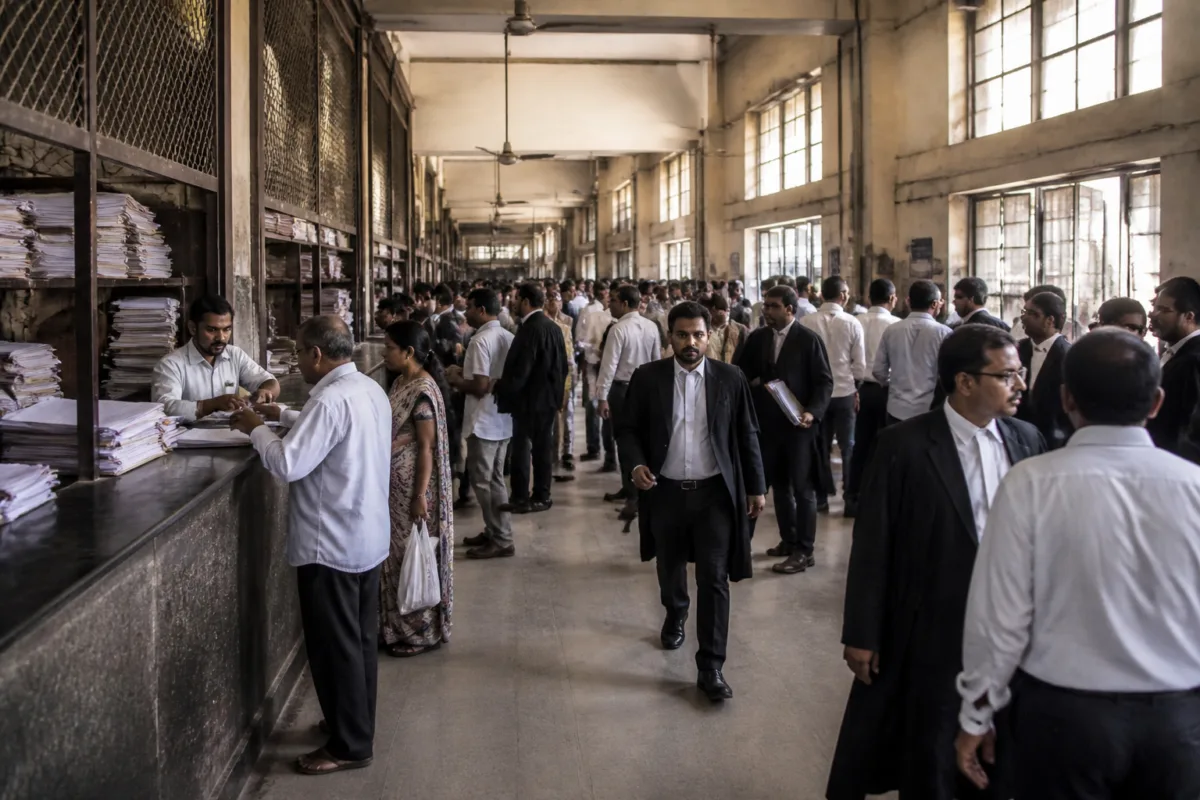
Bengaluru’s lower courts had more than 4.3 lakh pending cases as of September 2026, according to a Times of India report, revealing a civic capacity problem that extends well beyond courtrooms. The backlog includes criminal complaints, domestic violence cases, cheque-bounce disputes, rent matters, property conflicts, commercial claims and applications involving citizens’ identity documents. For a city whose population, real-estate activity and commercial economy have expanded rapidly, the figures show how access to urban justice is being constrained by the capacity of the institutions that administer it.
The pressure is distributed across a large but heavily burdened system. Bengaluru’s lower-court network comprises roughly 80 magistrate halls, about 20 small causes halls and more than 120 civil halls, including commercial courts. Yet fresh filings continue to outpace disposals, with pendency rising in most units. The result is not simply a numerical backlog. It is a delay in resolving the disputes that determine whether people can occupy a rented home, protect property rights, recover money, enforce contracts or obtain relief after an alleged offence.
The Chief Judicial Magistrate court unit is the clearest pressure point. The report puts its pending criminal cases at 2.4 lakh in 2026, up from 1.6 lakh in 2023. The unit handles theft, burglary, cheating, forgery, criminal breach of trust, assault, grievous hurt and domestic violence complaints. It also deals with cheque-bounce cases under the Negotiable Instruments Act, major rash-driving accident cases, public nuisance and rioting.
This mix of cases matters because the court unit is not handling one narrow category of dispute. It is carrying routine economic conflicts, personal-safety complaints and public-order matters at the same time. Each category has a different evidentiary process and urgency, but the cases compete within the same institutional system for judges, staff, hearing time and administrative support. The reported rise from 1.6 lakh pending criminal cases in 2023 to 2.4 lakh in 2026 indicates that the problem is not a temporary accumulation alone.
The Court of Small Causes shows how difficult it is to reduce a backlog even where disputes are comparatively defined. It had 95,816 cases—23,257 civil and 72,559 criminal—with 95,446 still pending, including 22,957 civil and 72,489 criminal cases. Pendency stood at 95,808 in 2024, meaning the reported backlog had barely changed. These courts hear straightforward money-recovery and rent disputes involving claims of up to Rs 2 lakh where ownership is not contested.
Rent disputes are particularly significant in a growing city because they sit at the intersection of housing security, property income and everyday urban mobility. A delayed case can affect a tenant’s ability to remain in a home or a landlord’s ability to recover possession or dues. The report does not establish how long individual cases have been pending or what proportion involve occupied homes, but the court-level figures show that even a forum intended for relatively limited disputes is operating with almost no reduction in its caseload.
The City Civil Court and Mayo Hall unit present a similar picture across property and personal-rights disputes. The two courts had 57,679 civil and 30,844 criminal cases. Of these, 57,472 civil and 31,182 criminal cases were pending, according to the report. The matters include injunction, declaration and partition suits, as well as neighbourhood disputes such as damage allegedly caused by adjacent construction.
These disputes are closely linked to the physical transformation of Bengaluru. Construction activity can generate conflicts over damage, access, boundaries and the use of adjoining property. Partition and declaration suits can affect the ability to transact in or develop land. Injunction proceedings can influence whether construction continues while a dispute is being heard. The courts therefore function as part of the city’s development and property-governance system, not as an institution separate from urban planning and real estate.
Commercial courts add another layer. The report records 5,157 civil and four criminal cases in these courts, with 5,053 civil and three criminal cases pending. These courts deal with financial disputes between companies, including loan-recovery actions. Rent and eviction disputes involving commercial premises such as hotels and offices also fall within their jurisdiction.
The commercial dispute process includes pre-litigation settlement through the District Legal Services Authority, which has a unit at the City Civil Court complex. That institutional arrangement is intended to provide an opportunity for settlement before a case proceeds. However, the figures reported for commercial courts show that the existence of a settlement mechanism has not eliminated the need for adjudication or prevented a substantial share of cases from remaining pending. The supplied report does not provide settlement rates, disposal timelines or the reasons individual cases remain unresolved, so the effectiveness of the process cannot be assessed from the available data.
The report also identifies name-change matters as a source of court activity. Corrections to names and identity details in certificates are generally handled administratively through a notarised affidavit, newspaper publication and government gazette notification. A declaration suit becomes necessary only when the issuing authority formally rejects an application. Times of India observed that many cases involved name changes in school or birth certificates.
This is an important administrative signal. When routine corrections that can ordinarily be addressed through government processes enter the court system, judicial capacity is used to resolve an administrative failure or disagreement. The report does not quantify these cases separately, but it indicates that the court workload includes matters that may originate in the interaction between residents and issuing authorities rather than in conventional civil conflict.
The institutional picture is further complicated by case movement and accounting. Administrative adjustments and transfers between court halls can result in a closing balance becoming higher than the opening balance. That means changes in the reported pendency may not represent only newly filed cases or cases that courts failed to dispose of during the period. At the same time, the broader trend remains clear in the supplied report: fresh filings are outpacing disposals in most units, and the backlog is rising.
Senior advocates quoted by the publication identify several causes. Gurupasrad MN said interim applications frequently stall the main trial because the case cannot move forward until the interim issue is settled. This points to a structural feature of litigation: the headline case may remain formally active while procedural applications consume hearing time and delay the resolution of the underlying dispute.
AP Ranganatha, former president of the Advocates Association of Bengaluru, attributed the pressure to shortages of judges and staff, insufficient dedicated funding and the creation of special courts without the facilities needed to operate them. His comment frames the backlog as a capacity and implementation problem rather than merely a question of filing volume. The report also cites rising family cases and the absence of fast-track courts among the factors contributing to pendency.
The funding and staffing issue is central to how Bengaluru’s lower courts function. A court hall requires more than a judge: clerks, registrars, process servers, record management, scheduling systems and legal-support services all influence whether a case can progress. The supplied material does not provide sanctioned and working strength, vacancy numbers, courtroom utilisation rates or annual disposal targets. It is therefore not possible to determine which part of the system is the binding constraint. But the advocates’ accounts and the court-level pendency figures indicate that adding jurisdiction without matching facilities has placed pressure on existing institutions.
The backlog also exposes the limits of treating the justice system as a separate administrative service. A rent dispute is connected to housing stability. A property injunction is connected to land use and construction. A commercial claim is connected to business continuity. A rash-driving case is connected to road safety. A domestic violence complaint is connected to household security. Delays in each category have different consequences, but all are experienced through the same city and its institutions.
The figures supplied by the report should not be read as a complete performance assessment. They do not show the age of cases, disposal quality, adjournment rates, settlement outcomes or the proportion of cases that are effectively inactive. Nor do they establish whether the reported totals use identical counting methods across court units. The note about transfers and administrative adjustments reinforces the need for transparent, comparable court data.
What the evidence does establish is more basic and more consequential: Bengaluru’s lower courts are carrying a very large caseload, several units have barely reduced their backlog, and the largest criminal unit has seen a substantial increase since 2023. The reported causes—interim applications, staff shortages, rising family disputes, inadequate facilities and the lack of fast-track capacity—point to a system whose workload is expanding faster than its institutional resources.
The next question for Bengaluru is not only how many cases are pending, but how the city’s justice infrastructure is being planned, funded and measured. The available report calls for more judges, staff and funds, while also identifying administrative routes that could keep some matters out of court. Until those capacities and pathways are assessed through consistent public data, residents will continue to experience the backlog as delayed housing security, unresolved property conflict, uncertain commercial claims and prolonged criminal proceedings.

