


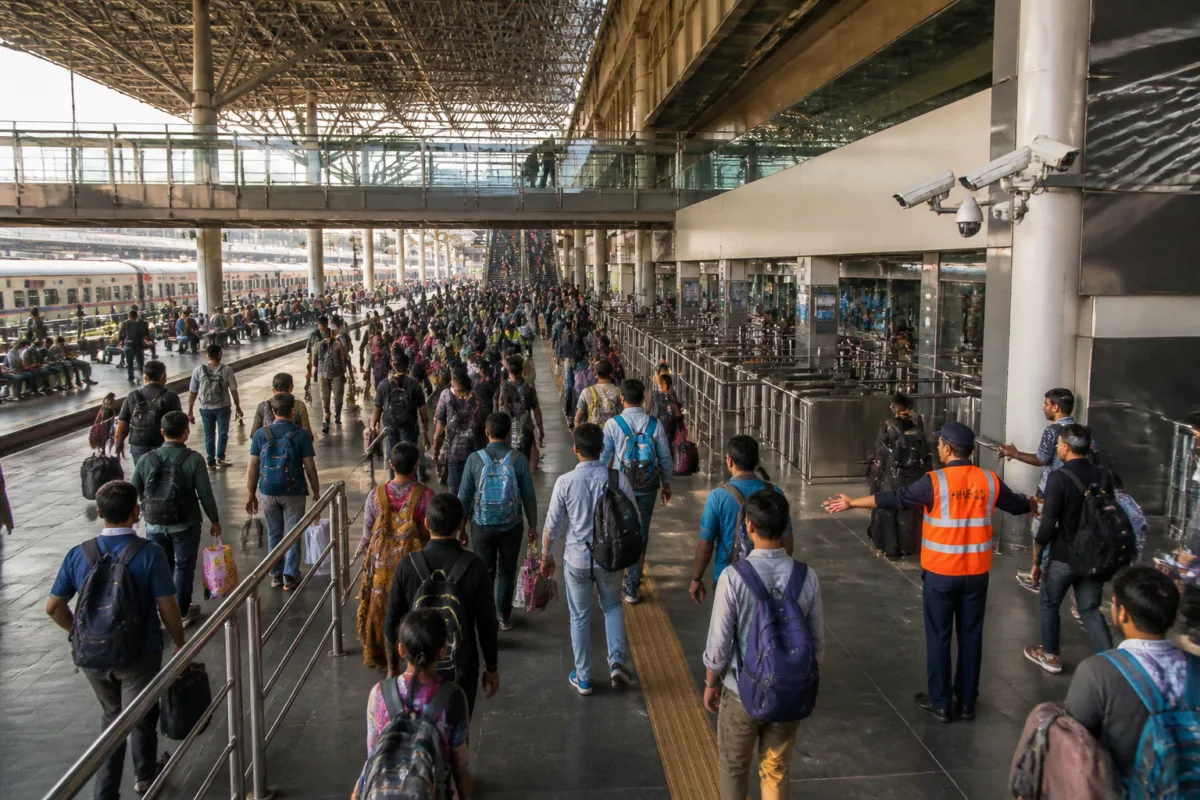
The Delhi High Court’s direction to railway authorities to strictly implement crowd-management protocols at New Delhi Railway Station does more than restate an existing safety requirement. It places the focus on the point at which railway plans become operational: the station floor, the foot-over-bridge, the holding area, the entry gate and the control room, especially when an event is expected to bring an exceptional surge of passengers.
The order, passed by Justice Amit Mahajan on November 2, requires a senior officer nominated by the competent authority to review arrangements at least one week before every event expected to generate large passenger footfall. The review must be conducted in coordination with the Delhi Police and other concerned agencies. The court also directed the authorities to maintain proper records and prepare a written report on arrangements in case it is required after an untoward incident.
This emphasis on advance review and documentation is significant because the railway authorities already had protocols covering several of the basic components of crowd management. These included advance planning for festivals and melas, holding areas, access control, CCTV monitoring and limits on waiting-list bookings. The court’s observation was that the existence of these protocols was not enough. The February 2025 stampede at New Delhi Railway Station demonstrated that the central question was how the measures were implemented before and during each crowded event.
The distinction is important for a station that is not simply a building through which passengers pass. It is a large public system where ticketing, platform access, train operations, security screening, passenger information, police deployment and crowd movement must work together under pressure. If any one of these functions is planned in isolation, a sudden concentration of passengers can turn a routine operational disruption into a safety emergency.
The court cited daily footfall of up to 3,29,527 passengers at New Delhi Railway Station on October 24, 2025, while directing that measures be monitored and recorded for every crowded event. The figure illustrates the scale at which the station operates, but it also underlines why ordinary daily traffic and event-related surges cannot be treated as the same management problem. A station that handles a very high regular volume may still require a separate operating plan when thousands of passengers arrive within a short period to board trains associated with a major public event.
The case arose from a petition filed by two passengers who could not board their train at New Delhi Railway Station on February 15, 2025, because of a stampede. One of the petitioners was a person with disability. The petitioners said they were present at the station when the stampede occurred on the foot-over-bridge. At least 18 people were killed in the overnight incident, which followed a surge of passengers waiting to board trains for Prayagraj while the Maha Kumbh was under way.
The facts place accessibility within the wider crowd-management question. The presence of a person with disability among the petitioners shows that crowd safety cannot be measured only by whether the majority of passengers eventually reach a platform. A system must also account for people who move more slowly, require assistance, use mobility aids or may be unable to respond quickly when passenger density changes. The supplied court report does not set out a separate accessibility protocol, but the petition makes clear that the consequences of poor crowd control are not distributed evenly among passengers.
In response to the petition, the authorities largely described future steps for managing sudden passenger surges. These included developing a holding area on the Ajmeri Gate side of New Delhi Railway Station with a capacity of about 7,000 passengers. The proposed facility was also to include 22 ticket counters, 25 Automatic Ticket Vending Machines, CCTV cameras, luggage scanners, door-frame metal detectors and a dedicated control room.
The list is notable because it combines passenger processing, security and surveillance within one proposed arrangement. A holding area can keep passengers away from platforms until they can be admitted in a controlled manner. Ticket counters and vending machines can regulate the flow of passengers who still need to complete ticketing. Screening equipment and CCTV can support security and monitoring, while a control room can provide a point for coordinating the response.
However, the court observed that the authorities had not shown much on the ground. This is the central institutional issue in the order. Infrastructure announced in response to an incident does not automatically become operational capacity. Its usefulness depends on whether it has been created, whether its capacity matches the expected passenger surge, whether staff know their roles, whether access routes are clear and whether agencies can coordinate decisions in real time.
The court’s direction for a written report adds an accountability layer to that implementation problem. Without records, it is difficult to establish who reviewed the arrangements, what risks were identified, which agency was responsible for each action and whether the plan was actually followed. A written record also creates a basis for examining non-compliance after an incident rather than relying only on broad statements that protocols existed.
The requirement to conduct the review at least one week before an expected event also shifts crowd management away from last-minute deployment. The authorities are expected to identify the event, estimate the likely passenger load, review the arrangements and coordinate with the Delhi Police and other agencies in advance. The order does not prescribe a new numerical threshold for what constitutes a large passenger footfall, but it makes clear that a predictable surge must trigger a documented review by a senior officer.
That framework assigns responsibility across institutional boundaries. Railway authorities control station operations and passenger facilities, while the Delhi Police and other agencies may have responsibilities connected with security, access and emergency response. Such a system can function only when the division of responsibilities is settled before passengers begin arriving. The court’s insistence on coordination indicates that crowd management cannot be treated as the responsibility of a single department operating inside the station.
The New Delhi station case also shows how event-linked travel can test the capacity of urban transport infrastructure. Passengers travelling for festivals, melas and other large public events do not arrive in a uniform pattern. They may gather before train departures, wait for tickets or platform access, carry luggage and move through common circulation areas at the same time. The court’s reference to holding areas, access control and waiting-list limits indicates that the pressure begins before passengers reach the platform.
The February 2025 stampede therefore remains relevant not only as a past accident but as a test of whether safety systems are capable of converting planning into controlled movement. The court did not accept the existence of protocols as evidence that the problem had been solved. Instead, it required the authorities to demonstrate implementation, monitoring and records for each crowded event.
The petitioners had initially sought compensation for all victims but ultimately pressed for directions requiring the authorities to prepare an action plan for sudden crowd surges at stations during public events. That change in emphasis moved the case from an individual claim towards the management system that governs passenger safety. The court’s response similarly concentrated on procedures, accountability and preparedness rather than only on the incident itself.
The order also states that the authorities concerned will be liable for non-compliance. This gives the directions a clear administrative consequence. The requirement is not merely to publish or retain standard operating procedures; it is to implement them, review arrangements in advance, coordinate with the relevant agencies and maintain records that can establish what was done.
What remains unresolved in the supplied material is the extent to which the proposed Ajmeri Gate holding area and its associated facilities have been operationalised. The court’s observation that little had been shown on the ground indicates an implementation concern, but the report does not provide a completion date, current operating status or details of staffing and passenger-flow drills. Those are the practical indicators that will determine whether the proposed response has moved beyond planning.
The larger urban question is whether high-volume transport hubs are being managed as dynamic public spaces rather than as fixed facilities with static capacity. Passenger safety depends not only on the number of platforms or ticket counters, but also on how people are admitted, held, screened, directed and evacuated during exceptional demand. The Delhi High Court’s order makes the implementation record part of that safety system.
For New Delhi Railway Station, the next test will be whether the mandated reviews produce visible, coordinated and documented arrangements before the next major event. The court has established the process: advance review by a senior officer, coordination with the Delhi Police and other agencies, strict implementation of existing protocols, monitoring for every crowded event and written records that can support accountability if something goes wrong.

