


An order linking teacher leave in Hyderabad district to a 95 per cent attendance threshold has opened a wider question about how education performance targets are enforced: can a district administration impose blanket restrictions when existing government rules already assign leave-sanctioning powers to specific education officials?
The dispute began after a November 13 order issued by Hyderabad district collector Dr Priyanka Ala directed teachers, headmasters, Deputy Inspectors of Schools and Deputy Educational Officers not to avail themselves of any kind of leave until student and teacher attendance reached 95 per cent across all schools. The order also required teachers to obtain prior permission from the Additional Collector before taking leave.
The Telangana State Primary Teachers Association has demanded that the directive be withdrawn immediately. Its leaders, state president Syed Showkath Ali and general secretary R. Rohith Naik, argued that the order conflicts with existing government orders and exceeds the Collector’s authority. Their objection is not to attendance monitoring alone, but to the administrative method used to pursue it.
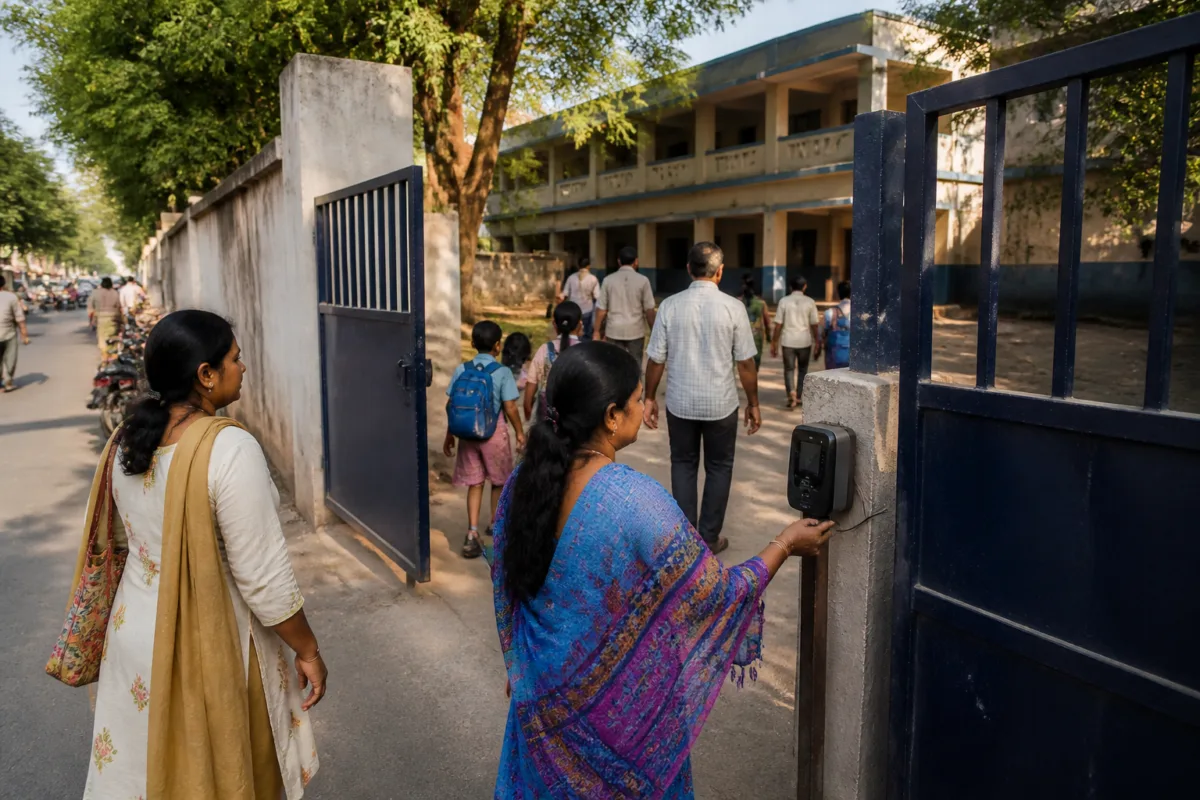
The reported trigger was a video conference chaired by the Chief Secretary on November 13. During the meeting, attendance figures recorded through Hyderabad’s facial recognition system were found to be significantly lower than those of other districts. The district administration then connected the attendance target to restrictions on leave across the school system.
That sequence is important because it shows how a technology-generated performance signal can quickly become an administrative instruction. The source report does not establish why Hyderabad’s figures were lower, whether the facial recognition system had technical or operational limitations, or whether the recorded attendance reflected actual student and teacher presence. It establishes only that the figures were discussed as significantly lower than those of other districts and that the Collector issued the subsequent direction.
The 95 per cent threshold therefore functions as more than a number in the dispute. It becomes the condition for exercising leave, while the reasons for the shortfall remain unspecified in the available material. The order, as reported, does not distinguish between casual leave, medical leave, authorised absence or other categories. It directs the listed officials not to avail themselves of any kind of leave until the target is achieved.
This is where the conflict with the existing administrative chain becomes central. The teachers’ association said headmasters were authorised to approve casual leave for teachers. It further stated that Mandal Educational Officers and Deputy Educational Officers had powers to sanction leave for the relevant categories of headmasters, while the District Educational Officer was the competent authority for Mandal Educational Officers and Deputy Educational Officers.
The association’s argument is that these delegated powers are not merely procedural conveniences. They define who is responsible for taking a decision, what category of employee is covered and how leave is to be processed. By requiring prior permission from the Additional Collector and suspending leave until an attendance benchmark is reached, the new directive may create a parallel approval structure, according to the association.
The available report does not include the full text of the November 13 order or a response from the district administration to the teachers’ objections. It is therefore not possible from the supplied material to determine whether the directive contains exceptions, how it is intended to interact with existing government orders, or whether the administration has issued a clarification. The legal validity of the order has also not been established in the report; the claim that it exceeds the Collector’s authority is the position taken by the association.
The episode illustrates a recurring administrative problem in public service delivery: the difference between setting a target and designing a lawful implementation mechanism. A district authority may seek higher attendance, but the instruments used to achieve that objective must still operate within the responsibilities assigned to headmasters, Mandal Educational Officers, Deputy Educational Officers and the District Educational Officer.
The distinction matters particularly in schools because attendance is not controlled by teachers alone. The reported order concerns both student and teacher attendance, but the source material does not identify the causes behind the student shortfall or explain how teachers are expected to raise it. It also does not indicate whether schools have been given additional staff, operational support or a separate plan to address student absence.
The use of facial recognition adds another institutional layer. In the reported account, the system supplied the comparative attendance figures that preceded the order. Yet a digital attendance system is a monitoring mechanism, not by itself an explanation of absence. The report provides no information about the system’s coverage, verification process, error rate or method for handling missed registrations. Those unanswered questions are relevant because the enforcement decision was tied directly to the system’s reported figures.
This does not establish that the attendance data were inaccurate. It does show that the available evidence does not explain how the figures were interpreted before the leave restrictions were imposed. A numerical benchmark can make administrative performance appear clear while leaving the underlying causes unresolved. In this case, the public dispute has shifted attention from the reported attendance gap to the authority and process used to respond to it.
The institutional structure described by the teachers’ association suggests that Hyderabad’s school administration already has a distributed decision-making system. Headmasters, Mandal Educational Officers, Deputy Educational Officers and the District Educational Officer each have specified responsibilities for different categories of leave. That arrangement allows decisions to be taken at the level where the relevant employee and school are known.
The Collector’s reported instruction brings a district-level approval requirement into that structure. It also makes the exercise of leave conditional on a district-wide or school-wide performance measure, rather than on the individual circumstances ordinarily considered under leave rules. Whether that is compatible with existing orders is the question at the centre of the dispute.
The association has warned of joint protests with other teachers’ unions if the order is not withdrawn. That response indicates that the issue could move beyond a disagreement between one association and the district administration. However, the supplied report does not confirm whether other unions have joined the demand, whether protests have been scheduled or whether the administration has begun a review.
The immediate public-interest concern is therefore administrative clarity. Teachers, headmasters and education officers need to know which rules govern leave applications, who can approve them and whether the 95 per cent condition applies to every category of leave. Schools also need clarity on whether attendance figures generated through the facial recognition system are being used for monitoring, disciplinary action or both.
The report confirms that Hyderabad’s attendance figures were raised during a Chief Secretary-chaired video conference, that the district Collector subsequently issued restrictions and that the teachers’ association has challenged the directive’s authority. It does not establish the reasons for the attendance gap, the full contents of the order, the district administration’s response or the outcome of any review.
Those are the next developments that will determine whether the episode remains a dispute over one order or becomes a broader test of digital monitoring, delegated authority and performance management in public schools. Until the administration clarifies the order’s legal basis and operational scope, the 95 per cent target remains inseparable from the unanswered question of who is empowered to enforce it.

