


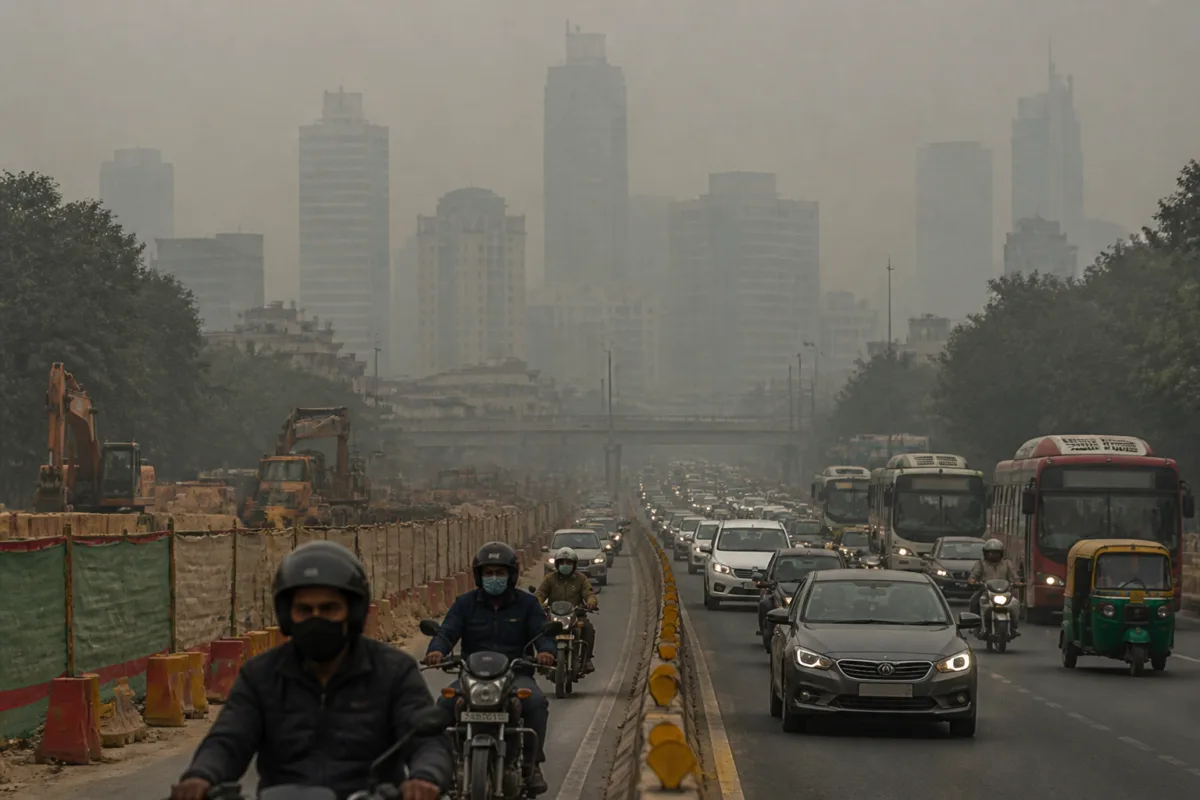
Delhi’s pollution problem cannot be explained by Diwali alone. An analysis of air-quality data from 24 state and Union Territory capitals found that the national capital recorded an annual average PM2.5 concentration of 94 micrograms per cubic metre between Diwali 2025 and Diwali 2026, excluding the festival days. That was more than twice India’s annual national standard and the highest level among the capitals examined.
The findings, reported by Navbharat Times citing Envirocatalysts and data analysis by PTI, are important because they shift attention from a short festival episode to the longer operating pattern of Delhi’s air. The data points to pollution being embedded in everyday urban activity: road traffic, dust from roads and construction sites, industries, power plants, open waste burning, household fuels, crop-residue burning and pollution transported across regional boundaries.
That distinction matters for how the city understands and governs its air. If the largest share of annual exposure is generated outside the two most publicly visible festival days, then measures focused primarily on fireworks cannot address the full problem. The report says the two Diwali-related days accounted for about 1.2 per cent of annual PM2.5 pollution on average across the capitals studied. In no city did the share exceed 2.5 per cent.
Delhi’s festival readings were nevertheless severe. The hourly PM2.5 concentration reached 584 micrograms per cubic metre between midnight and 1 am on Diwali night. The city’s 24-hour average was 257 micrograms per cubic metre on Diwali and rose to 266 micrograms per cubic metre the following day. These figures explain the intensity of the seasonal debate, but the annual data shows that the city’s pollution burden is not confined to that short period.
Delhi recorded 14 days during the year when its PM2.5 level exceeded the average recorded on Diwali day, according to the report. The finding is a direct challenge to the idea that a single festival period is the defining source of the city’s annual exposure. It also indicates why the policy response must be distributed across the urban systems that produce emissions throughout the year.
PM2.5 refers to fine particulate matter small enough to penetrate deep into the respiratory system. The report places Delhi’s annual average at 2.3 times India’s prescribed annual limit of 40 micrograms per cubic metre. It was also 18.7 times the World Health Organization’s annual guideline of 5 micrograms per cubic metre. These comparisons do not by themselves establish the health outcome for any individual, but they show the scale of the gap between measured air quality and the standards cited in the report.
The 201 days above the national 24-hour standard provide another measure of the city’s exposure pattern. India’s daily standard for PM2.5 is 60 micrograms per cubic metre. Delhi crossed that level on more than half the days covered by the analysis. The annual average and daily exceedance count describe different dimensions of the problem: one captures the sustained concentration over time, while the other shows how frequently pollution moved beyond the prescribed daily threshold.
The comparison with other capitals reinforces Delhi’s position as an outlier, while also showing that the problem is not unique to one city. Jaipur ranked second with an annual average of 54 micrograms per cubic metre, followed by Lucknow at 52, Kolkata at 48, Patna at 47, Bhubaneswar at 46, Dehradun at 45, Guwahati and Bhopal at 42 each, and Naharlagun at 41. Ten of the 24 capitals analysed recorded annual averages above India’s national standard.
The spread of results matters for urban policy. Delhi’s 94 micrograms per cubic metre was substantially higher than the second-ranked capital’s 54, but the presence of nine other capitals above the national limit shows a wider failure to control fine particulate pollution in urban environments. The data supplied in the report does not identify the contribution of each source for every city, so it cannot establish that the same source mix operates in identical proportions across all 24 capitals. It does, however, place Delhi within a larger national pattern of capital-city pollution.
The report’s source list describes a problem that cuts across administrative jurisdictions. Vehicles are regulated through transport and enforcement systems; road and construction dust is linked to municipal works, building activity and site management; industries and power plants fall under environmental regulation; open waste burning relates to municipal collection and disposal; household fuels involve energy access and household behaviour; and crop-residue burning and regional pollution extend beyond Delhi’s boundaries.
This fragmentation creates an institutional challenge. The city may record pollution at monitoring stations, but the actions needed to reduce it sit with several agencies and, in some cases, with governments outside the capital. A city-level response can address local traffic, construction practices, waste burning and road dust, but the report’s reference to regional pollution indicates that Delhi’s air cannot be managed entirely within its municipal or territorial limits.
The data also exposes the difference between monitoring pollution and controlling it. A monitoring network can show how often concentrations exceed a standard and how seasonal levels change. Turning those measurements into lower exposure requires enforcement, infrastructure and coordination: cleaner transport operations, control of dust at construction and road sites, effective waste management, industrial compliance and action on sources that move across regions. The supplied report does not assess the performance of individual programmes or agencies, so it cannot show which intervention has succeeded or failed.
The monthly figures for late 2025 illustrate why seasonal emergency measures are not enough. Delhi’s monthly average PM2.5 concentration exceeded 210 micrograms per cubic metre in both November and December 2025, according to the analysis. Those levels were close to the pollution recorded on Diwali day. The pattern indicates that the city experienced prolonged high pollution during the period, rather than a single isolated festival peak.
For residents, this means that the most consequential pollution exposure may occur through repeated ordinary days rather than only during highly publicised spikes. The report does not provide neighbourhood-level readings, individual exposure assessments or health data, so it cannot establish how pollution varied across Delhi or how specific communities were affected. It does show that the city-wide annual burden was high and frequent enough to demand a policy frame wider than festival enforcement.
The central urban question is therefore not whether Diwali contributes to Delhi’s pollution. The reported readings show that it does. The larger question is whether the city treats pollution as an episodic event or as a basic infrastructure and governance problem. The available evidence supports the second interpretation: most of the annual pollution identified in the analysis came from sources operating through transport, construction, energy, waste and regional systems.
The report does not provide a source-by-source emissions inventory, the methodology used to combine the monitoring data, or a performance assessment of mitigation measures. Those gaps limit what can be concluded about the precise responsibility of individual sectors. But the broad signal is clear. Delhi’s annual PM2.5 average was the highest among the 24 capitals examined, its daily standard was breached on 201 days, and Diwali-related pollution represented only a small share of the annual total. Any durable response will therefore have to be measured against year-round air quality, not only against the next festival peak.

