


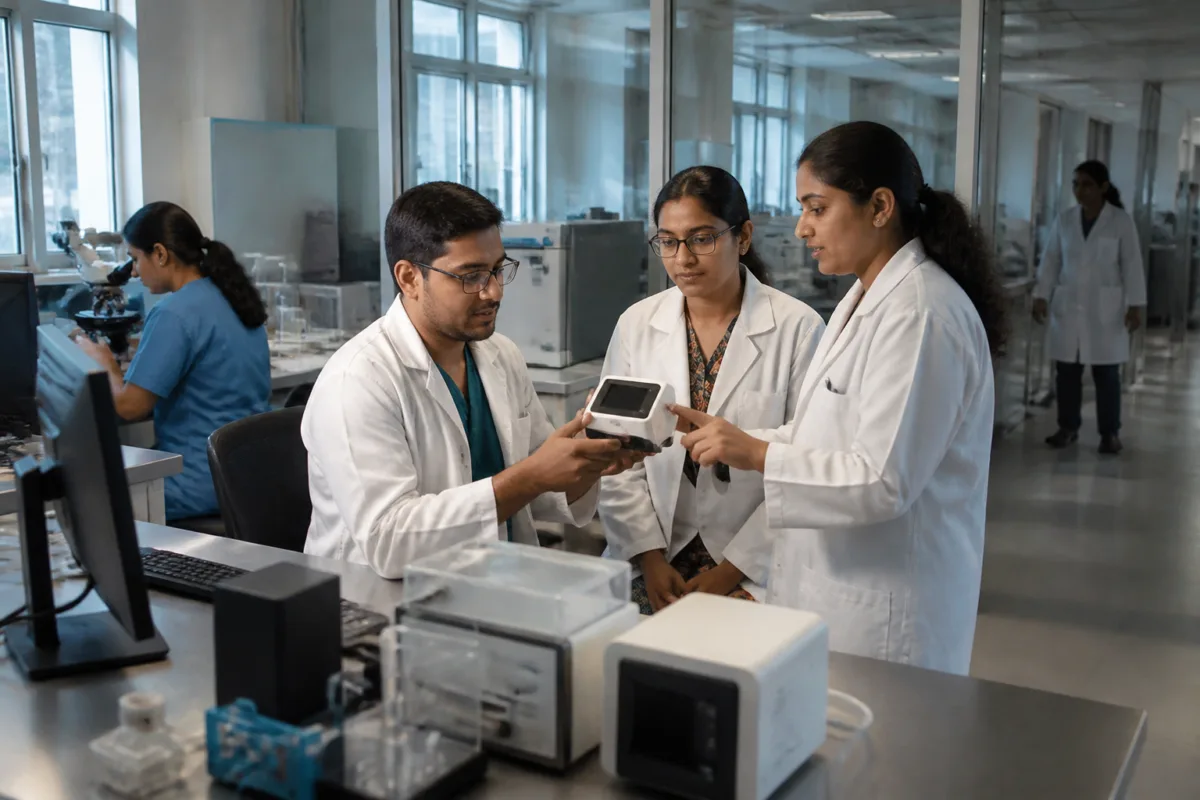
AIIMS Delhi’s new faculty entrepreneurship policy is designed to move medical research beyond laboratories and research papers by allowing eligible doctors to build or join medical startups. The policy also seeks to connect that commercial pathway to the public institution’s core responsibility: providing patients with affordable access to indigenous medical devices, diagnostic facilities and treatment options.
The announcement is significant because it addresses a persistent gap between medical innovation and its use in healthcare delivery. Research may produce a device, diagnostic method or treatment concept, but that work does not automatically become a product available to patients. By creating a formal route for faculty members to become founders, promoters, directors, shareholders, advisers or mentors, AIIMS is attempting to build an institutional bridge between research and application.
According to information published in the institute’s official newsletter and reported by Jagran, AIIMS has implemented the policy with the objective of giving practical shape to medical research and supporting the development of indigenous technology and equipment. The policy has been prepared on the lines of faculty entrepreneurship frameworks used by IITs. Faculty members may establish their own startups or associate with existing ones, subject to the conditions set by the institute.
The central policy question is not simply whether doctors can become entrepreneurs. It is whether a public medical institution can support commercial innovation without weakening its obligations to patients, students and research. The AIIMS framework attempts to address that tension by retaining treatment, teaching and research as the primary responsibilities of participating faculty members.
Only faculty members in regular appointments who have completed at least two years of service can use the policy. They may spend up to 20 per cent of their regular working time on startup-related activity. Any requirement to devote more time would require institutional permission and leave without pay. These limits create a formal boundary between an individual’s institutional role and their entrepreneurial activity.
That boundary is important in a hospital environment. Medical faculty members occupy positions that combine clinical authority, academic responsibility and access to institutional infrastructure. A policy that permits commercial activity therefore needs to define time commitments, ownership, intellectual property and patient access. The AIIMS framework, as described in the report, addresses each of these areas, although the supplied information does not set out the detailed approval process or monitoring mechanism.
The policy provides for the involvement of AIIMS’s Centre for Medical Innovation and Entrepreneurship, described as a bio-incubator. Faculty members establishing startups can receive technical advice and use laboratory facilities and modern equipment there. This gives the initiative a physical and institutional base rather than leaving individual researchers to commercialise their work independently.
The bio-incubator model also shows why the initiative is an infrastructure story, not only a technology or business story. Laboratories, equipment, technical guidance and licensing systems are enabling infrastructure for medical innovation. Without these institutional systems, promising research can remain confined to papers, prototypes or small-scale trials. The policy seeks to place those systems within the working structure of the country’s major public healthcare institution.
Intellectual property is another important part of the arrangement. The report states that faculty members must obtain licences and necessary approvals to use AIIMS intellectual property or technology developed at the institute. This provision recognises that research produced inside a public institution may involve institutional resources, staff and facilities. It also establishes that commercialisation cannot proceed solely on the basis of an individual faculty member’s association with a discovery.
The financial structure is unusually specific. AIIMS will receive a five per cent stake in each startup. The institute’s stake will not be reduced even if further investment enters the company. Participating faculty members, meanwhile, may be associated with a maximum of five startups, and their total stake across all startups cannot exceed 25 per cent.
These provisions create a basic framework for managing institutional and individual interests. AIIMS receives a continuing ownership share, while limits are placed on the number of companies a faculty member can join and the total equity they can hold. The supplied report does not provide details about valuation, revenue sharing, board representation, conflict-of-interest disclosures or the use of proceeds received by AIIMS. Those operational details will determine how transparent and effective the model becomes in practice.
The patient-facing condition is the most direct public-interest element of the policy. Products developed by the startups are to be made available to AIIMS patients free of cost or at discounted rates. The measure could make indigenous devices, diagnostic services and treatment options more accessible within the institution, while also giving innovators a real clinical setting in which to test whether their products respond to patient needs.
However, the policy’s promise of affordability depends on how it is implemented. A startup may develop a product using institutional support, but the report does not establish how discounts will be calculated, how long they will apply, which patients will qualify, or how the products will be evaluated before clinical use. The announcement confirms the intended patient benefit, but not the full system through which that benefit will be measured.
The initiative also reflects India’s effort to reduce dependence on foreign technology and equipment in healthcare. The report says the policy is expected to support the development of indigenous medical technology and reduce reliance on foreign products. That objective has two dimensions. It concerns the supply of equipment and diagnostics, but it also concerns the ability of public institutions to retain knowledge, develop products and create a domestic innovation pipeline.
For AIIMS, this changes the institutional role of medical research. The hospital is not only a site of treatment and teaching; under the policy, it also becomes an environment where research can be translated into commercial products. That expansion brings potential benefits, including faster movement from discovery to use, but it also increases the importance of clear rules around patient safety, data, procurement and conflicts of interest. The supplied material does not state whether the policy contains additional safeguards in these areas.
The 20 per cent time limit and the requirement of leave without pay for greater involvement indicate that AIIMS is trying to prevent startup work from displacing clinical and academic duties. The effectiveness of that arrangement will depend on how working time is recorded and how patient care is protected when a faculty member holds responsibilities in both the institution and a private company. These are implementation questions rather than claims established by the announcement.
The policy’s wider relevance lies in its attempt to connect three systems that often operate separately: public healthcare, academic research and private enterprise. Medical innovation requires all three, but their objectives are not identical. Hospitals prioritise patient care, universities prioritise knowledge and companies prioritise the development and distribution of viable products. AIIMS’s framework is an effort to make those relationships explicit within one institution.
The immediate evidence confirms that AIIMS has created a formal route for eligible faculty members to participate in startups, supported by its bio-incubator, subject to time, ownership and licensing conditions. It also establishes a stated obligation to offer resulting products to AIIMS patients free or at discounted rates. What remains unclear from the available information is how many startups will be formed, what products will emerge, how approvals will work and how patient outcomes and affordability will be assessed.
Those implementation details will determine whether the policy becomes a durable model for public medical innovation or remains primarily an institutional permission framework. The next important developments will be the startups created under the policy, the technologies they commercialise, the approvals they receive and the extent to which AIIMS patients actually gain access to affordable products and services.

