


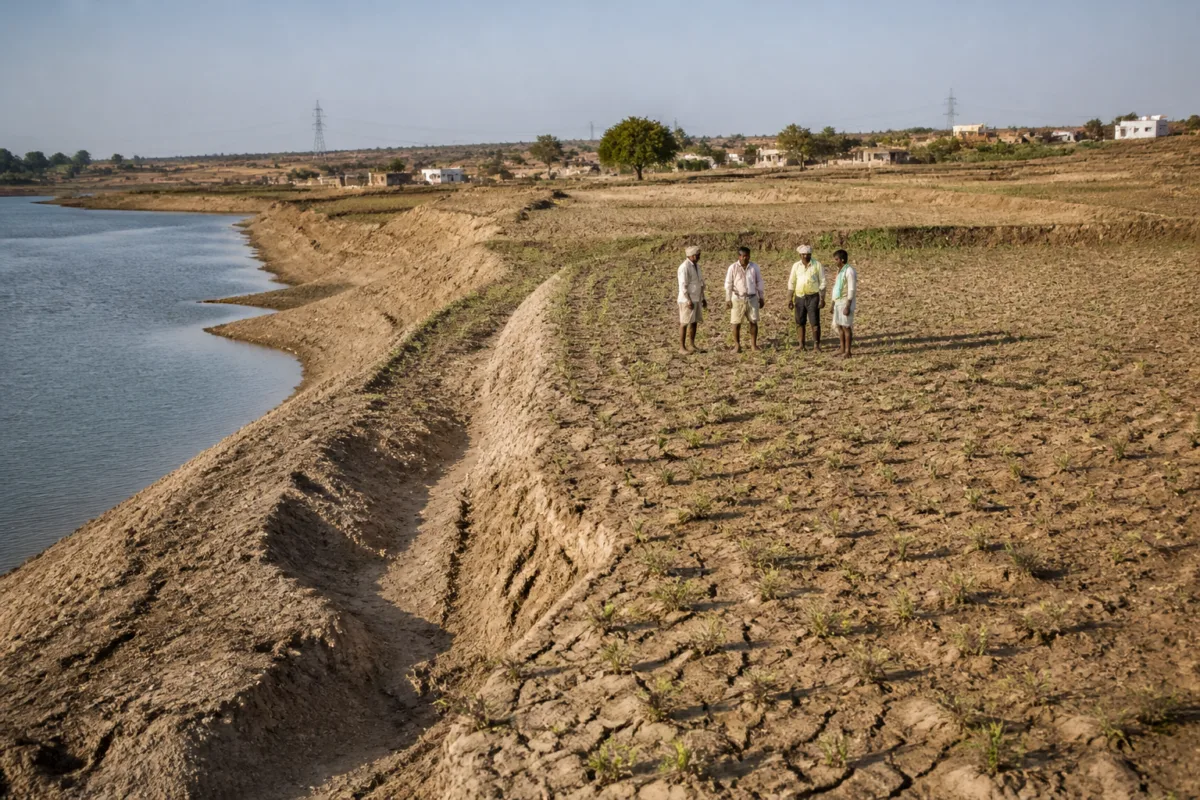
Telangana’s drought situation is tightening across rainfall, reservoir storage, groundwater and farm activity, according to a report by the Times of India, even as the state government seeks central assistance for relief and water-security measures. The report says overall Yasangi sowing has reached only 1.85 lakh acres against a normal area of 73.71 lakh acres, while all 32 districts remain below 25% of their normal sowing area.
The immediate significance of the Telangana drought extends beyond agricultural output. The reported deficits are also placing pressure on reservoirs, groundwater and drinking-water planning, linking the farm crisis to the wider management of the state’s water systems. The state government has declared 365 mandals across 31 districts drought-affected, including 111 severely affected and 254 moderately affected mandals.
The report attributes the weak agricultural activity to the combined effect of El Niño-related conditions and rainfall shortages. Telangana received 645.5 mm of rainfall between June 1 and November 11, against a normal 839.2 mm, representing a 23% deficit. The southwest monsoon ended with a 17% deficit, while the northeast monsoon had recorded a 70% shortfall at the time of reporting. October was particularly dry, with rainfall of 12.7 mm against a normal 90.1 mm, an 86% deficit.
These figures matter because the state’s cropping calendar depends on the availability and timing of water, not merely on the total annual rainfall. A delayed or deficient monsoon can affect the area farmers are willing or able to cultivate, while low reservoir levels and falling groundwater reduce the options available for supplementary irrigation. The supplied report does not establish how much of the affected agricultural area depends on each source of water, but it shows that both surface and groundwater indicators have deteriorated.
Cumulative storage in major reservoirs stood at 409.78 trillion cubic feet on November 11, compared with 905.83 TMC during the corresponding period a year earlier, according to the report. The comparison indicates a substantial reduction in stored water available for competing needs. Those needs include irrigation, drinking water and livestock protection, all of which the state has included in its request for central assistance.
Groundwater conditions have also worsened. The state’s average depth to groundwater increased from 4.42 metres below ground level in October 2025 to 8.28 metres in October 2026. A greater depth to groundwater means that water is located farther below the surface, increasing the dependence on deeper extraction and potentially raising the cost and energy required to access it. The report places Vikarabad at 13.54 metres, followed by Sangareddy at 12.93 metres and Medchal at 12.67 metres.
The district-level figures show that the water stress is not confined to one agricultural belt. All 32 districts have reported less than 25% of their normal sowing area. Maize sowing stood at 27,994 acres against a normal 8.95 lakh acres, while jowar covered 12,746 acres against a normal 2.55 lakh acres. Groundnut performed relatively better, with 66,835 acres, or 28.2% of its normal area, reported as covered. Bengal gram accounted for 44,246 acres and black gram for 11,867 acres.
The supplied report contains a material inconsistency in its paddy-sowing figure. It states that paddy sowing has covered only 38 acres against a normal seasonal area of 54.33 lakh acres. That figure does not align with the report’s broader description of sowing or with the scale implied by the other crop numbers. The original report must be checked against the state agriculture department’s sowing bulletin or another primary record to establish whether the intended figure was 38 acres, 38 lakh acres or another number. Until that clarification is obtained, the paddy-specific comparison should not be treated as established.
The wider sowing total is also presented as 1.85 lakh acres against a normal Yasangi area of 73.71 lakh acres, equivalent to 2.5% of the seasonal target. This number is central to understanding the severity and timing of the agricultural slowdown, but the report does not provide the date on which the normal seasonal target is expected to be reached or the share of the season that had elapsed when the figures were recorded. Those details would help distinguish an early-season delay from a more persistent failure to sow.
The comparison with the 2014-15 agricultural season provides historical context. During that El Niño year, rainfall reportedly declined from 905 mm to 682 mm, a fall of 25%. Paddy cultivation area fell from 49.3 lakh acres to 34.97 lakh acres, a 29% decline, while rice production dropped from 98.72 lakh tonnes to 68.18 lakh tonnes, a 31% reduction. The net irrigated area declined from 56.34 lakh acres to 42.65 lakh acres.
That earlier episode illustrates how rainfall stress can move through the agricultural system. The initial disruption is meteorological, but its consequences are transmitted through irrigation availability, cultivated area and production. The figures do not establish that the current season will follow the same pattern, but they show why the present reservoir and groundwater data are relevant to more than the immediate sowing count.
The governance response is being organised across multiple layers. Chief Minister A Revanth Reddy is seeking central assistance and relief measures, while the state government has requested a special assistance package of ₹30,000 crore to address El Niño-related drought concerns. The request covers crop losses, input subsidies, drinking water, fodder, livestock protection and groundwater recharge.
This list is important because it combines short-term relief with measures aimed at water-system recovery. Crop-loss support and input subsidies address the immediate financial impact on farmers. Drinking-water and fodder assistance respond to household and livestock needs. Groundwater recharge addresses a slower-moving resource problem. The supplied material does not specify the proposed funding structure, implementing agencies, release schedule or criteria for distributing the requested package, so those administrative details remain unestablished.
The drought declaration covering 365 mandals across 31 districts also creates an institutional basis for relief measures, but the report does not state how the mandals were assessed, what thresholds were applied or how the categories of severe and moderate drought translate into assistance. Those details will determine how the declaration works in practice for residents, farmers and local administrations.
For urban areas, the most relevant issue is the link between rural water stress and municipal resilience. Declining groundwater and low reservoir storage can affect drinking-water systems, tanker dependence, livestock movement and the allocation of water between agricultural and domestic uses. The supplied report does not quantify any urban supply disruption, so no such impact can yet be stated as a current fact. But the water indicators show why city and district administrations will need reliable information about storage, extraction and demand as the season progresses.
The evidence currently confirms a broad-based rainfall deficit, sharply reduced reservoir storage, deeper groundwater levels, low sowing across crops and a large drought declaration. It does not yet establish the corrected paddy-sowing figure, the full causes of the reported deficits, the final scale of crop loss or whether the requested ₹30,000 crore package has been approved. The next developments to monitor are clarification of the sowing data, official decisions on central assistance, changes in reservoir storage and groundwater levels, and the implementation of drinking-water, livestock and recharge measures across the affected mandals.

