


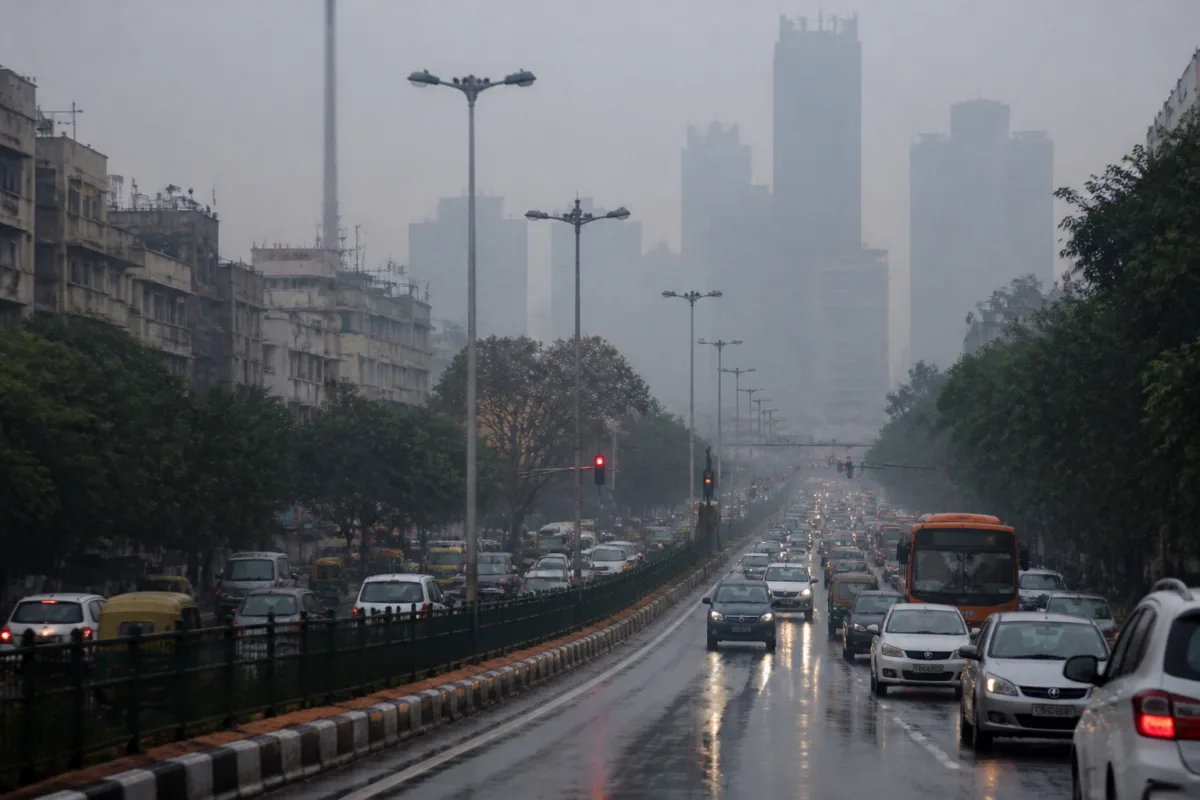
Delhi air quality improved to the poor category on Sunday after stronger winds and light drizzle helped disperse pollutants, but the relief is expected to be short-lived, with forecasts indicating a return to the very poor category between Tuesday and Wednesday. Authorities have therefore decided to keep Stage 3 restrictions under the Graded Response Action Plan in force across Delhi-NCR.
The city’s average air quality index stood at 290 at 4 pm on Sunday, according to Central Pollution Control Board data. The reading brought Delhi out of the very poor category after five consecutive days. The AQI had been 350 in the morning before falling as weather conditions improved.
Of Delhi’s 58 monitoring stations, 34 recorded air quality in the poor category, while 23 remained in the very poor category. Delhi Cantonment recorded AQI levels between 200 and 300, placing it in the moderate category. The highest reading was recorded at the NSIT monitoring station in Dwarka, where the AQI reached 364.
Delhi’s AQI had previously stood at 299 on November 10, after which pollution remained in the very poor category for five days. During that period, hourly pollution levels came close to the severe category on several occasions and crossed it once, according to the report.
Real-time source apportionment data showed that biomass burning was the largest contributor to Delhi’s pollution on Sunday, accounting for 37.1 per cent. This category included stubble burning as well as the household burning of wood, cow-dung cakes and other solid biofuels. Secondary organic aerosols contributed 22 per cent, while vehicle emissions accounted for 17.2 per cent.
Secondary inorganic aerosols contributed 9.6 per cent, followed by waste burning at 5.5 per cent, mixed fuel combustion at 4.3 per cent, mineral dust and ash at 2 per cent, fireworks at 1.6 per cent and industrial emissions at 0.6 per cent.
Weather conditions were the main factor behind Sunday’s improvement. Winds from the south-west reached speeds of up to 15 kmph, while very light rain or drizzle was recorded in several parts of Delhi during the previous 24 hours. The combination helped disperse suspended pollutants from the atmosphere.
However, the ventilation index is expected to weaken over the coming days. According to the weather department, Delhi’s ventilation index was 16,000 square metres per second on Sunday. It is expected to fall to 15,000 on Monday, 7,500 on Tuesday and 6,000 on Wednesday. When the index falls below 6,000 and average wind speed remains below 10 kmph, the dispersion of pollutants becomes more difficult.
The Air Quality Early Warning System has forecast that Delhi’s air could remain in the poor category on Monday before deteriorating to very poor between Tuesday and Wednesday. Pollution is expected to remain in the very poor category for up to the following six days, according to the forecast cited in the report.
Tarun Pithode, member secretary of the Commission for Air Quality Management, told Jagran that the improvement was likely to last only one or two days. He said GRAP Stage 3 would not be withdrawn because conditions were forecast to worsen from Tuesday.

