


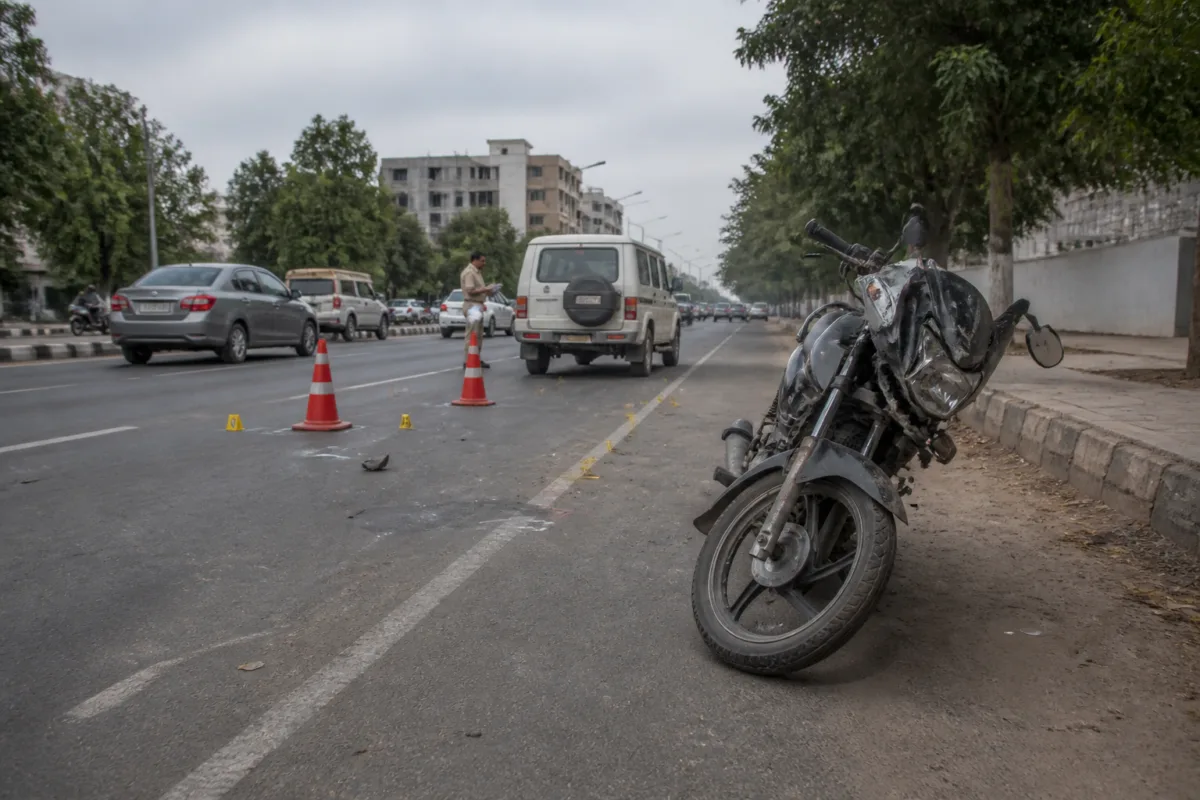
The Ahmedabad hit-and-run case in Shilaj is no longer only a story about a fatal collision involving a Range Rover and a motorcycle. It has become a test of how quickly police preserve evidence, apply serious charges and communicate with the public when the accused is related to a sitting legislator. The reported sequence—an arrest about 17 hours after the crash, a blood sample collected roughly 30 hours after it, and the accused later released on bail—has placed the investigation’s procedure under scrutiny.
According to the report by Gujarat Samachar – Ahmedabad, the crash took place in Shilaj on November 11. Raghavendra Kushwaha, identified as the nephew of BJP MLA Dinesh Kushwaha, allegedly struck a motorcycle with a Range Rover, killing 35-year-old Harshadkumar. The report says the driver left the scene after the collision and was arrested the following day after witnesses helped police identify the vehicle.
The central public-interest question is not limited to whether the vehicle was speeding or whether the driver had consumed alcohol. It is whether the investigation moved with the urgency normally expected in a fatal road crash. In such cases, the first hours are important because blood alcohol evidence can diminish, digital records can establish movement, vehicle data can assist reconstruction, and witness recollections can be secured before they weaken.
## What the Ahmedabad hit-and-run case reveals about evidence timing
The report says the accused was arrested approximately 17 hours after the incident. It also says that the blood sample was collected around 30 hours after the crash. Police have reportedly indicated that further action will depend on the forensic report. If intoxicating substances are detected, additional sections may be added to the case.
That sequence creates a basic evidentiary problem. A blood test taken many hours after a crash may not answer the same question as a sample collected soon after the incident. The supplied report does not establish the eventual forensic result, nor does it provide an independent assessment of how the delay affected the evidentiary value of the sample. What it does establish is that the timing has become a major point of dispute between the police account and the public account of the investigation.
The report says a deputy superintendent of police initially avoided giving a clear answer on the blood test, while the accused told the media that a test had been conducted. Police later stated that the blood sample was taken after the delay. This contradiction matters because public confidence in a road-death investigation depends not only on the final charge sheet, but also on whether the investigative steps are explained consistently and promptly.
Police have reportedly said that preliminary statements and the initial inquiry indicate a misunderstanding involving vehicles ahead of the motorcycle. According to the reported police account, a vehicle in front stopped suddenly and the Range Rover collided with the motorcycle while the driver attempted to avoid it. The accused is also reported to have said that he was frightened after the crash. These are claims within the investigation, not findings that have been legally established.
## The institutional chain now under scrutiny
The investigation is not being handled by one institution alone. Police are examining witness statements and the accused’s movements; the Regional Transport Office is expected to contribute technical analysis; the Forensic Science Laboratory is involved in testing; and the vehicle manufacturer has reportedly been asked for technical information. The police are also expected to analyse the accused’s call detail records to establish where he was during the 17-hour period after the crash.
This institutional chain is important because vehicle-crash investigations often require different kinds of evidence to be assembled together. The RTO may assist with vehicle-related technical information, the forensic laboratory may examine physical or biological evidence, and digital records may help reconstruct communication and movement. None of these components, by itself, can settle the entire case. Their value depends on whether they are collected quickly, preserved properly and interpreted transparently.
The report says police have sought technical reports from the RTO, the FSL and Range Rover. It also says preliminary investigation did not indicate that the vehicle was travelling at extremely high speed, although the exact speed remains subject to technical reports. That distinction is significant: an initial police impression is not the same as a completed reconstruction, and the eventual findings will have to explain how speed was assessed and what evidence supports the conclusion.
The reported use of less serious sections, followed by the accused’s release on bail after questioning, has further intensified scrutiny. The supplied material does not provide the complete first information report, the precise sections invoked, the bail order or the court’s reasoning. It therefore cannot establish whether the charges were legally appropriate or whether the release departed from normal procedure. It does, however, show why access to these documents is essential for assessing the investigation independently.
## Why delayed action becomes a governance issue
Road crashes are often treated as isolated incidents caused by individual behaviour. Fatal hit-and-run cases also expose the administrative capacity of the city: how quickly emergency services and police respond, how investigators secure a scene, how vehicle evidence is documented, and how the system treats victims and accused persons during the first day of a case.
The Shilaj case raises these issues sharply because the accused is reported to be related to a political figure. That relationship does not prove preferential treatment. It does, however, create a heightened responsibility for the police to disclose the chronology of action clearly and to demonstrate that the same procedures would apply regardless of social or political connections.
The difference between an allegation and an established finding must remain central. The source report argues that the police appeared to act leniently and suggests that the accused was being protected. Those are allegations and editorial interpretations in the source material. The confirmed elements available in the report are the fatal crash, the delayed arrest, the delayed blood sampling, the accused’s release on bail, the police account of the collision and the decision to seek additional technical and digital evidence.
For urban residents, the larger concern is institutional predictability. A city’s road-safety system does not consist only of speed limits, traffic signals and enforcement drives. It also includes what happens after a crash. If evidence collection appears inconsistent, families of victims may struggle to understand the process, witnesses may lose confidence in cooperating, and public debate may shift from the facts of the crash to questions about influence.
## The unresolved evidence trail
Several questions remain open in the reported case. The first is what the blood test will show and how investigators will account for the time between the crash and collection of the sample. The second is whether the call detail records establish the accused’s movements during the period before his arrest. The third is what the technical reports conclude about the vehicle’s speed, braking, impact and other relevant conditions.
The fourth concerns the precise legal provisions applied at the beginning of the case and whether investigators later modify them in response to forensic findings. The source material says that additional sections may be added if intoxicants are detected, but it does not specify the complete set of existing sections or the legal basis for bail. Those details will be necessary to evaluate whether the response was proportionate to the available evidence.
The final question is one of communication. The reported contradiction over the blood test has already weakened clarity around the investigation. A credible process requires authorities to publish or explain the timeline: when the crash was reported, when officers reached the location, when the vehicle was identified, when the accused was contacted or arrested, when samples were taken, and which agencies received evidence for examination.
The Ahmedabad hit-and-run case therefore presents a broader accountability test. The eventual forensic, technical and digital findings may clarify what happened on the road. They will not, by themselves, resolve questions about why key investigative steps occurred when they did or whether the process was applied without favour. Those answers depend on the police record, the court documents and the transparency of the authorities handling the case.

