


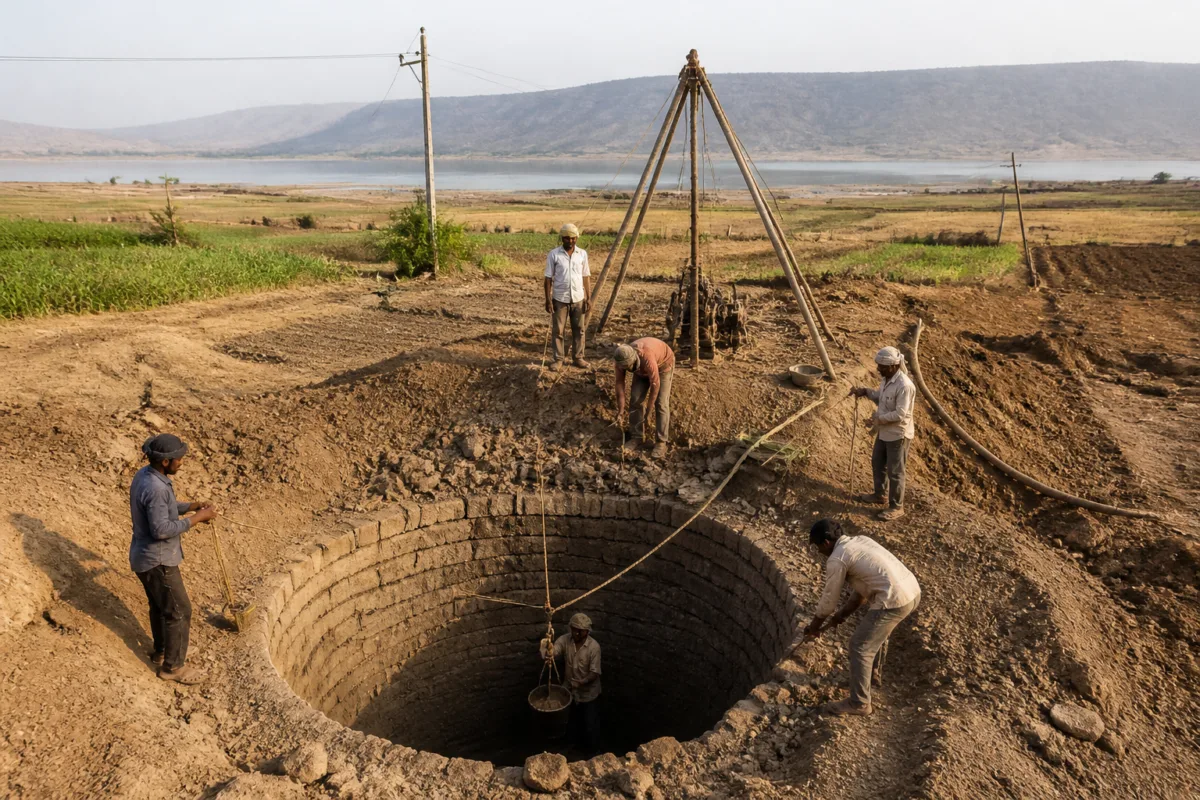
Farmers living along the Ujani Dam in Pune district are turning to privately financed wells and borewells as falling reservoir levels and restricted electricity supply make it harder to keep standing crops watered, according to a report by Lokmat – Pune.
The situation has been reported from the Palasdev area and surrounding villages, where farmers are preparing for a further decline in available water. The report said electricity supply for agricultural use has been limited to eight hours, adding to the difficulty of operating irrigation systems and delivering water to fields.
With the Ujani reservoir’s storage reducing, farmers have begun digging wells and borewells in an effort to protect crops. The measures are being taken before water availability falls further, as farmers seek to maintain at least part of their cultivation if the reservoir’s supplies become critically low.
According to the report, wells dug to a depth of about 30 feet can cost between Rs 2 lakh and Rs 2.5 lakh. Despite the expense, farmers in the Ujani region are reportedly prepared to undertake the work using their own money. Some are also considering borrowing to finance the excavation, placing the cost of water access directly on already vulnerable farm households.
The decision reflects a wider administrative problem in how irrigation support reaches farmers. Farmers in the Palasdev area told Lokmat – Pune that financial assistance of up to Rs 6 lakh is available for wells under the Mahatma Gandhi National Rural Employment Guarantee Scheme. However, they said complicated rules, financial constraints and difficulties in dealing with officials have discouraged them from using the scheme.
The farmers have described the scheme as difficult to access and burdensome to implement, alleging that administrative negligence has reduced its practical usefulness. Rather than wait for the subsidy process, they are choosing to arrange funds themselves and begin the work independently.
The immediate issue is not only the declining water stored in Ujani Dam but also the reliability of the systems connecting public support to farm-level water security. Restricted electricity hours affect when irrigation equipment can be operated, while the cost of new wells creates a separate financial barrier. Together, these pressures are forcing farmers to make urgent decisions before the water situation worsens.
The report did not provide the current live storage level of Ujani Dam, the number of affected villages or an official response from the irrigation, electricity or rural development authorities. It also did not establish whether the reported subsidy amount has been revised or how many applications from the region remain pending.
For farmers around Ujani, the next steps will depend on the reservoir’s remaining storage, the availability of agricultural electricity and whether government assistance can be accessed without delays or procedural obstacles. The digging of private wells and borewells is already under way as households attempt to protect crops ahead of a possible further reduction in water availability.

