


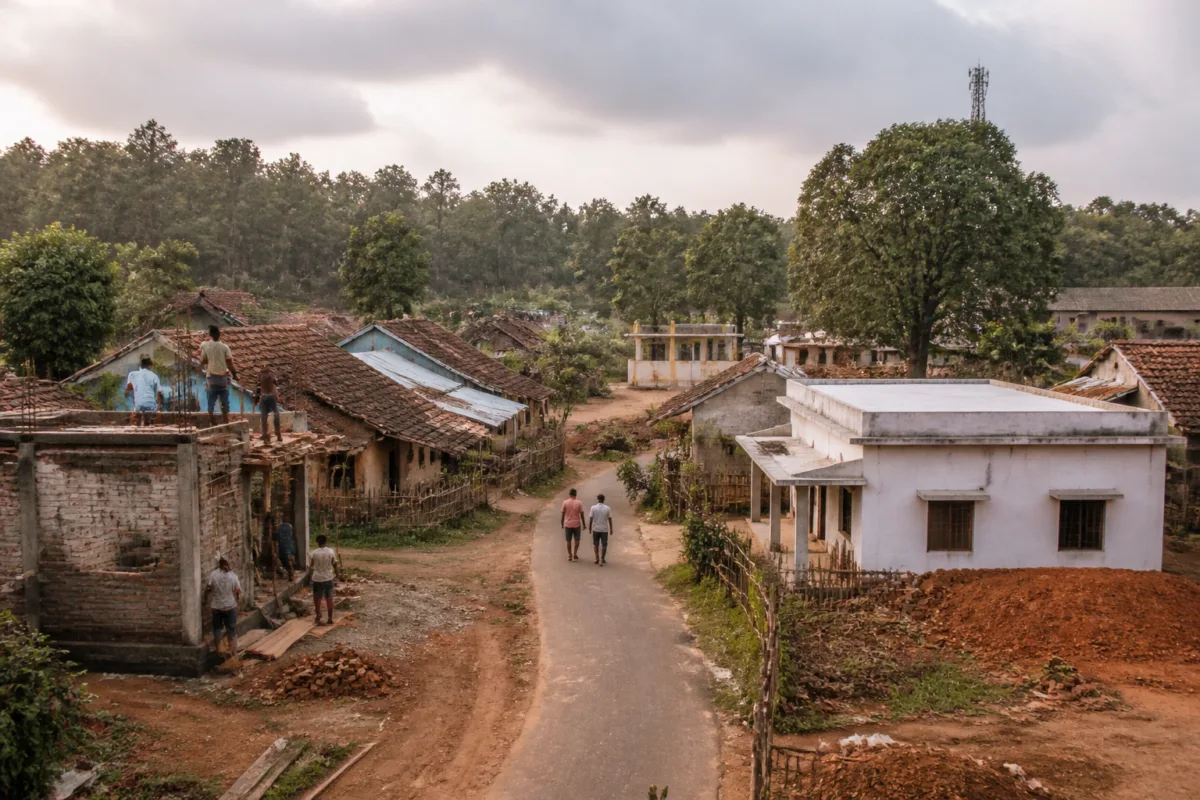
A reported promise to eliminate mud houses in Jhargram and provide concrete roofs to every resident has placed housing, land rights and basic infrastructure at the centre of a public programme in the district. The report also describes announcements involving drinking water, tribal land ownership, employment and 188 infrastructure projects. However, the account contains a material inconsistency over the identity and office of the leader who made these commitments, making independent verification necessary before the announcement can be treated as established fact.
According to Anandabazar, the announcements were made at Shilda in Jhargram during an event marking the birth anniversary of Birsa Munda and Janjatiya Gaurav Divas. The report says the leader told tribal residents that no kutcha, or non-permanent, houses would remain in the district and that residents would receive concrete roofs instead of having to live under tin or tiled roofs.
The same report attributes additional commitments to the speaker. These include a promise that tribal residents would not face discrimination in employment, that no fraudulent Scheduled Tribe certificates would be issued, and that drinking water would reach every household in Jhargram. The account also says that 770 tribal residents were handed land ownership documents or pattas during the programme.
The housing announcement is significant because it frames the district’s built environment through the condition of individual homes rather than only through large public projects. A promise to replace kutcha structures with permanent roofs would involve identifying eligible households, determining the form of financial or technical assistance, securing land and construction permissions, and monitoring whether houses are completed. The report does not provide a deadline, a budget, a beneficiary list or an implementation agency for the proposed housing work.
That absence of operational detail is important. A public commitment to provide concrete roofs can refer to several different interventions, including new house construction, structural upgrades, roofing replacement or support under an existing housing programme. The supplied report does not specify which model would be used in Jhargram. It also does not establish whether the commitment covers every household in the district or households identified as living in kutcha structures.
The report says the leader cited an aerial view of Jhargram, where many tin-roofed and tiled houses were visible, as the reason for making the housing promise. This observation provides a political description of the district’s housing condition, but the report does not supply a survey count of kutcha homes, information on their structural condition or details of how housing need was assessed.
Housing quality in rural and forest-edge settlements is closely linked to land tenure, access to roads, water supply and public services. In this account, the housing promise appears alongside a land-rights announcement and a drinking-water commitment. That combination suggests that the reported programme is not limited to roofing or construction. It also touches the administrative conditions that determine whether households can build, improve or legally occupy homes.
The report attributes a statement that 770 tribal residents received land ownership rights. It does not identify the specific land law, the type of pattas issued, the area covered, or whether the documents provide individual or community rights. Those details matter because different forms of land documentation create different rights and administrative responsibilities. Without them, the public significance of the announcement can be described only in broad terms.
The drinking-water commitment raises a similar implementation question. The report says work is under way to provide potable water to every house in Jhargram, but it does not state the number of households covered, the source of water, the delivery system or the completion schedule. Household water access can depend on pipelines, local sources, treatment systems, electricity supply and maintenance arrangements. None of these operational details is included in the supplied account.
The programme also included infrastructure announcements. Anandabazar reports that 137 projects were given foundation stones and 51 projects were inaugurated in Jhargram. The projects reportedly include roads, anganwadi centres, hostels, bridges and culverts. These categories cover both social infrastructure and transport links, but the report does not provide project-wise costs, locations, capacities, contractors or timelines.
The distinction between projects inaugurated and projects for which foundation stones were laid is administratively important. An inauguration generally indicates that an asset or completed stage is being opened for use, while a foundation-stone ceremony marks the beginning of a proposed project. The supplied report does not state the completion status of the 51 inaugurated projects or the expected delivery dates for the 137 projects announced for construction.
The account also contains a claim that 73 allegedly fraudulent Scheduled Tribe certificates had been identified and cancelled before the leader reached the district. The report does not name the issuing authority, describe the verification process, identify the affected individuals or provide documents relating to the cancellations. Since caste and tribal certificates determine access to reservations and public benefits, such claims require careful official confirmation and should not be treated as established beyond the attribution made in the report.
The most serious editorial limitation concerns attribution. The report’s headline and portions of its text describe the speaker as the chief minister, while another passage says that Suvendu Adhikari made the announcement. It also includes a quote referring to a cabinet under the speaker’s leadership. These descriptions cannot be reconciled from the supplied material alone. The identity of the speaker is central because the authority to announce state housing, land, employment and certificate policies depends on the office held and the institutional process behind the statement.
This ambiguity also affects the interpretation of the promises. If the statement came from the state government, readers would need to know which department, scheme or budget would carry it out. If it came from a political leader in another capacity, the commitments would have a different administrative status. The source does not provide a government notification, speech transcript, cabinet decision, departmental order or project document that resolves the matter.
The event nevertheless highlights a broader governance issue in Jhargram: the difference between announcing urban and rural built-environment improvements and delivering them through accountable systems. Homes, water connections, bridges, roads and anganwadi centres are experienced locally, but their delivery is divided across departments, local bodies and implementation agencies. The report identifies several promised outcomes without establishing the institutional chain responsible for each one.
For residents, the practical questions are therefore more specific than the political announcement. Which households qualify for permanent housing support? When will construction begin? Who will verify land ownership? How will water supply be maintained? Where are the 137 proposed projects located, and what are their budgets? What evidence supports the cancellation of the 73 certificates? The supplied report does not answer these questions.
The commitments also show how housing policy intersects with social inclusion. A permanent roof can improve safety and resilience, but housing support may remain incomplete if households lack secure tenure, road access, water or nearby public facilities. The reported inclusion of hostels, anganwadi centres, bridges and culverts indicates an approach that combines household assets with community infrastructure, although the available material does not establish whether the projects form a coordinated district plan.
At present, the evidence supports reporting that Anandabazar published an account of a public event at Shilda where major commitments relating to housing, land, water, employment, certificates and infrastructure were attributed to a political leader. It does not support treating the identity of that leader, the official status of the commitments or their implementation timetable as fully established.
The next verification steps are clear: the event speech or official transcript should be examined, the responsible government departments should confirm the housing and land announcements, and project documents should establish the locations, costs and timelines of the 188 infrastructure works. Until those records are available, the Jhargram housing promise remains a significant but incompletely verified announcement.

