


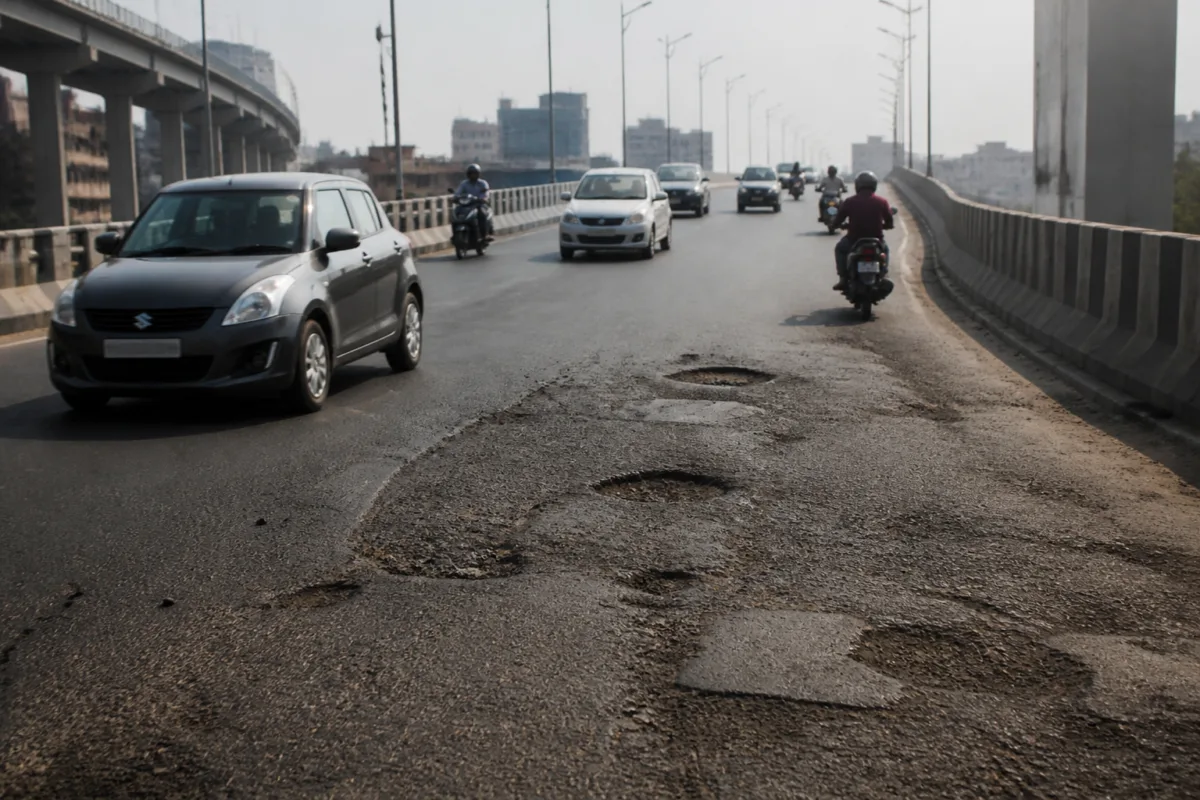
Potholes appearing on Ahmedabad’s ₹464 crore Sarkhej-Iskcon bridge within a week of its inauguration have turned a new piece of urban infrastructure into a test of construction supervision, defect liability and public accountability. Sandesh reported that the bridge, inaugurated on November 9, developed damaged asphalt and potholes near one end within seven days, raising concerns about whether the project was adequately inspected before being opened to traffic.
The immediate issue is physical safety. A pothole on a busy bridge is not merely a maintenance inconvenience. It can force drivers to brake or swerve suddenly, particularly where vehicles are travelling at speed and road users have limited space to avoid a damaged patch. The report says motorists expressed anger and that the condition created the possibility of accidents. However, the supplied report does not establish whether any accident or injury has occurred.
The incident also highlights a familiar weakness in the way urban infrastructure is judged. A bridge is often treated as complete when construction ends and an inauguration takes place. For residents, however, the useful life of the asset begins only when it carries daily traffic. The first days of operation reveal whether the road surface, joints, approaches, drainage, markings and safety arrangements can withstand actual use. In this case, the reported early failure of the asphalt surface has placed the quality of that transition under scrutiny.
The bridge was built at an estimated cost of ₹464 crore and the construction work was assigned to Ram Kumar Contractor, according to the report. Those details make the timing significant. The problem is not being reported after years of wear, repeated monsoon damage or prolonged heavy use. It is alleged to have emerged within roughly one week of the opening. That does not by itself establish the technical cause, but it makes the questions around inspection, material quality, workmanship and acceptance procedures difficult to avoid.
A pothole can result from several possible failures in a road system, including weaknesses in the asphalt layer, poor compaction, inadequate preparation of the underlying surface, water infiltration or damage at the junction between the bridge and the approach road. The supplied report does not identify which of these caused the damage. It also does not provide an engineering inspection, laboratory test, project completion certificate or official technical explanation. Those limits matter because responsibility cannot be assigned conclusively from the appearance of a pothole alone.
What the report does establish is a troubling sequence: a high-value bridge was inaugurated, the road surface reportedly deteriorated within days, and motorists began questioning the quality of the work. The sequence points to a potential gap between formal completion and effective quality assurance. In a well-functioning project system, construction is followed by inspection, testing and acceptance before the asset is opened. A defect that becomes visible almost immediately raises the question of whether those checks were sufficient, whether defects were recorded, and who remains responsible for correcting them.
## The accountability chain behind a new bridge
Public infrastructure is delivered through a chain rather than by a single actor. The contractor executes the work, while the responsible public authority oversees specifications, supervision, measurements, payments, testing and final acceptance. Consultants or engineers may also be involved, depending on the project structure. When a defect appears, accountability therefore requires more than identifying the contractor named in a news report. It requires establishing which authority approved the work, what standards were specified, what inspections were carried out and whether the work remains covered by a defect-liability obligation.
The report calls for an immediate investigation and strict action against the responsible agency. That demand reflects a broader governance problem: citizens can see the defect, but they cannot easily see the documents that explain how the project was certified. Public confidence depends not only on repairing the damaged surface but also on clarifying the process that allowed the problem to appear so soon after inauguration.
The supplied material does not identify the project-owning authority’s response, the contractor’s explanation or the findings of any inspection. It also does not state whether the damaged portion was temporarily repaired, whether traffic controls were introduced or whether the entire bridge was examined for similar defects. These are the next factual questions for any official follow-up. Without them, the public can see the symptom but not yet the institutional cause.
## Why the timing matters more than the repair alone
A quick patch may reduce the immediate risk, but it would not resolve the larger issue if the underlying construction or water-management problem remains. Nor would a repair alone answer whether the project was accepted in accordance with its contract. The difference between maintenance and accountability is important. Maintenance restores service; accountability explains why the defect occurred, who bears the cost and what safeguards will prevent repetition.
The timing also changes the meaning of the expenditure. At ₹464 crore, the bridge represents a substantial public investment. The report does not provide the project’s length, design capacity, traffic volume, construction duration or approved technical specifications, so it is not possible to assess value for money or compare the asset with similar bridges. But the reported early deterioration makes lifecycle performance more relevant than the inauguration-day presentation. A public project’s value is measured over the years it safely serves users, not only by the scale of its opening ceremony.
For road users, the distinction is practical. A new bridge is expected to reduce travel friction and provide a reliable connection across a busy urban corridor. If its surface requires urgent attention almost immediately, motorists face uncertainty about the condition of the route and the possibility of disruptions during repairs. The report identifies the Iskcon-Sarkhej bridge as being on a busy road, making the quality of the approach and bridge surface directly relevant to everyday mobility in Ahmedabad.
## What remains unverified
The central reported fact is that potholes appeared near the end of the bridge within seven days of inauguration. The supplied report does not include an official statement, engineering assessment, photographs with independently verified timing, repair records or a response from Ram Kumar Contractor. It also does not establish that poor construction caused the damage, although the report and public reaction raise that possibility.
That distinction is essential. Allegations of corruption or waste of public money cannot be treated as established facts without documentary or official evidence. The reported condition may justify an investigation, but the result of that investigation is not available in the supplied material. Similarly, the presence of a defect does not automatically prove that every part of the bridge is unsafe. A technical assessment would be needed to determine the extent and severity of the problem.
The most important follow-up is therefore not another inauguration statement or an isolated patch. It is a documented response from the responsible authority: an inspection of the damaged area and the wider bridge, identification of the failure mechanism, disclosure of the repair responsibility and confirmation of whether the work meets the project’s contractual standards. The contractor’s response and any findings from the authority would also help distinguish a local surface defect from a wider construction-quality issue.
Ahmedabad’s bridge episode shows how a visible defect can expose an invisible governance gap. The public sees potholes within days; the administrative system must show whether the project was properly tested, accepted and protected by enforceable quality controls. Until that evidence is available, the reported damage remains a serious warning about the distance between completing infrastructure and delivering infrastructure that performs safely in daily urban life.

