


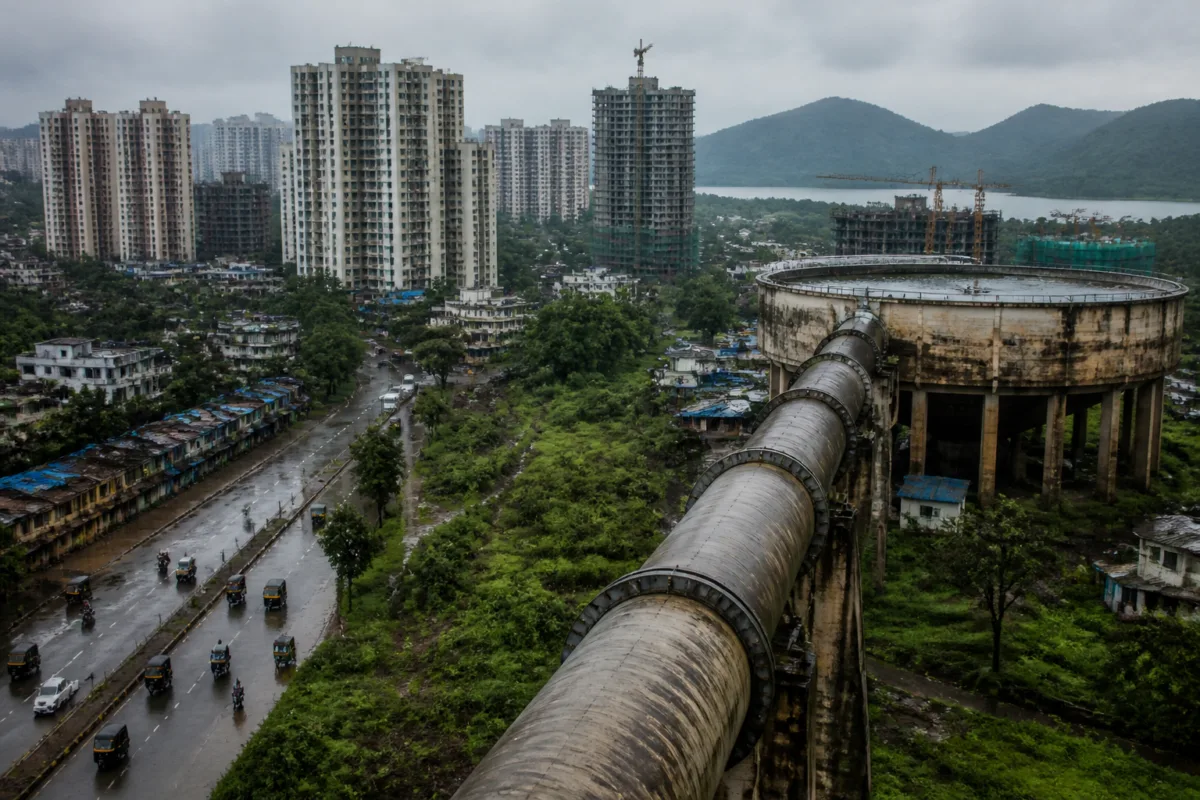
The Mumbai Metropolitan Region is being asked to absorb eight lakh new homes by 2030, but the water system serving the region is already short of current demand. That mismatch, highlighted in a Loksatta report, puts the region’s housing expansion plan at the centre of a larger urban question: can new homes be counted as progress when the basic infrastructure needed to make them liveable is not yet secured?
The housing target is part of a broader plan to develop the Mumbai Metropolitan Region as a growth hub. The report says the Union government has directed states to develop selected metropolitan areas to support the national goal of building a five-trillion-dollar economy. Under this framework, the MMR is expected to plan for 30 lakh affordable homes by 2047, with eight lakh to be completed by 2030.
The scale is substantial. The report says the City and Industrial Development Corporation, Maharashtra Housing and Area Development Authority, Slum Rehabilitation Authority and other government agencies will participate in the programme. MHADA alone has been assigned responsibility for 7,14,082 homes. That means the largest share of the target is tied to a public housing agency, even as the region’s water availability remains below present demand.
This is not simply a question of finding land or approving construction. Housing is an urban service bundle. A dwelling requires a dependable supply of water, drainage, roads, electricity, public transport and access to social infrastructure. When one of those systems is weaker than the rate of construction, the result is not only an engineering shortfall. It can affect the daily usability, affordability and long-term sustainability of the homes being created.
The immediate water numbers are already difficult. According to the report, Mumbai’s current daily drinking-water demand is approximately 4,600 million litres per day, while actual available supply is about 4,100 MLD. On the figures cited, the existing gap is roughly 500 MLD. This shortfall exists before the proposed eight lakh homes are added to the urban system.
The distinction between housing supply and serviced housing is therefore critical. A construction target can be measured through tenders, work orders, building completions or possession. Water capacity must be measured differently: through source availability, treatment, transmission, storage, distribution and the ability of local agencies to deliver water consistently to each settlement. The report does not provide a detailed water allocation plan for the proposed homes, but its central concern is clear: the housing programme has a quantified target, while the corresponding resource plan remains inadequate in the assessment presented.
Mumbai’s present water system is also exposed to climatic variability because it depends primarily on rainfall and reservoir storage, the report says. In years of deficient rainfall, alternative sources are limited. This creates a planning problem that cannot be resolved merely by adding housing to a regional development schedule. A housing programme tied to a growth-hub strategy must also account for the reliability of the systems that support urban life during both normal and stressed conditions.
Two proposed sources are expected to improve the position: the Gargai dam and desalination projects at Manori and Versova. The report says these projects are planned for completion by 2030. However, even after their expected contribution, the supply available is projected to remain below demand, with an estimated deficit of 180 MLD. The figure is significant because it suggests that new sources may reduce the gap without eliminating it.
That projected deficit changes the meaning of the 2030 deadline. If the housing target and the water projects share the same completion horizon, the region has little margin for delay, cost escalation, land-related obstacles, environmental approvals, construction setbacks or commissioning problems. The report does not establish whether the water projects will be completed on schedule, nor does it set out the quantity each project is expected to add. But it does establish the underlying planning tension: the homes are being planned at a scale that outpaces the water security described in the report.
The institutional structure makes coordination especially important. MHADA, CIDCO, the Slum Rehabilitation Authority and other agencies may build or facilitate housing, while water supply is managed through separate municipal and regional systems. That separation can produce a familiar governance gap. One authority may be assessed on the number of homes delivered, while another carries responsibility for ensuring that those homes receive water. Unless targets, budgets and implementation schedules are aligned, physical construction can move faster than service readiness.
The reported allocation also shows why the issue cannot be treated as a private real-estate concern. More than seven lakh of the eight lakh proposed homes are assigned to MHADA, according to Loksatta. Public agencies are therefore central to the delivery model. The question is not only whether the state can create affordable housing, but whether it can integrate housing production with the capital-intensive systems that make urban expansion functional.
The phrase ‘affordable housing’ adds another layer to the problem. A home may have a controlled sale price or be developed under a public programme, but household costs are also shaped by the reliability of basic services. Where water supply is uncertain, residents may face indirect costs linked to storage, private purchases, time spent collecting water or dependence on informal arrangements. The supplied report does not quantify these household impacts, so their scale cannot be established here. But the infrastructure constraint identified in the report makes service reliability a necessary part of evaluating affordability.
The numbers also reveal a sequencing issue. The MMR’s long-term objective is 30 lakh affordable homes by 2047, while the first eight lakh are expected by 2030. This creates a phased development pathway, but the report’s water assessment indicates that the service system is already under pressure at the beginning of that pathway. If the initial phase proceeds without closing the current gap, subsequent phases could compound the problem. Conversely, if water capacity is treated as a condition for each phase, housing delivery may need to be synchronised with source augmentation and network expansion.
The report does not provide a detailed regional breakdown of where the homes will be built, which municipalities will receive them, or how demand will be distributed across the MMR. That information matters because water stress is not experienced uniformly across a metropolitan region. The capacity of a source is only one part of the supply chain; local treatment, pipelines, reservoirs and distribution networks determine whether water reaches a particular settlement. Without those details, the region-wide housing target cannot yet be translated into a precise local service requirement.
The same limitation applies to the projected 180 MLD deficit. It signals that the planned additions may not meet expected demand, but the supplied material does not explain the assumptions behind the projection, including the population basis, per-capita demand, industrial use or the contribution expected from each proposed project. Those details would be necessary to assess whether the estimate is conservative, optimistic or linked to a specific planning scenario. The figure should therefore be read as the deficit reported by Loksatta, not as an independently verified forecast in this article.
Even with those limitations, the planning signal is strong. Metropolitan growth cannot be governed through construction numbers alone. The MMR is being positioned as an economic growth hub, and housing is a central component of that ambition. But growth-hub planning increases, rather than reduces, the need to match land development with water security. New households, workers and communities will depend on the same stressed resource system as existing residents.
The immediate institutional task is to connect the two plans. Housing agencies need clarity on the water capacity available for each project and each phase. Municipal and regional authorities need a coordinated schedule for source development, treatment and distribution. Public monitoring also needs to distinguish between homes sanctioned, homes under construction and homes that are occupied with assured basic services. The supplied report does not state whether such a unified monitoring system currently exists.
What the evidence confirms is a sharp imbalance: eight lakh homes are targeted by 2030, current Mumbai demand is reported at 4,600 MLD against 4,100 MLD of supply, and a further 180 MLD deficit is expected even after the planned Gargai and desalination projects. What remains unclear is how water will be allocated to the new settlements, how the regional network will be expanded and whether the proposed projects will meet their planned timelines. Those questions will determine whether the MMR’s housing ambition becomes a programme of serviced urban growth or a larger construction target built on an unresolved water crisis.

