


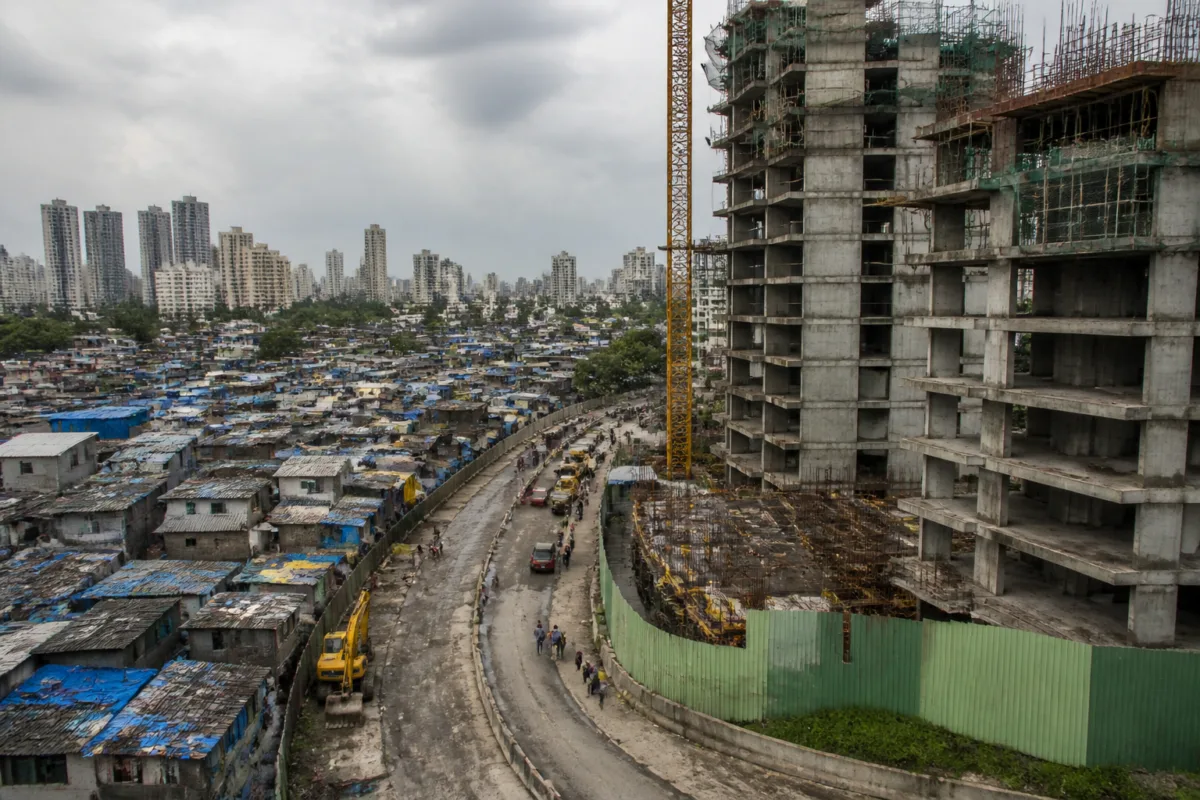
The revision of Letters of Intent for more than 30 Mumbai SRA projects in Bandra, Santacruz and Versova has exposed a regulatory fault line at the intersection of coastal protection, road widening and slum redevelopment. The Slum Rehabilitation Authority has reduced the buildable area available to these projects after identifying that earlier calculations had been made over the entire plot, rather than the portion left after land was transferred for public use.
The change affects projects mainly located in the H West and K West municipal wards, covering parts of the Bandra-to-Andheri coastal belt. According to a report by Loksatta – Mumbai, the SRA cancelled the earlier Letters of Intent and issued revised documents after the interpretation was found to be inconsistent with Coastal Regulation Zone rules.
The immediate consequence is financial. The revised calculations reduce the floor space available to developers, which is expected to lower the profitability of the affected schemes. Developers have consequently become concerned about projects that had been planned around the earlier development potential. The change also illustrates how a technical approval error can alter the viability of redevelopment long after a project has entered the regulatory pipeline.
At the centre of the dispute is the treatment of plots located in the Coastal Regulation Zone where part of the land is transferred for road widening. The rule described in the report requires the floor space calculation to be applied to the remaining plot after the area handed over for public use is excluded. The SRA had instead issued floor space calculations on the entire plot, according to the report. Once the inconsistency was identified, the authority withdrew the earlier approvals and replaced them with revised Letters of Intent.
This is not simply a dispute over an additional portion of construction area. In slum rehabilitation, floor space is closely linked to the financial structure of a project. A developer typically uses the sale component to cross-subsidise the rehabilitation component, while the total permissible floor space determines how many sale units, rehabilitation units and supporting facilities can be accommodated. A reduction in the permissible area can therefore affect the scheme’s internal economics, even when the obligation to rehabilitate eligible residents remains unchanged.
The source report also links the affected proposals to Development Control Regulation 33(11). Under the provision described in the report, the SRA has powers to permit a floor space index of up to four even on vacant plots in qualifying circumstances. Developers are required to provide permanent transit accommodation within five kilometres. The combination of enhanced development potential and a geographically defined transit-accommodation obligation creates a planning framework in which both the land calculation and the location of temporary housing are important to project feasibility.
The latest action shows why the sequence of approvals matters. A Letter of Intent is not the final building permission, but it establishes key parameters around which a redevelopment proposal is structured. If the development potential recorded in that document is later revised, the impact can spread across design, financing, construction phasing, sale inventory and negotiations with residents. The report does not establish how far construction has progressed in each of the affected projects or whether all schemes had reached the same approval stage. Those project-level details remain important for understanding the operational impact of the revisions.
The regulatory issue also highlights a recurring governance challenge in Mumbai’s redevelopment system: different public objectives are often carried by the same parcel of land. A plot may be needed for rehabilitation, commercial cross-subsidy, road widening and compliance with coastal regulations at the same time. Each objective is administered through a different set of rules or institutions, but the development potential is ultimately calculated on one physical site. A change in the treatment of even one part of that site can alter the outcome for every stakeholder.
In this case, land transferred for road widening is treated as land for public use and therefore excluded from the area on which the relevant floor space is to be calculated, as described by the report. That distinction is central. If public-purpose land is counted in the development calculation, the project receives a larger theoretical development envelope than it would if the calculation were based only on the balance plot. The SRA’s revision therefore functions as a correction to the base used for calculating permissible construction, rather than as a new citywide reduction in FSI.
The episode also raises questions about coordination between coastal regulation, municipal road planning and redevelopment approvals. The affected schemes are in a high-value and densely urbanised corridor where road capacity, land scarcity and redevelopment pressure overlap. The source report says that issues raised by Municipal Commissioner Ashwini Bhide remained unresolved when the matter came to light. It does not specify the full content of those issues, the date on which they were raised or the institutional process through which they are being examined. These gaps prevent a broader conclusion about the administration’s position, but they underline that the FSI calculation is part of a larger approval dispute.
For residents, the impact is less immediately visible than the effect on developers, but it may be more consequential over time. Slum rehabilitation projects depend on a chain of approvals that converts an existing settlement into a formal housing project. Any change in permissible construction area can affect the project’s timing and its ability to move from planning to execution. The supplied report does not say whether residents have been informed about the revised Letters of Intent, whether rehabilitation entitlements will change, or whether construction schedules will be revised. Those are essential questions because a reduction in sale-area potential should not automatically translate into a reduction in the rehabilitation component promised to eligible households.
The five-kilometre requirement for permanent transit accommodation adds another layer to the planning problem. Temporary housing is not only a construction input; its location affects access to schools, employment, transport and social networks. The source material does not provide the addresses, capacity or quality standards of the transit accommodation associated with these projects. It does, however, make clear that the obligation is part of the regulatory framework connected to the additional development potential under DCR 33(11). This links the value of the FSI benefit to the practical question of where displaced residents are housed during redevelopment.
The action taken by the SRA is significant because it occurred before the reported error could become a larger problem across the affected schemes. Loksatta – Mumbai describes the intervention as preventing a future FSI irregularity. In institutional terms, the episode shows the importance of correcting an approval at the Letter of Intent stage rather than allowing an incorrect development calculation to move into later permissions, construction contracts or sales. It also demonstrates that early approvals are not insulated from later scrutiny when a conflict with a higher-level regulation is identified.
At the same time, the correction creates a second governance challenge: managing the consequences for projects that were planned in reliance on the earlier documents. The report says developers are unsettled because their expected profits will fall. It does not state whether the affected developers have formally challenged the revised Letters of Intent, whether compensation or restructuring is being considered, or whether any project has been halted. Without those details, the long-term consequences cannot be determined. The immediate fact is that the SRA has replaced the earlier documents with revised ones.
The broader urban question is whether Mumbai’s redevelopment approvals can provide predictable outcomes when multiple public-purpose requirements are applied to the same land parcel. Coastal regulation protects environmentally sensitive areas, road widening supports public mobility, and slum rehabilitation seeks to provide formal housing to residents. None of these objectives is incidental. But when their interaction is resolved late in the approval process, uncertainty is transferred to residents, developers and public agencies alike.
The reported revisions confirm that the affected SRA projects must be recalculated using the plot area remaining after the relevant public-use transfer, rather than the full original plot area. They also confirm that the earlier Letters of Intent have been cancelled and replaced. What remains unclear is the project-wise effect on construction timelines, resident rehabilitation schedules, transit accommodation and any legal or administrative response from developers. Those details will determine whether this remains a contained correction in coastal redevelopment approvals or becomes a wider test of how Mumbai calculates development potential under overlapping planning rules.

